



Cryptocurrency entered the financial vocabulary with a simple promise: a decentralised medium of exchange secured by cryptography. Bitcoin’s launch in 2009 gave that idea operational form, drawing on earlier work by David Chaum on electronic cash. What followed, however, was not the gradual construction of a payments system but the rapid transformation of crypto into a tradeable object.
That shift matters. Cryptocurrencies no longer function primarily as instruments for settling transactions. They are traded at speed, priced continuously, and leveraged aggressively. Yet the analytical work needed to justify their treatment as assets was never done. In the absence of such clarity, regulators in many jurisdictions allowed crypto exposure to migrate into derivatives markets. Classification came before comprehension.
READ | Crypto regulation in India: Why SEBI is set to step in
Crypto market volatility
Recent volatility has brought that weakness back into view. Crypto prices collapsed amid broader market stress triggered by renewed trade tensions between the United States and China, including the announcement of a 100 per cent import tariff and new export controls on software. Establishing causality is difficult. What is not in doubt is the scale of damage. Market estimates suggest losses of around $19 billion, with close to two million traders forced into liquidation. Bitcoin fell below $100,000. Ethereum lost over a fifth of its value. Dogecoin fell by half. Several newer tokens lost substantially more. These were large price moves without commensurate policy or macroeconomic triggers, reflecting how shallow many of these markets remain.
The fallout was not only financial. The death of a 32-year-old trader in Kyiv during the sell-off became a grim reminder of the personal costs of extreme volatility. Crypto markets are designed around continuous trading and instant feedback. Prices move within hours, sometimes minutes. That structure rewards timing rather than analysis and amplifies emotional decision-making. Social media signals and influencer commentary often carry more weight than balance sheets or cash flows. In such conditions, trust erodes quickly.
Volatility is also shaped by market structure. A handful of centralised exchanges dominate trading, custody, and price formation. Their margin rules, liquidation algorithms, and internal risk controls determine how quickly losses cascade. High leverage through perpetual futures ensures that price declines trigger forced selling, turning corrections into crashes. Unlike regulated markets, disclosures on leverage, rehypothecation, and counterparty exposure remain limited. Traders face not only price risk but platform risk, where exchange stress can freeze withdrawals or accelerate liquidations. These institutional weaknesses amplify instability and distinguish crypto crashes from conventional market sell-offs.

READ | Blockchain regulation: Why India must see beyond crypto
Cryptocurrencies and speculative risk
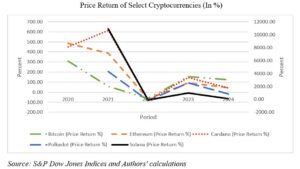
The return profiles of major cryptocurrencies over the past five years underline this instability. Solana rose by more than 10,000% in 2021 and lost over 90 per cent the following year. Bitcoin, Ethereum, Cardano, and Polkadot all posted strong gains in 2021 and deep negative returns in 2022. These swings are not anomalies. They are intrinsic to the market’s design.
This is why crypto is widely treated as a speculative allocation rather than a long-term investment. Information on ownership concentration, leverage, and counterparty exposure remains limited. Unlike equities or bonds, there is no claim on future cash flows. Valuation rests on expectation rather than fundamentals. Other financial instruments are required to meet disclosure and suitability standards before trading. Crypto largely bypassed that discipline.
Prices are shaped by a combination of demand–supply dynamics, market capitalisation, regulatory signals, and macro sentiment. The interaction is opaque. Excessive buying and selling magnifies imbalances, producing abrupt price shifts. Regulatory uncertainty compounds the risk. Potential bans, evolving tax rules, weak supervision, and uneven enforcement across jurisdictions feed instability rather than contain it. Markets exist to discover prices and manage risk. Crypto still struggles to meet either test.
READ | How clear cryptocurrency rules can boost digital finance
Global crypto regulation and policy gaps
That gap has drawn regulatory attention, but unevenly. The Financial Stability Board’s thematic review of the global regulatory framework for crypto-asset activities, released in October 2025, identified persistent shortcomings. Risk coverage remains incomplete. Reporting and compliance standards are complex and inconsistently applied. Oversight of global stablecoin arrangements is particularly weak. International coordination is limited.
Several major economies, including India, China, and Saudi Arabia, do not yet have comprehensive frameworks governing crypto-asset market activity. The same is true for stablecoins in countries such as Argentina, Chile, Mexico, and India. This fragmentation matters because crypto markets are borderless even when regulation is not.
Signals from advanced economies have also been mixed. US regulatory permissiveness has encouraged trading activity. In contrast, the UK’s Financial Conduct Authority earlier warned retail investors against crypto exposure. The original appeal of crypto lay in near-zero transaction costs and frictionless transfers. But the coexistence of fiat money and private digital currencies raises deeper issues. It can weaken monetary transmission and complicate price stability.
India’s crypto policy and regulatory caution
India’s approach reflects this ambivalence. Cryptocurrencies are not banned, but they are taxed heavily and monitored closely. The objective is deterrence rather than accommodation. The Reserve Bank of India has repeatedly expressed scepticism, particularly about stablecoins, arguing that they lack the essential attributes of money while posing clear risks. The policy response has been to develop sovereign digital infrastructure and promote a central bank digital currency as a safer alternative.
The broader pattern is familiar. The volatility of crypto markets resembles earlier asset bubbles, most famously the Dutch tulip mania of the 1630s. Prices detached from utility. Participation widened rapidly. The collapse was swift. Crypto trading today shows similar traits. The technology is new. The behaviour is not.
(Chinmay Joshi is a Research Associate at the Economics and Policy Area at Bhavans’ SP Jain Institute of Management and Research (SPJIMR), Mumbai and a Research Scholar at Gokhale Institute of Politics and Economics (GIPE), Pune. Dr Siva Reddy is a faculty member at Gokhale Institute of Politics and Economics (GIPE), Pune, and Dr Prabhakar Patil is a former Chief General Manager at SEBI.)