


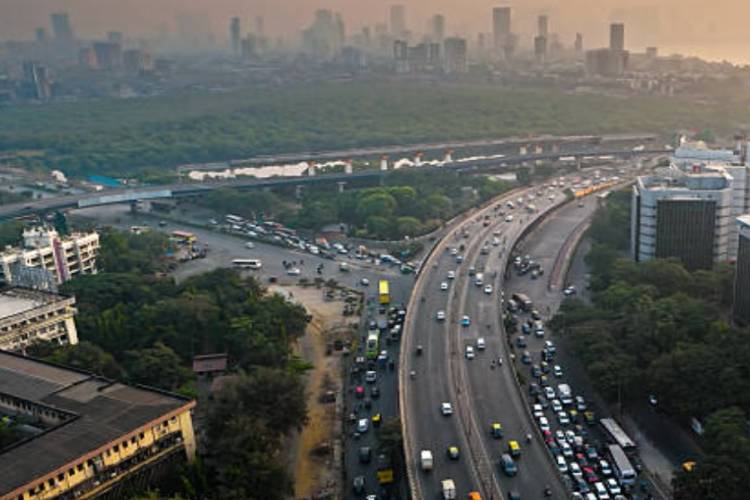
Infrastructure push: The Union Budget 2026-27 has made major announcements around infrastructure spending, reinforcing the idea that capex is the surest lever to steady growth in a turbulent global environment. Finance Minister Nirmala Sitharaman has pitched public investment as both shield and stimulus which will protect the economy from external shocks at a time when the government is attempting to rewire India’s productive capacity. With capital expenditure scaled up sharply and total infrastructure-linked commitments estimated at nearly $133 billion, the Budget has made allocations towards logistics, manufacturing, water systems, digital infrastructure and regional development.
The government has proposed to scale up public capital expenditure to Rs 12.2 lakh crore as part of an infrastructure and industrial package estimated at nearly $133 billion. This package will span transport, logistics, water, urban systems and digital capacity. It has earmarked a $4.3 billion outlay to deepen electronic components manufacturing and has also announced fresh support for mega textile parks. The government has also set aside $1.1 billion to boost biologics and biosimilars production.
READ | Budget 2026 bets on industrial policy amid constraints
During the speech, FM Sitharaman also proposed City Economic Regions (CERs) and efforts to deepen municipal bond financing. In the water sector, allocations for river basin management, groundwater and hydrology systems have risen sharply, alongside a near tripling of outlay for the Jal Jeevan Mission to expand rural tap water coverage. For small businesses, a Rs 100-billion growth fund has been announced. On the financial side, the government has raised the securities transaction tax on equity futures and options.
The infrastructure push has come at a time when the external backdrop is challenging. Persistent geopolitical tensions and steep US tariffs on several products have clouded India’s export prospects. The government has acknowledged that multilateralism is under strain and supply chains are disrupted which means the infra push is a strategic necessity. If global demand is uncertain, the government must create domestic capacity and competitiveness so that India can seize market share when opportunities arise.
An important component of the infrastructure push is targeted outlays for electronic components, textiles and biopharmaceuticals which means the government takes cognisance of the fact that sector-specific ecosystem building will go a long run. Similarly, the focus on mega textile parks is both defensive and opportunistic. With Indian apparel exporters hit by elevated US tariffs, integrated parks offering plug-and-play infrastructure, logistics links and policy support are designed to offset cost disadvantages.
READ | Budget 2026–27 signals slow return to fiscal discipline
While pharmaceuticals and biopharma are not necessarily infrastructural, in this Budget’s framing, they fall under what economists call productive infrastructure or strategic industrial infrastructure. An outlay of roughly $1.1 billion over five years for biologics and biosimilars seeks to position India not just as a generics powerhouse but as a hub for advanced therapeutics. With non-communicable diseases rising domestically and global demand for affordable biologics expanding, the government is trying to align public health needs with industrial policy.
Digital infrastructure is another pillar. The government has proposed tax holidays for foreign companies offering global cloud services from India-based data centres through 2047. As hyperscalers such as Google commit billions to computing infrastructure, the Budget looks to lock in these investments by ensuring fiscal predictability.
Coming back to traditional infrastructure, announcements around ship-repair ecosystems, seaplane connectivity, freight corridors and high-speed urban rail were also made. Firms in shipping, ports and rail-linked logistics, including Shipping Corporation of India and Container Corporation of India, stand to gain if these projects move from paper to ground. Reduced turnaround times and lower freight costs are essential if manufacturing ambitions are to translate into export competitiveness.
READ | Budget 2026: The hidden costs of India’s fiscal consolidation
Urban infrastructure
Water and urban infrastructure remain central to the broader infra story. Large increases in allocations for river basin management, groundwater systems and the Jal Jeevan Mission suggest that water security is economic infrastructure. Reliable water supply, sanitation and wastewater management are foundational for industrial clusters, urban productivity, and public health but they have remained underprovided. The City Economic Regions may attempt to align infrastructure, housing and jobs across metropolitan and peri-urban geographies.
Clean energy’s relatively muted treatment is another gap. Industry expectations of significant customs duty rationalisation for renewable components were not fully realised. Given India’s net-zero commitments and the capital intensity of the energy transition, the absence of stronger fiscal signals may slow momentum in a sector that is both climate-critical and investment-heavy.
The balance sheet of the infrastructure push is complex. On the positive side, the Budget has broadened the definition of infrastructure to include water, digital systems, and regional planning and has linked capex to manufacturing and jobs. It has recognised that competitiveness today depends as much on data centres and wastewater plants as on highways.
On the cautionary side, execution capacity, fiscal sustainability and private investment response remain open questions. Large allocations do not automatically translate into completed projects and state-led investment cannot indefinitely substitute for private capital.
Budget 2026-27 has doubled down on an infrastructure-led development model as both economic strategy and geopolitical hedge. But unless the government is able to crowd-in private investment too, growth cannot be catalysed. Whether the current approach can convert public spending into durable productivity gains, stronger exports and broad-based employment will depend less on the scale of announcements than on the discipline of implementation.