


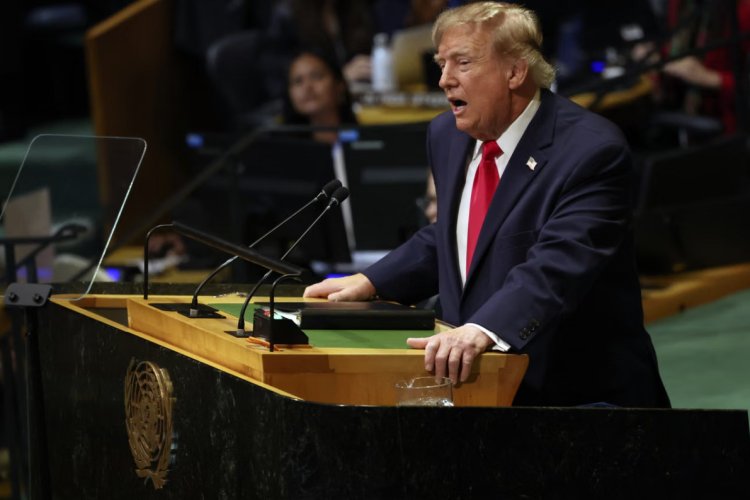
Trump’s UN speech and the limits to American power: Donald Trump’s latest address to the United Nations General Assembly was less a statement of American leadership than a declaration of how he intends to use American power. His remark that, after the US intervention in Venezuela, “to the victor belong the spoils” was revealing. It reduced an international question to the logic of possession: the stronger power acts, prevails and takes what it can.
That is a very different proposition from the one on which the post-1945 international system was built. The United States was its principal architect, but American power was made more durable by accepting rules, building alliances and persuading other countries that US leadership served interests beyond those of Washington. Trump’s speech suggested that this bargain is being replaced by something more transactional. The United States will remain powerful. Whether it can still command the confidence required to lead is another matter.
READ | Trump’s generic drug tariffs threaten India’s pharma trade
From leadership to leverage
The distinction matters. A hegemon can compel. A leader has to persuade.
The United States still possesses unmatched military capabilities, enormous financial power, technological advantages and an alliance network that no other country can readily reproduce. Nothing in one UN speech changes that. But those assets become less useful when allies begin to doubt whether American commitments will survive the next dispute, tariff negotiation or change in presidential preference.
Trump’s worldview is increasingly explicit. International relationships are treated as transactions in which Washington should extract a measurable return. Security commitments are linked to payments and burden-sharing. Trade is used as leverage. Immigration is treated as a matter of national strength rather than international cooperation. Multilateral institutions are judged principally by whether they advance immediate American interests.
This approach can produce concessions. It can also diminish influence.

The United Nations is an obvious example. Article 2(4) of the UN Charter requires member states to refrain from the threat or use of force against the territorial integrity or political independence of other states, subject to the Charter’s recognised exceptions. The principle was designed precisely to prevent international politics from reverting to a world in which military power determined who could take what.
Trump’s formulation about the victor taking the spoils therefore carried significance beyond Venezuela. It offered a starkly different conception of international order: power establishes the terms, and weaker states must adjust.
READ | Trump-FIFA controversy exposes weak sports governance
The world is already adjusting
The damage to American leadership cannot be measured by the reaction inside the General Assembly hall alone. It is visible in the calculations being made by other governments.
A Pew Research Center survey of 42,151 people in 36 countries, conducted between February and May 2026, found that only a median 23% expressed confidence in Trump to do the right thing in world affairs. Public opinion does not determine foreign policy. But it can become a useful indicator of whether a country’s diplomatic capital is being depleted.
More consequential is the behaviour of governments.
European countries have been preparing for a world in which Washington may be less predictable. Asian allies face the same problem. A recent analysis by the University of Maryland’s Global Policy Institute found that US allies in the Indo-Pacific are simultaneously strengthening their relationships with Washington, developing alternative security partnerships, increasing their own capabilities and, in some cases, reaching out to Beijing. It describes this as “hedging”, with uncertainty about the alliance patron itself becoming an important driver.
That is the opposite of what a successful alliance system is supposed to achieve. Allies should be able to make long-term plans on the assumption that the central power will remain broadly predictable. If they instead prepare for American withdrawal, the alliance still exists on paper but its political value has diminished.
READ | Trump China visit: All form, little content
America is abandoning an asset it built
There is an irony here. Much of America’s postwar strength came from institutions that constrained the exercise of American power.
The UN, NATO, the Bretton Woods institutions and the wider trading system did not merely restrict Washington. They multiplied its influence. American allies accepted a degree of US leadership because they had a stake in the institutions through which that leadership operated. Washington could then mobilise coalitions without having to coerce every participant.
Trump’s approach reverses that logic.
A June 2026 Carnegie Endowment study makes an important qualification: it would be wrong to describe the second Trump administration as simply anti-multilateral. Its policies vary across institutions. Washington has sometimes withdrawn, sometimes disrupted existing arrangements, sometimes created alternatives and sometimes continued working through institutions it considers useful. But Carnegie also identifies the dominant tendency as transactional, sovereignty-focused and sceptical of large parts of the postwar multilateral system.
That distinction is important because the consequences extend beyond the United Nations. If American partners conclude that US commitments are conditional on the personal preferences of one president, they will begin investing in alternatives. Such investments are difficult to reverse.
The result need not be a Chinese-led world. It could be a world in which middle powers hedge, regional coalitions become stronger and governments increasingly refuse to choose between Washington and Beijing. That would leave the United States powerful but less central.
Credibility problem in Trump’s UN speech
Trump’s supporters would argue that this is precisely the point. The old system imposed disproportionate costs on the United States, while other countries enjoyed American security guarantees, access to American markets and the benefits of the dollar-based financial system. Washington, they argue, should use its leverage to force allies to contribute more and adversaries to make concessions.
There is force in that criticism. The postwar order has never been perfectly reciprocal, and the United Nations has repeatedly failed to prevent wars. The Security Council’s veto system can paralyse collective action. The multilateral trading system has also struggled to accommodate China’s rise and the return of great-power competition.
But reforming an imperfect order is different from weakening the credibility of the power that helped construct it.
This is the central risk for the United States. A country can use coercion to win a negotiation and still lose influence over time. A tariff can extract a concession. A military threat can force a government to reconsider its position. But neither necessarily creates the trust required for allies to follow Washington when the cost of doing so becomes high.
The United Nations Secretary-General, António Guterres, made the larger point in his final annual General Assembly address. As geopolitical divisions widen, he argued, the world faces the paradox of needing international cooperation more urgently while showing less willingness to invest in it. At the opening of the 2026 General Assembly, he warned that the world’s fault lines were widening and called for law and cooperation to prevail over force and fragmentation.
Trump’s speech offered almost the reverse proposition.
That may prove to be its most consequential message. The United States is unlikely to cease being the world’s most important military and financial power because of one president or one speech. But leadership is not measured only by the size of a country’s arsenal or economy. It rests on whether other countries believe that following its lead is safer and more useful than resisting it or finding alternatives.
The danger for Washington is that other governments may eventually answer that question differently.
The end of American leadership, if it comes, is unlikely to arrive with a formal declaration. It will be visible first in the decisions of allies that begin to hedge, the institutions that operate without Washington and the countries that no longer assume that American power will be used in defence of a common order.
Trump’s UN speech did not end the American era. It showed how far its foundations have already been weakened.