


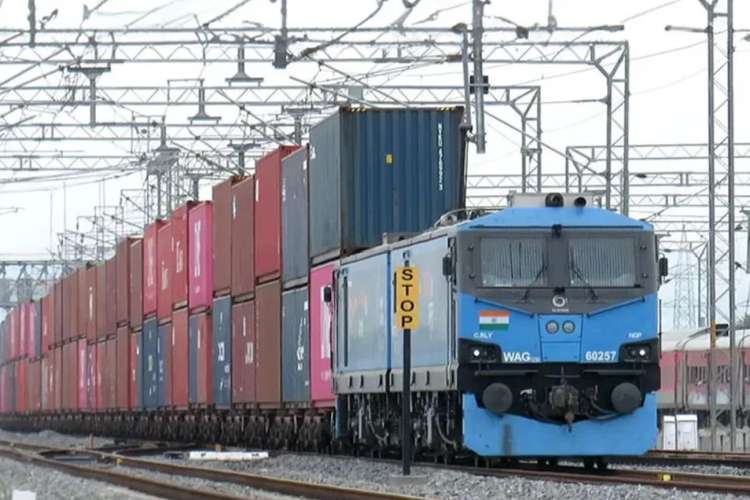
Western Dedicated Freight Corridor: Freight has long paid for the railway’s passenger bias. Mixed-use tracks gave passenger trains priority and left cargo waiting at sidings. The World Bank has noted that most trunk routes on Indian Railways operate above design capacity. The DFCs address that capacity problem directly.
The two corridors account for only about 4% of Indian Railways’ network length, yet handle more than 13% of rail freight traffic. That is the case for separation. Freight trains need their own path if rail is to win traffic from road.
READ | Railway expansion alone cannot guarantee sustainable transport
DFCCIL data cited by industry reports show the WDFC cutting transit times by 40-50%. Cargo between Mumbai and Delhi that earlier took more than three days can now move in under 48 hours. Container traffic from Haryana and Rajasthan to Gujarat’s ports has also fallen from three to four days to less than 48 hours.
WDFC logistics cost is the easy gain
The latest DPIIT-NCAER estimate puts India’s logistics cost at 7.97% of GDP in 2023-24. The older 13-14% figure should now be treated with caution. The same assessment puts rail freight at Rs 1.96 per tonne-km and road at Rs 3.78 when first-mile and last-mile costs are excluded.
The WDFC therefore attacks the correct cost line. It makes rail more credible for containers, industrial cargo and port-linked movement. It also helps the National Rail Plan’s ambition of raising rail’s freight share from 27% to 45% by 2030.
But the modal shift will not happen by track alone. Rail still loses cargo where factories lack terminals, where the first and last mile remain costly, or where service schedules cannot match road’s flexibility. A dedicated corridor is necessary capacity. It is not a complete logistics market.
Western Dedicated Freight Corridor manufacturing reform
Infrastructure has not been India’s only manufacturing constraint. Input duties raise costs. Land acquisition delays projects. Labour compliance remains uneven across states. Component ecosystems remain shallow outside a few sectors. The WDFC reduces freight friction; it does not remove these barriers.
Matthew McCartney’s work on the China-Pakistan Economic Corridor carries a useful warning. CPEC, he wrote, was “unlikely to be transformative” because Pakistan lacked “a capable state and commitment to an industrial policy”. India is a different economy with a larger domestic market and stronger institutions. The caution still applies. Transport corridors do not create industrialisation unless firms can use them.
The Delhi-Mumbai Industrial Corridor can gain from the WDFC. So can logistics parks, inland container depots and port-linked clusters. But industrial capability will depend on whether state governments assemble land, clear power and water links, settle local permissions and provide predictable regulation. Without those choices, faster freight will serve existing production better than it creates new production.
China Plus One cannot carry WDFC argument
The WDFC should not be sold mainly as a China Plus One asset. Supply-chain relocation from China is being split across Vietnam, Mexico, Thailand, Malaysia and India. No single country is inheriting China’s factory base.
The corridor helps firms that choose India. It lowers the cost of moving goods between factories and ports. It improves reliability for exporters. But a board deciding between India and Vietnam will also look at tariffs, contract enforcement, labour availability, supplier depth and the time taken by state agencies. The railway is one line in that decision, not the decision itself.
READ | Indian Railways asset monetisation: Govt plans sale without loss of control
The stronger argument is domestic. India needs cheaper internal movement even if little production leaves China. A large domestic market cannot be served efficiently by trucks alone. Ports cannot expand throughput if inland evacuation remains slow. The WDFC gives India a freight spine for its own manufacturing base.
IMEC, Vadhavan port and the WDFC
A similar restraint is needed on the India-Middle East-Europe Economic Corridor. The WDFC, linked with the planned Vadhavan deep-draft port, would give India a credible western node. The Union Cabinet approved Vadhavan in 2024 with planned capacity of 298 million tonnes a year, including about 23.2 million TEUs.
That is important for India’s maritime trade. It may also help IMEC if the overseas links are built. But IMEC is still a diplomatic and logistics proposition spread across the Middle East and Europe. India can prepare its port and rail end. It cannot alone settle the route’s external politics.
The WDFC is best judged without attaching too much of its value to China Plus One or IMEC. Its first purpose is Indian manufacturing. India has spent nearly two decades building a freight railway suited to industry. The return will be decided by reforms off the track. If they lag, the WDFC will carry more cargo, but it will not create the industrial depth India needs.
Venkatakrishnan Asuri is an undergraduate student at the Indian Institute of Technology Madras.