


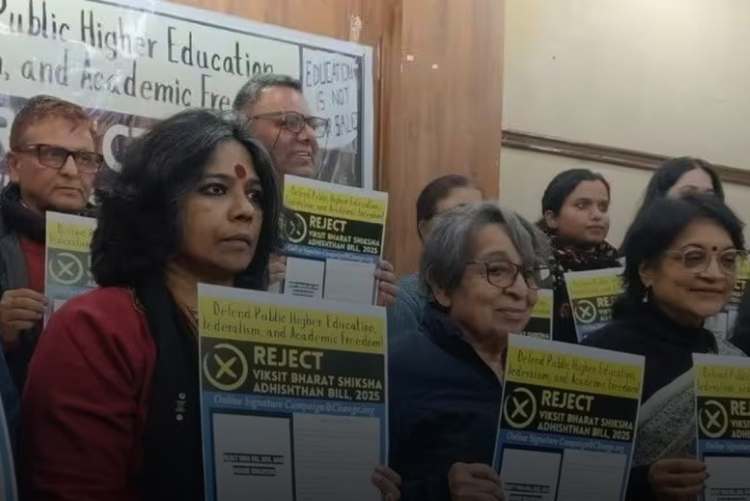
VBSA Bill and the Federal question: The Viksit Bharat Shiksha Adhishthan Bill, 2025, introduced in the Lok Sabha on December 15, 2025, seeks to replace three existing regulators: the University Grants Commission, the All India Council for Technical Education, and the National Council for Teacher Education. Legal and medical education will remain outside its scope.
The VBSA Bill proposes a new apex body, the Viksit Bharat Shiksha Adhishthan Commission, with three councils for regulation, accreditation, and academic standards. The design seeks to separate functions that are now spread across different laws and institutions. The Regulatory Council will oversee institutional regulation. The Accreditation Council will deal with quality assessment. The Standards Council will set academic benchmarks and learning outcomes.
This is the most significant attempt in recent years to recast higher education regulation. Its declared aim is to align governance with the National Education Policy 2020, reduce institutional fragmentation, and push universities towards multidisciplinary teaching and research. The deeper issue, however, is not only administrative efficiency. It is the redistribution of power between the Centre, states, regulators, and higher education institutions.
The Bill is anchored in Entry 66 of the Union List, which gives Parliament power over coordination and determination of standards in higher education and research institutions. Education is otherwise in the Concurrent List. By relying on Entry 66, the Centre has framed the Bill as a standards law, not merely an education law. That gives the proposed regulator a stronger constitutional footing, but it also sharpens the federal question.
READ I Higher education inequality: Why access is not the same as opportunity
VBSA Bill vs UGC, AICTE and NCTE
The present structure is fragmented by sector and discipline. The UGC Act, 1956, covers university education and empowers the UGC to coordinate, determine, and maintain standards. The AICTE Act, 1987, governs technical education. The NCTE Act, 1993, deals with teacher education.

The VBSA Bill replaces this discipline-based arrangement with a single institutional framework. The UGC, AICTE, and NCTE would be dissolved, and their regulatory functions would move into the VBSA architecture. The Bill therefore shifts the system from sectoral regulation to institution-level regulation.
This is consistent with the NEP’s preference for multidisciplinary institutions. It may reduce duplication. It may also create a more coherent compliance framework for universities that now operate across general, technical, vocational, and teacher education. But the move will also remove the separate institutional histories and sector-specific checks built into the existing regulators.
READ I Digital internationalisation is reshaping higher education in India
Higher education funding outside VBSA
The change is more limited on funding. The UGC now functions as the principal grant-giving agency for universities and colleges. AICTE also has grant-making powers, though its role is narrower.
The VBSA Bill does not give the new Commission or its councils grant-giving powers for higher education institutions. Funding will remain with the Central government through separate schemes. The Bill provides for a VBSA Fund, but that fund is meant for the functioning of the Commission and councils, not for financing universities and colleges.
This distinction matters. The proposed regulator will have wide authority over recognition, standards, compliance, and penalties, but not over institutional funding. That may avoid one conflict of interest. It may also leave universities facing a regulator with strong compliance powers and no matching financing responsibility.

The larger test of the Bill will lie in the space between autonomy and control. The proposed regulator may give accredited institutions greater freedom to grant degrees and design programmes, but that autonomy will depend on central recognition, accreditation and compliance. The separation of funding from regulation also creates an unresolved problem for public universities, especially state institutions that have relied on UGC grants for faculty support, research and development.
A regulator that can prescribe standards without carrying financing responsibility may improve accountability on paper, but it can also impose compliance costs on institutions already short of resources.
READ I Higher education reform: How universities can restore academic rigour
Degree powers and institutional autonomy
The Bill also alters the degree-granting framework. Under the UGC regime, degrees can be awarded only by universities and institutions specifically empowered by law. Under the VBSA Bill, the Regulatory Council may authorise accredited institutions to grant degrees.
This is a major shift. It links degree-granting power to accreditation and regulatory approval, rather than only to formal university status. The intended direction is greater autonomy for institutions that meet quality standards. The risk is that accreditation will become the gateway to institutional legitimacy, making the independence and credibility of the accreditation process central to the law’s success.
The Standards Council will also have a significant role in harmonising curriculum, credits, learning outcomes, and faculty qualifications. In principle, this could reduce the artificial divide between general and technical streams. A science degree and an engineering degree in related fields could be brought closer in academic weight, credit design, and employability value.
The same logic applies to faculty recruitment. If the minimum qualifications for teachers are unified across general and technical institutions, long-standing differences between UGC and AICTE norms may narrow. That would be a useful correction, provided the standards are not reduced to administrative uniformity.
VBSA Bill and regulatory adjudication
The enforcement framework gives the Regulatory Council power to create an adjudicatory mechanism for violations of the Act and regulations. The Bill provides for graded penalties, ranging from ₹10 lakh to ₹2 crore. It also requires that penalties should not harm student interests or impose financial consequences on enrolled students.
The appellate structure is less satisfactory. Clause 37 allows an aggrieved person or institution to appeal orders of the Commission or its councils to the Central government. The procedure and timeline will be prescribed later.
That design raises a basic institutional concern. The Central government will have a large role in the appointment, administration, and policy direction of the Commission. The Secretary of Higher Education is an ex-officio member. The Chairperson and Council Presidents are appointed through a process controlled by the Union executive. Member-Secretaries are also appointed by the Central government. Clause 45 gives the Centre power to issue binding policy directions, with the Centre itself deciding what counts as a policy matter.
This makes the appellate authority too close to the regulator. In modern regulatory design, appeals usually go to an independent or quasi-judicial forum. The NCLAT, TDSAT, and NGT offer examples from other sectors. The VBSA Bill instead allows the executive to sit in appeal over a regulatory structure it largely controls. That weakens procedural fairness.
VBSA Bill and Centre-state powers
The federal issue is unavoidable. Education is in the Concurrent List, but Entry 66 gives Parliament a special role in maintaining standards in higher education. The Supreme Court has read Entry 66 broadly in cases involving higher and technical education. In State of Tamil Nadu v Adhiyaman Educational & Research Institute, the Court recognised the primacy of central standards in the field covered by Entry 66.
The same line of reasoning has appeared in disputes over university appointments. In Gambhirdan K Gadhvi v State of Gujarat, the Supreme Court held that vice-chancellor appointments must comply with UGC regulations where those regulations have statutory force.
The VBSA Bill will strengthen this centralising tendency. Once the UGC, AICTE, and NCTE are replaced by a single apex regulator, state universities will face a more consolidated national authority. The Centre’s case is that this is necessary for uniform standards and global competitiveness. The states’ concern will be that academic governance, institutional leadership, and regulatory priorities may move further away from them.
The Bill does include state representation. At least two members of the 12-member apex Commission must be from state higher education institutions. The Regulatory and Standards Councils will include rotational state nominees. These are useful safeguards, but they do not alter the basic structure. The power to define standards, regulate institutions, and issue binding directions remains heavily centralised.
JPC review of VBSA Bill
As of May 2026, the Bill is under examination by a Joint Parliamentary Committee. PRS records show that the committee has held meetings with the Ministry of Education, UGC, AICTE, NCTE, the Council of Architecture, domain experts, and representatives of universities.
The JPC should focus on three issues. First, whether the Bill gives states a meaningful voice or merely symbolic representation. Second, whether appellate remedies should lie with an independent tribunal rather than the Central government. Third, whether the separation of regulation from funding will leave public universities with new compliance burdens and no corresponding financial support.
The case for regulatory reform is strong. India’s higher education system cannot continue with overlapping regulators, inconsistent standards, and unclear accountability. But a single regulator is not automatically a better regulator. The final law must preserve procedural fairness, federal balance, and institutional autonomy. Without those safeguards, the VBSA Bill may replace fragmentation with centralisation.
Dr Sweety Supriya is Assistant Professor (Electronics) at LS College, Muzaffarpur, Bihar.