



Sustainable Development Goal or SDG 12, on responsible consumption and production, is often filed under the environmental agenda. That understates its reach. Its targets cover material use, food loss, waste, chemicals, corporate reporting, public procurement, and fossil-fuel subsidies. Performance on these measures bears directly on food security, public health, cities and climate. UNEP has described Goal 12 as important to the attainment of the other SDGs.
The arithmetic behind it is stark. The United Nations estimates that if the global population reaches 9.8 billion by 2050, sustaining current patterns of resource use would require the equivalent of almost three planets. The problem is therefore less about adding another environmental programme than about reducing the volume of materials, energy and waste built into economic growth.
READ | Ecolabelling, public procurement support key to achieving SDG 12
South and South-West Asia has particular reason to worry. The subregion contains about a quarter of the world’s population. Rising incomes, urbanisation and industrial growth are increasing demand for energy and materials while waste collection and treatment remain weak in many countries. ESCAP’s 2022 subregional assessment showed regression on both SDG 12 and SDG 13. Its latest Asia-Pacific assessment, released in February 2026, says 88% of measurable SDG targets across the wider region are unlikely to be achieved by 2030.
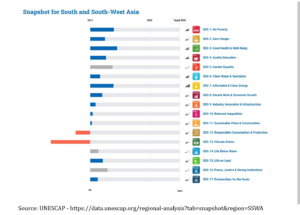

SDG 12 exposes the food and waste problem
The contradiction is clearest in food systems. South Asia still has the highest difficulty in Asia and the Pacific in affording a healthy diet. In 2024, 41.7% of its population could not afford one. Food insecurity coexists with losses between farm and market, poor storage and cold-chain capacity, and waste at the consumer end.
Waste is growing with consumption. The World Bank’s latest What a Waste assessment says collection coverage in South Asia is about 67%, while the region’s waste volumes could rise by 99% by 2050 without a change in course. Electronic waste adds another stream that municipal systems are poorly equipped to handle. Globally, 62 million tonnes of e-waste were generated in 2022, but only 22.3% was documented as formally collected and recycled.
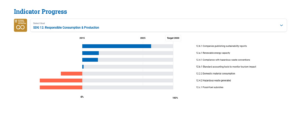

These are not separate environmental problems. They arise from the way production is priced and organised. Subsidised inputs can weaken incentives to conserve water, energy and materials. Producers do not always bear the full cost of the waste their products create. Municipal bodies are then left to collect, segregate and dispose of growing waste streams with limited money, equipment and technical staff.
READ | Water use efficiency key to achieving multiple SDGs
SDG 12 policies moved faster than enforcement
Governments across the subregion have responded with laws, programmes and national plans. India has Extended Producer Responsibility for plastic packaging, Swachh Bharat programmes for solid and liquid waste, and Mission LiFE to influence household and community behaviour. Pakistan adopted a Sustainable Consumption and Production National Action Plan in 2017 and has continued the Green Pakistan programme. The Maldives has put waste management and reduction of single-use plastics into its national policy framework.
The number of policies is no longer the main constraint. Measurement remains poor. Even across Asia and the Pacific, where data availability has improved, only 55% of SDG indicators now have enough observations for progress assessment. The deficiency matters more for SDG 12 because material flows, waste treatment and consumption patterns need local data. National averages say little about whether a city is collecting plastic, where hazardous waste ends up or whether producer-responsibility rules are being enforced.
Finance is the other constraint. Developing countries face an annual SDG financing gap of around $4 trillion. Debt servicing and competing demands on public budgets make waste infrastructure an easy item to postpone. Yet this is where national promises usually become municipal responsibilities. Collection fleets, material-recovery facilities, landfill management and wastewater treatment require capital expenditure followed by reliable operating budgets.
READ | SDG 5: Govt must offer social protection to unpaid women workers
Fix incentives and municipal capacity
Subsidies that encourage excessive use of fossil fuels, water or chemical inputs need closer targeting. Governments need not withdraw support from vulnerable households or farmers. They should stop designing support in ways that reward higher consumption. Producer-responsibility rules should also make firms bear more of the cost of collecting and processing the waste generated by their products.
Municipal finance needs equal attention. Urban local bodies cannot enforce segregation rules or manage modern waste systems through occasional grants and centrally sponsored projects. Predictable transfers, user charges where feasible and clearer responsibility for operating expenditure would do more for SDG 12 than another national strategy.
Behavioural programmes have a narrower but useful role. Mission LiFE, for example, seeks to change individual and community choices on waste, water, energy and single-use plastics. Such programmes work best when the infrastructure supports the behaviour being encouraged. Asking households to segregate waste achieves little if collection trucks mix it again.
There is also a case for regional cooperation. Supply chains and waste shipments cross borders, while countries face similar problems in textiles, plastics, electronics and agricultural residues. Common measurement standards and better exchange of enforcement data would make national rules harder to evade.
South and South-West Asia has already written much of the policy architecture for SDG 12. Its larger problem is the gap between national commitments and the incentives, data and municipal capacity that determine resource use on the ground. With less than four years remaining to the 2030 deadline, that gap is becoming harder to conceal.
Aakansha Choudhary is a Policy Researcher and Consultant, and George Cheriyan is Executive Director, at Center for Environment and Sustainable Development India (CESDI).