



India’s higher education system is entering a structurally competitive phase. The expansion of private universities and the entry of foreign institutions under the UGC’s 2023 regulatory framework have shifted the sector from capacity creation to differentiation and outcomes. With over 4.33 crore students across 1,168 universities, scarcity no longer defines the system. Choice and signalling do.
The labour market is shifting in parallel. The World Economic Forum (WEF) estimates that 22% of jobs will be disrupted by 2030. Demand is moving toward analytical thinking, problem-solving and adaptability alongside technical skills. This dual shift sharpens a long-standing fault line: the separation of liberal education (thinking) and professional education (doing).
READ | Digital internationalisation is reshaping higher education in India
Competition is no longer confined to domestic versus foreign institutions. It is between institutional designs. Ranking frameworks reflect this but do not resolve it. QS combines academic and employer reputation with learning experience. Times Higher Education emphasises research, teaching and international outlook. Both reward multidimensional institutions. Many universities continue to operate within disciplinary silos.
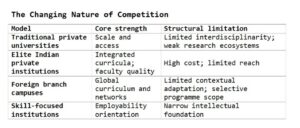
No single model aligns with emerging demand
Traditional private universities offer scale but limited interdisciplinarity and weak research ecosystems.
Elite private institutions provide integrated curricula and faculty quality but remain high-cost and limited in reach.
Foreign branch campuses bring global curricula and networks but operate with narrow programme scope and limited contextual adaptation.
Skill-focused institutions emphasise employability but offer a thin intellectual base.
The implication is structural. Models that treat liberal and professional education as substitutes are misaligned with labour market requirements.
READ | Higher education inequality: Why access is not the same as opportunity
The core challenge: rigour and relevance
The dichotomy between rigour and relevance does not hold. Liberal education, when designed well, builds transferable cognitive capabilities. Professional education translates these capabilities into application. The distortion arises when the two are separated. Liberal education becomes abstract. Professional education becomes narrow and short-lived.

Labour market evidence reinforces this. Employers value combinations—technical expertise alongside cognitive flexibility. Employability frameworks now track outcomes such as employer reputation and graduate trajectories. Knowledge without application carries limited weight.
In India, many private universities continue with fragmented models. Curricula remain discipline-bound. Research output is uneven. Industry engagement is largely confined to placements. The fragmentation weakens both rigour and relevance.
What type of universities will succeed
Institutions that integrate liberal and professional education at the level of design will have an advantage. This is not a matter of adding electives or labels. It requires reworking the architecture of learning. Data literacy within economics. Policy reasoning within engineering. Communication within technical programmes.
Such institutions display internal coherence. Teaching connects with research and application. Students engage with real-world problems through projects and internships. The outcome is not limited to initial employability. It extends to adaptability.
READ | Higher education reform: How universities can restore academic rigour
A data-based roadmap for private universities
Incremental change will not suffice.
First, research must inform teaching. Faculty scholarship should shape curriculum design.
Second, programme structures should be oriented toward capability formation. Conceptual learning and applied experience need to be combined within the same framework.
Third, industry engagement must be institutionalised. Co-designed curricula should replace episodic placement linkages.
Fourth, rankings should not anchor strategy. They privilege input metrics such as citations and internationalisation. Internal measures—capability, progression, long-term outcomes—are more relevant.
Regulation is moving in this direction. The UGC’s emphasis on transparency signals a shift toward accountability.
The trajectory of Indian private universities will be determined less by scale than by design. The central challenge is to integrate liberal and professional education into a coherent model. Institutions that resolve this will align with both competition and labour market change. Those that do not will remain structurally constrained.