


Kerala entered its demographic transition earlier than most Indian states. Its fertility rate fell below replacement level in 1988, and the National Family Health Survey (NFHS-5) recorded a total fertility rate of 1.8 children per woman in 2019–20. The Sample Registration System put the figure at 1.5 in 2023. Much has been written about the implications for an ageing society. Far less attention has gone to how many couples want children but cannot have them, and how much male infertility contributes to their difficulties.
Kerala has no reliable population-based estimate of male infertility. Studies cited in the available literature put infertility or childlessness among ever-married women at roughly 6–11%, depending on the definition and population studied. These figures tell us little about the male contribution. Without better evidence, the state cannot adequately distinguish couples who choose to have fewer children from those whose reproductive choices are constrained by infertility.
READ | Kerala Senior Citizens Bill must guarantee enforceable rights
The distinction has consequences for healthcare spending, access to treatment and planning for an ageing population.
What Kerala’s infertility data reveal
Existing estimates come largely from women’s reproductive histories rather than direct assessment of male reproductive health.
Thomas and Ramanathan (2022), using the 2011 Census, estimated infertility at about 6.1% among ever-married women. Their measure of childlessness among women aged 45–49 was 5.8%, with district estimates ranging from 4.4% in Wayanad to 6.7% in Malappuram. The earlier District Level Household Survey (DLHS-3) for 2007–08 suggested a higher prevalence, close to 11%, among ever-married women aged 15–49.
The measures are not directly comparable. Childlessness at the end of reproductive life can arise from several circumstances, including personal choice, marital circumstances and infertility. Nor can a survey of women alone establish whether infertility originates with the man, the woman or both.
A community survey involving 604 women in Kerala, cited by Thomas (2020), found male-factor infertility more frequently than female-factor infertility, while men were less likely to receive treatment. International clinical literature suggests that male factors contribute to a substantial proportion of infertility cases. This gives reason to suspect that Kerala’s existing figures considerably understate the importance of male reproductive health.
It does not, however, justify assigning a precise prevalence rate to male infertility in Kerala. The available samples and definitions are insufficient for that purpose.
The district differences also deserve attention. A state average can obscure disparities in access to diagnosis, reproductive behaviour and healthcare. Kerala has relatively strong health statistics and an extensive public health system. Yet even here, the prevalence of male infertility remains uncertain. Estimates for states with weaker health information systems warrant still greater caution.
Male reproductive health and demographic transition
Several developments may influence male reproductive health in Kerala. Marriage and parenthood are being postponed, while metabolic disorders, tobacco use, alcohol consumption and some occupational exposures are recognised reproductive health concerns. Migration can also keep couples apart for prolonged periods, reducing opportunities for conception without necessarily implying infertility.
Studies documenting declines in sperm concentration internationally have raised additional concerns. Such findings cannot be applied directly to Kerala, where representative data on male reproductive function are lacking. The contribution of individual risk factors to infertility in the state remains unmeasured.
Infertility is often treated primarily as a clinical problem. Its social consequences are wider. Couples may spend substantial sums on investigations and assisted reproduction, while women continue to bear much of the stigma attached to childlessness, even when male factors are involved.
Kerala’s demographic profile makes these questions especially relevant. People aged 60 and above accounted for an estimated 16.5% of its population in 2021. Government projections indicate that the proportion could reach 22.8% by 2036.
Ageing policy has understandably concentrated on pensions, long-term care and chronic disease. It has paid less attention to older people who have no children to support them.
Childlessness does not invariably mean the absence of family support, nor can every childless household be classified as infertile. Nevertheless, involuntary childlessness can influence household composition and the availability of informal care later in life. With smaller families and substantial outmigration, Kerala needs better information on older people who may eventually depend on public or community services.
Infertility must therefore be considered within both reproductive healthcare and ageing policy. This does not mean treating low fertility itself as a medical problem. Decisions to remain childless or have smaller families are distinct from the inability to conceive.
READ | Kerala power crisis exposes the limits of solar growth
IVF treatment costs expose a major policy gap
Access to infertility treatment presents a more immediate challenge. Kerala has a substantial private fertility-treatment sector, but reliable public information on the number of couples receiving in-vitro fertilisation (IVF), intracytoplasmic sperm injection (ICSI) or intrauterine insemination (IUI) is limited.
The Assisted Reproductive Technology (Regulation) Act, 2021, established a framework for registering and regulating assisted reproduction clinics. The national registry began operating in April 2022. The regulatory framework provides an opportunity to collect better information on treatment volumes, outcomes and clinic practices.
The financial burden is considerable. A 2026 study by Patil and colleagues examined out-of-pocket expenditure among 148 couples receiving IVF treatment at five tertiary hospitals in India, three public and two private.
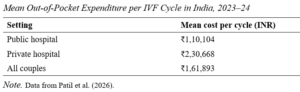

These findings cannot establish the financial burden across Kerala. They do, however, show how costly assisted reproduction can become when treatment depends largely on household finances.
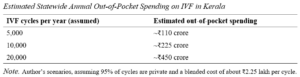
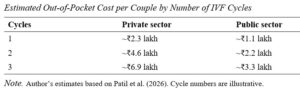


At the average private-sector cost reported in the study, three IVF cycles would require nearly ₹6.9 lakh in out-of-pocket spending. This is an illustrative calculation, not a forecast of what a couple will pay. Costs vary with the treatment protocol, drugs, complications and services included. Repeated cycles also do not guarantee a live birth.
Kerala lacks the data needed to estimate total annual household expenditure on IVF with confidence. The number of cycles performed, the distribution between public and private facilities, and the amounts paid by patients need systematic measurement before a credible statewide expenditure estimate can be produced.
There is already a precedent for affordable public provision. SAT Hospital in Thiruvananthapuram has provided fertility treatment at substantially lower prices than private clinics, according to earlier reports. Expanding public capacity could reduce the burden on households, particularly where initial investigations and less intensive treatment may be sufficient.
The case for expanding services must also recognise that assisted reproduction is expensive and success rates vary with age and clinical circumstances. Public spending should be guided by clinical effectiveness, transparent eligibility criteria and the relative costs of different interventions.
READ | Kerala must prepare for an ageing population
Kerala needs a male infertility policy
Kerala’s health system has the capacity to address much of this gap through existing institutions. The immediate priority should be to establish reliable evidence on the prevalence, causes and treatment of infertility.
State health surveys should collect information on reproductive difficulties among both women and men. Surveys could distinguish involuntary childlessness from decisions to delay or avoid parenthood, while recording age, district, occupation and migration circumstances. Clinical assessments would be needed to establish the causes of infertility rather than relying entirely on self-reported experience.
Male reproductive health services should also become part of routine public healthcare. Basic investigations, including semen analysis where clinically indicated, could be made available through district hospitals and referral facilities. Assessing both partners earlier may prevent unnecessary investigations, prolonged treatment and avoidable expenditure.
Regulation of assisted reproduction offers another starting point. Kerala should use the reporting framework under the ART legislation to develop reliable aggregate statistics on treatment cycles, outcomes, costs and access, with appropriate safeguards for patient confidentiality.
Financial protection deserves equal attention. Expanding diagnostic services and first-line treatment in public hospitals may provide a more affordable initial response than relying chiefly on private IVF. The state could also examine coverage for selected infertility services under existing public health financing arrangements. Any expansion should be evaluated against other demands on the health budget.
Prevention should draw on established public health programmes dealing with tobacco use, metabolic disease, untreated infections and occupational hazards. The relationship between individual exposures and infertility should be assessed using local evidence rather than assumed from international studies. Counselling programmes should address the tendency to blame women for infertility without adequate investigation of their partners.
There is also a reason to connect infertility policy with Kerala’s arrangements for older people. Social protection and community-based care need to account for households without children or dependable family support. Surveys of older people should identify their actual care networks rather than presume that adult children are available.
Kerala does not need an infertility policy designed to increase births. It needs one that allows couples to make informed reproductive choices, ensures that treatable infertility is properly diagnosed, and reduces the financial barriers to care.
The first task is measurement. Without representative evidence on male infertility and better reporting of treatment outcomes, neither the scale of unmet reproductive needs nor the appropriate level of public investment can be established.