



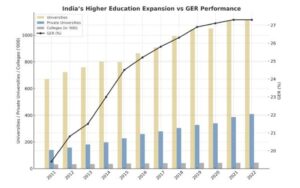
India’s higher education system has expanded at a pace unmatched in its history. The All India Survey on Higher Education (AISHE 2021–22) reports 1,113 universities and more than 43,000 colleges, with private institutions forming nearly 60% of all establishments. This expansion has widened access, especially in states with limited public university presence. Yet the central question remains unresolved: how can India convert scale into a durable architecture of excellence?
Excellence in Indian higher education continues to come from public institutions. The IITs, NITs, IISc, IISERs, AIIMS and central universities such as JNU, BHU and Delhi University enjoy national-level recruitment systems, research grants, and long-term institutional continuity. India’s representation in global rankings has risen 318% over the past decade (QS), but most institutions featured in QS and THE lists remain public. Their strength lies in research cultures built over decades, not in market responsiveness.
READ | Solar-powered buildings: The next big shift in climate resilience
Private Universities Are Expanding Fast, But Quality Must Precede Scale
The private sector has grown even faster. University-level enrolment in private institutions has expanded 108.7% in ten years, accounting for 40% of total enrolment growth. This demonstrates latent demand and private-sector agility. But private higher education faces a structural trade-off: growth without academic depth risks dilution. Expansion must align with investments in faculty, research capability and governance—not the other way around.

The real divide is not public versus private. It is between institutions that practice stewardship and those that do not. Global leaders—Harvard, Stanford, NUS, Tsinghua—grew by embedding patient, long-term commitments to academic purpose. Universities create value when research infrastructure, faculty quality and intellectual culture are built before enrolment targets. Sequencing matters more than ownership.
East Asia Shows What Quality-Led Expansion Looks Like
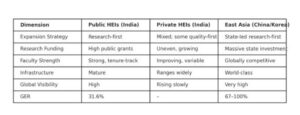
East Asia offers a clear model. South Korea’s BK21 programme invested USD 1.2 billion in graduate schools and research clusters. China’s Projects 211, 985, and the Double First-Class initiative channel billions into select universities. These investments created robust ecosystems before markets scaled. The results are visible in tertiary enrolment: India’s Gross Tertiary Enrolment Ratio (GER) is 31.6%, versus 67.4% in China and more than 100% in South Korea (World Bank). These outcomes reflect systematic, state-backed investments in academic quality.
Several Indian private HEIs show what long-term construction of academic ecosystems can achieve. Ashoka University is built on collective philanthropy from over 100 donors, aided by a ₹250-crore grant from the Harish and Bina Shah Foundation and a ₹104-crore CSR partnership with Axis Bank. It maintains a 7:1 faculty–student ratio and offers significant financial aid.
Manipal Academy of Higher Education (MAHE), an Institution of Eminence, has sustained quality through medical and engineering laboratories, teaching hospitals and externally funded research centres, including a recent ₹12.84-crore ICMR-supported Centre for Advanced Research.
Private HEIs Must Move Beyond Tuition Dependence
Quality institutions cannot run on tuition alone. Globally, universities thrive on a triad: philanthropy, competitive research funding and diversified revenue. Indian private s can build professionally managed endowments, attract CSR partnerships, and expand executive education portfolios. They can also establish research parks—similar to those at IIT Madras, whose Research Park generates industry tenancy and collaborative research revenue.

India’s private sector stands at a turning point. The future depends less on regulation and more on the philosophy of institution-building. Institutions that invest early in research, faculty and academic culture will not only match public universities—they will redefine the architecture of Indian higher education. The priority is clear: India must move from expansion to excellence, from scale to stewardship.