



India biofuel policy: The global energy system is being reshaped by climate constraints, rising demand, and the strategic risks of fossil fuel dependence. For transport, where electrification remains partial, biofuels have moved from the margins to the centre of transition strategies. For India, they also address a structural vulnerability: dependence on imported oil.
India is the world’s 3rd-largest energy consumer and imports over 85% of its crude oil. It is also a large agricultural economy that generates vast quantities of biomass and organic waste. Few countries combine these features at comparable scale. If India expands biofuel use sharply over the next decade, the effect will extend beyond domestic energy balances. It would shape markets by creating demand, lowering costs, and normalising deployment in developing economies.
READ I India’s energy transition needs resilience, not silver bullets
Transport fuels and import dependence
Transport accounts for close to 40% of India’s petroleum consumption. That alone explains the policy focus on ethanol blended with petrol, biodiesel with diesel, and compressed biogas as a substitute for CNG.

The resource base is not marginal. India produces over 750 million tonnes of agricultural residue annually, much of it under-used or burnt in the open. Municipal solid waste exceeds 60 million tonnes a year. These are recurring inputs that can be mobilised at scale if collection and pricing systems work.
READ I A sustainable biofuel policy needed for India’s energy transition
Policy architecture and execution
India’s biofuel policy has evolved incrementally. The National Policy on Biofuels, first issued in 2009 and revised in 2018 and 2022, widened eligible feedstocks, permitted advanced biofuels, and anchored the programme in a circular-economy framework.
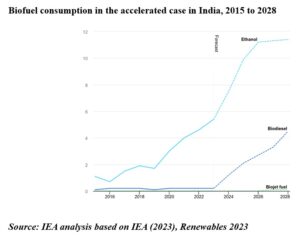
Execution has mattered more than policy text. The Ethanol Blended Petrol (EBP) programme crossed 10% blending by 2022, five years ahead of schedule, and the 20% target has been advanced to 2025–26. Assured pricing, long-term offtake contracts by oil marketing companies, and concessional finance aligned incentives across producers and refiners.
The SATAT scheme applies a similar logic to compressed biogas. Its ambition to establish 5,000 plants links waste management, urban sanitation, and transport fuels. Progress has been uneven, but the institutional design remains intact.
READ I Public policy is not just economics; it is applied psychology
Feedstocks, capacity, and constraints
Early ethanol expansion relied heavily on sugarcane molasses. That constraint is easing. Grain-based ethanol using surplus rice, maize, and broken rice has expanded supply without tightening food markets.

Installed ethanol capacity has risen from about 3 billion litres in 2014 to over 13 billion litres by 2023, supported by interest-subvention schemes and guaranteed procurement. The next phase depends on second-generation biofuels. Using rice straw, wheat straw, and bagasse reduces pressure on land and water while directly addressing residue burning.
Biogas draws from a different stream: cattle dung, municipal waste, and industrial organic effluents. Its climate impact is large because it captures methane that would otherwise escape.
Macroeconomic payoffs of biofuel push
Oil imports dominate India’s merchandise import bill and amplify current-account vulnerability during price shocks. Official estimates suggest that 20% ethanol blending could save ₹30,000–40,000 crore in foreign exchange annually.
Replacing imported fuel with domestic biofuels stabilises fiscal planning and insulates transport costs from geopolitical disruptions. Private investment in refineries, storage, and logistics adds a second-round growth effect, concentrated outside metropolitan corridors.
Rural income and employment effects
Biofuels alter farm economics at the margin but at scale. Agricultural residues acquire value. Rice straw sold to a 2G plant competes directly with stubble burning, which persists because disposal costs exceed returns.
The value chain—collection, aggregation, transport, processing—is labour-intensive. Farmer-producer organisations and cooperatives are better placed than large corporates to manage decentralised supply, provided pricing and payment systems remain predictable.
Emissions, air quality, and sustainability
The emissions case for biofuels is incremental rather than absolute. Life-cycle assessments indicate 35–50% greenhouse-gas reductions for ethanol relative to petrol, with higher savings from advanced biofuels. Biogas reduces methane emissions from waste streams that are otherwise unmanaged.
India’s emphasis on residues and waste-based fuels limits food-security risks. Sustainability will depend less on headline blending targets than on feedstock discipline and water use.
Global scale and strategic leverage
India’s advantage is scale. Tripling biofuel consumption would create predictable demand that justifies investment and drives cost reduction. Few markets can do this unilaterally.
There is also a diplomatic dimension. Experience with feedstock diversification, pricing mechanisms, and public-private coordination is transferable to agrarian economies where electrification of transport will be slow.
Biofuel policy and trade compatibility
One constraint remains largely unexamined. As biofuels scale, they will collide with international rules on sustainability, traceability, and life-cycle emissions. The European Union’s fuel standards, emerging global norms for sustainable aviation fuel, and carbon-accounting requirements will matter even if India’s immediate focus is domestic blending.
A system designed only for volume risks incompatibility with future trade and technology regimes. The question is not exports alone. It is whether today’s investments remain usable as transport standards tighten. Without early alignment on certification and emissions accounting, India could face avoidable friction just as scale becomes an advantage.
Constraints remain. Feedstock supply chains are fragmented. Transport costs are high. Blending, storage, and distribution infrastructure needs upgrading. Water use and land availability require constant monitoring.
Three priorities for the biofuel policy stand out: sustained investment in conversion technologies; integration of biofuels with transport, climate, and agricultural policy rather than siloed targets; and stronger institutions to manage decentralised supply. If these hold, biofuels can shift India from being a price-taker in oil markets to a scale-setter in an alternative fuel system.
Dr Savitha KL is Assistant Professor, Christ University, Bangalore; Dr Flavio Eduardo da Silva de Carvalho Veterinarian and Federal Agricultural Auditor at the Brazilian Ministry of Agriculture and Livestock; and Dr Jomit CP is Assistant Professor, Amity University, Gurugram.