


High voter risk appetite behind Bengal, Tamil Nadu verdicts: The BJP’s landslide victory in West Bengal and Tamilaga Vettri Kazhagam’s breakthrough in Tamil Nadu seem, at first glance, to belong to different political stories. One is the rise of a national party in a state where it had never governed. The other is the arrival of a new party led by actor-politician C Joseph Vijay in a state long dominated by the Dravidian duopoly.
Yet the two results share a deeper feature. Voters in both states were willing to move away from familiar incumbents and take a chance on less tested alternatives. In West Bengal, the BJP won 207 seats against the Trinamool Congress’s 80, according to the Election Commission’s May 2026 results. In Tamil Nadu, TVK won 108 seats, ahead of the DMK’s 59 and the AIADMK’s 47, though short of a majority in the 234-member Assembly.
READ | One Nation, One Election: A fixed election cycle can cut governance cost
The point is not merely anti-incumbency. It is risk appetite. The BJP may be entrenched nationally, but Bengal had no experience of BJP rule at the state level. TVK, founded in 2024, had no governing record at all. The voter chose not just change, but uncertainty.
Prospect theory and voter risk
Prospect theory, developed by Daniel Kahneman and Amos Tversky in 1979, offers one way to understand this behaviour. People evaluate outcomes relative to a reference point. They tend to avoid risk when choosing between gains, but become risk-seeking when they fear losses. A risky option becomes attractive if the existing path looks like a certain decline.
This does not mean voters consciously apply behavioural economics. It means they may act as loss-avoiding citizens rather than as simple beneficiaries of welfare or identity appeals. When the incumbent is seen as unable to protect future income, jobs or purchasing power, an untested challenger can begin to look less risky than continuity.
West Bengal and Tamil Nadu show this logic in different ways.
West Bengal growth and the BJP risk
West Bengal’s economic record under the TMC was not uniformly poor. Poverty fell sharply. Welfare transfers had political salience. Rural education indicators were not uniformly weak. But the broader economic story lacked momentum.
The state’s NSDP at current prices grew 9.86% in 2024-25, close to the national figure but below Bihar’s 13.07% and Odisha’s 13.04%. The contrast mattered because Bengal is no longer judged only against its own past. It is judged against faster-moving eastern states.
READ | AI in elections: ECI may struggle to tackle synthetic campaigns
NITI Aayog had earlier noted that West Bengal’s real GSDP grew at an average 4.3% between 2012-13 and 2021-22, below the national average of 5.6%. Its share in national GDP declined from 6.8% in 1990-91 to 5.8% in 2021-22. Its per capita income was about 20% below the national average.
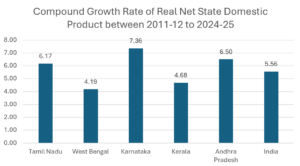

This is the ground on which political risk changes character. Welfare schemes such as Lakshmir Bhandar may have helped households. But welfare can become an entitlement once embedded. It no longer works as a sufficient answer to migration, low investment and weak job creation.
The TMC campaign tried to frame the BJP as an outsider force hostile to Bengali identity. That argument had worked earlier. In 2026, it was not enough. If voters believed that another term would mean more drift, then the BJP’s inexperience in Bengal became less damaging. The unknown began to compete with a known ceiling.
Welfare gains without economic confidence
West Bengal’s social record complicates any simple verdict. Multidimensional poverty fell significantly in the state, as it did across India. Nationally, NITI Aayog estimated that India’s poverty headcount ratio declined from 29.17% in 2013-14 to 11.28% in 2022-23.
This matters. Voters did not necessarily reject welfare. They rejected the idea that welfare alone could substitute for economic mobility. The poor may value transfers, but they also compare wages, migration options and the visible prosperity of other states.
That comparison is sharper in Bengal because out-migration has become part of the household economy. A voter who receives a state benefit but sees family members working in Kerala, Maharashtra, Karnataka or Gujarat has a larger reference point. The benchmark is no longer the village panchayat or the block office. It is the labour market outside Bengal.
The BJP’s promise, therefore, did not have to be fully believed. It only had to appear less hopeless than continuation.
READ | Machine-readable rolls key to election transparency in India
Tamil Nadu and fatigue with a duopoly
Tamil Nadu presents a different puzzle. It is richer, more industrialised and better governed than many Indian states. Its per capita NSDP is high. Its welfare architecture is older and more institutionalised. Its human development record is stronger.
Yet TVK’s rise suggests that high income does not immunise a state against political fatigue. The DMK and AIADMK have alternated power within a Dravidian framework since 1967. Their rivalry gave Tamil Nadu stability, but also narrowed the imagination of electoral change.
Tamil Nadu’s 2024-25 economic performance was strong in headline terms. The state’s Economic Survey said Tamil Nadu contributed 9.21% to India’s GDP in 2023-24 despite having about 4% of India’s land area and 6% of its population.
But voters do not judge only aggregate output. They judge opportunity, prices, local corruption, employment quality and whether political competition has become stale. A state can grow and still produce impatience. It can be prosperous and still appear politically exhausted.
TVK benefited from that opening. Vijay was not a conventional party leader. That was the liability. It was also the asset. In a system where the principal alternatives were familiar, unfamiliarity itself became a political proposition.
Why Kerala was different
Kerala’s 2026 change of government fits the anti-incumbency pattern, but not the same risk pattern. A return to the United Democratic Front was a low-risk choice. Kerala has long alternated between the Left Democratic Front and the UDF. Voters were not breaking the system. They were using it.
This distinction is important. Kerala’s relatively low poverty and strong welfare record may have reduced the need for a leap into the unknown. Slow growth may still have encouraged change. But the voter had a familiar alternative. In Bengal and Tamil Nadu, the choice involved a greater departure from past voting habits.
The Kerala case shows that economic dissatisfaction does not always produce political experimentation. It does so only when familiar alternatives lose credibility or when new entrants become plausible vehicles of discontent.
Voter risk appetite: The new benchmark for incumbents
The broader lesson is that Indian voters increasingly judge governments against external benchmarks. A state is compared not only with its own past, but with neighbouring states, rival regional models and national expectations.
This weakens the old comfort of incumbency. Welfare delivery, identity appeals and organisational control remain powerful. But they cannot indefinitely compensate for weak income growth, corruption in everyday dealings, migration distress or the perception that the state is falling behind.
It also changes the challenger’s problem. A new party no longer needs a full governing record to be credible. It needs to persuade voters that the current path has become a loss-making proposition. Once that happens, political inexperience can be reframed as freedom from the old bargain.
West Bengal and Tamil Nadu are not identical. One chose a national party that had waited for years at the state’s gate. The other elevated a new regional force led by a film star. But both point to the same electoral psychology. When the status quo begins to look like a certain loss, voters become willing to gamble.
For incumbents, the warning is clear. Performance is no longer judged only by schemes delivered or rivals defeated. It is judged by whether citizens see a credible economic future. If they do not, even the unknown can become electable.
Dr Indranil De is Professor of Social Sciences and Economics, and Axis Bank Chair at Institute of Rural Management Anand (IRMA).