


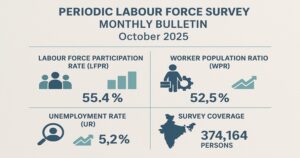
India’s efforts to raise women’s labour force participation have drawn renewed attention. The latest Monthly Bulletin of the Periodic Labour Force Survey (October 2025) places the national female labour force participation rate at 34.2 percent, rural and urban combined. The gap with men remains wide at 77.4 percent. The persistence of this divide has less to do with aspiration than with constraints that shape whether women can enter and stay in paid work.
Time-use and labour data point to three such constraints. Mobility remains restricted. Caregiving is unevenly distributed. And employment that is both local and viable is scarce. These are not abstract barriers. They determine daily choices.
It is against this backdrop that community-based skilling camps in Anapati and Guntur in Andhra Pradesh offer useful evidence. The PLFS places women’s participation in the state at around 31 percent, against over 60% for men. The predominance of informal and low-quality work makes Andhra Pradesh a revealing site to assess whether skilling programmes can support sustained participation rather than short spells of employment.
READ I Women’s self-employment surges, but gaps persist
Community-based skilling camps
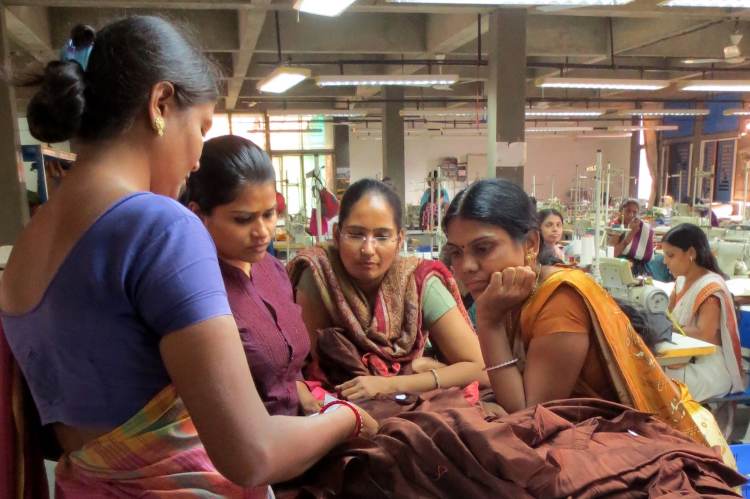
At one camp, a young woman employed at a local hotel described how her entry into paid work followed her husband’s participation in a skilling programme. When a camp was later set up in their village, she enrolled. Proximity mattered.

She could attend training while managing household work. Her day now runs on a predictable loop- school drop-off, work, school pick-up, home. This routine was not exceptional. It was enabled. Across sites, small design decisions consistently reshaped who could participate and for how long.
READ I Women in manufacturing: The missing link in the India story
Mobility and women’s work
Mobility remains among the least acknowledged constraints on women’s work. Concerns around safety, distance, and social norms limit movement, particularly for younger women. Locating training within the community altered this equation.
Camps within walking distance allowed women who would not travel to distant centres to attend regularly. By lowering both physical distance and social friction, mobility shifted from an individual burden to a programme responsibility.
READ I PLFS 2025: India looks to bridge the jobs reality gap
Care work and skilling programmes
Care responsibilities surfaced just as clearly. In several classrooms, women attended sessions with young children beside them, supported by trainers and peers. This accommodation matters when placed against the Time Use Survey 2024.
Women spend an average 289 minutes a day on unpaid domestic work, compared with 88 minutes for men. Caregiving accounts for a further 137 minutes for women, against 75 for men. Training models that assume uninterrupted time exclude women by design. Allowing children into classrooms did not dilute learning. It aligned training with lived realities. Care was treated as part of daily life, not as a disruption to be managed privately.
Local placement and retention
Skilling programmes are ultimately judged by whether training leads to employment that lasts. In Andhra Pradesh, placement facilitators worked continuously with local employers rather than treating placement as a final-day formality. Two adjustments recurred in these discussions: clearly defined shift timings and arranged transport from home to workplace. Both addressed constraints that routinely push women out of jobs within weeks of joining.
What remains less examined, however, is the quality of work women are being retained in. Local placements improve continuity, but they often cluster women into a narrow band of low-wage roles with limited progression. Defined shifts and proximity can stabilise employment without raising earnings or bargaining power.


If skilling outcomes are assessed only by placement and retention, programmes risk institutionalising better-managed precarity. For female labour force participation gains to translate into economic agency, policy metrics must also track wage growth, tenure, and pathways to higher-skilled roles.
India would need to nearly double female labour force participation to approach 70 percent by 2047, a level often cited as necessary to unlock an estimated $14 trillion in additional economic value. That scale will not be achieved through gender-neutral design. It will require workplaces to adapt to how women’s lives are organised. These are not concessions. They determine retention.
Female labour force participation and skilling
The skilling ecosystem has expanded rapidly, but outcomes remain uneven. Evidence suggests the problem is not access alone, but duration and continuity. ASER 2023 shows that only 4.5 percent of young women report participating in vocational training, against 6.8 percent of young men. Nearly half of female trainees are concentrated in courses lasting three months or less. Women remain under-represented in longer programmes that are more closely linked to employability and income gains.
The camps in Anapati and Guntur show why participation improves when systems are built around constraints rather than ignoring them. Three elements recur. Training is local. Flexibility is built into learning spaces, including the accommodation of care. And employers are engaged early, so skills translate into jobs women can sustain.
These elements do not create ideal pathways. They create realistic ones.
As policy discussions turn to gender-inclusive growth, intent must be matched by grounded programme design. Community camps demonstrate how skilling can move from access on paper to access in practice. The woman balancing work, school schedules, and care in Andhra Pradesh is not an outlier. She represents what becomes possible when training is nearby, care is acknowledged, and employment terms respond to constraints rather than denying them.
If India is serious about raising female labour force participation, attention must shift to these everyday design decisions. Often, it is not sweeping policy shifts but small, deliberate adjustments that decide whether women can remain in the workforce.
Dhanashree Gurudu works with PrathamEducation Foundation (vocational skilling and youth development arm). She has more than seven years of experience designing, implementing, and strengthening skilling and employment-linked programmes for women and youth across multiple states in India.