


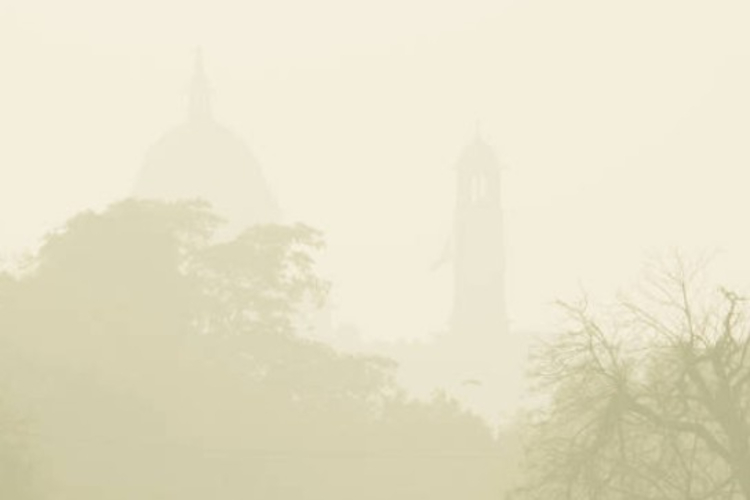
Air pollution and inequality: The annual deterioration of air quality in Delhi and the National Capital Region now unfolds with the certainty of a public health emergency rather than the unpredictability of a natural disaster. In the days following Diwali 2025, air quality indices crossed 500, entering the hazardous range and triggering a public health alert. Hospitals reported a spike in respiratory distress among infants, pregnant women and the elderly. Schools restricted outdoor activity. Advisories urged residents to stay indoors.
On November 2, a former doctor from AIIMS publicly advised vulnerable residents to temporarily leave the city if they could afford to do so. Citizens took to the streets demanding accountability. The Supreme Court of India intervened, asking the Union government to explain failures in air quality monitoring and delays in enforcing pollution-control measures.
READ | Delhi air pollution crisis exposes institutional breakdown
Yet the official response remained contradictory. Construction activity was not halted in time, while police action was taken against protesters asking for clean air. The larger question went unanswered: who bears the costs of this invisible emergency, and who benefits from prolonged inaction?
Erosion of the social contract
Clean air is inseparable from the constitutional understanding of the right to life. Political thought has long linked the idea of a good life to health, safety, and environmental security. That places a clear obligation on the state to act through policy, regulation, and enforcement.
In practice, pollution control in North India has been reduced to a seasonal ritual. Delhi NCR, Punjab, Haryana, western Uttar Pradesh, Bihar, and parts of Madhya Pradesh repeat the same cycle each year. Emissions from industry, construction, vehicles, and agriculture accumulate through the year. Winter meteorology merely traps what has already been released.
Once the smog lifts, urgency fades. Pollution is treated as episodic rather than structural. Enforcement slackens, political attention shifts, and the social contract weakens—not through overt denial, but through regulatory neglect.
READ | Breaking Delhi air pollution cycle with a solar revolution
Air pollution as health emergency
The health consequences are neither abstract nor marginal. Air pollution has become one of India’s leading causes of premature death.
A major assessment published in The Lancet estimates that human-caused PM2.5 pollution contributed to more than 1.7 million deaths in India in 2022, a 38 per cent increase since 2010. Fossil fuel use accounted for roughly 44 per cent of these deaths. Child mortality is especially alarming. Deaths among children under five linked to indoor and outdoor air pollution rose sharply between 2016 and 2021.
Children exposed to polluted air suffer irreversible lung damage. Adults develop chronic respiratory and cardiovascular disease. Public hospitals absorb the burden of preventable illness, without commensurate increases in funding or infrastructure. This is not an environmental side issue. It is a systemic public health failure.
When survival becomes a commodity
Pollution governance in India increasingly mirrors inequality. Those with means retreat indoors behind air purifiers, sealed windows, and private transport. Those without continue to breathe toxic air without choice or protection.
A basic air purifier costs Rs 6,000 or more—well beyond the reach of lower-income households. Clean air is quietly commodified, offered as a consumer product rather than protected as a public good. Markets provide coping mechanisms; the state withdraws from prevention.
This logic extends across sectors. Electric vehicle adoption remains skewed towards premium models, while public transport is overcrowded and underfunded. Renewable energy subsidies favour large corporate developers, while decentralised and community-owned systems struggle for policy support. Industrial polluters face penalties that barely register against profits, while “green” branding substitutes for genuine reform.
The pollution governance keeps failing
India’s air pollution crisis persists not because solutions are unknown, but because governance is fragmented and responsibility dispersed. Authority is split between the Union government, state governments, municipal bodies, and regulators such as the Central Pollution Control Board and its state counterparts. No single institution is empowered—or penalised—for failure across an entire airshed.
Delhi’s pollution cannot be addressed meaningfully without coordinated action across Haryana, Punjab, Uttar Pradesh, and Rajasthan. Yet India lacks an airshed-based governance framework that assigns binding obligations across state boundaries. Inter-state coordination remains voluntary, episodic, and politically fraught.
Weak monitoring compounds this failure. Sparse and frequently malfunctioning air-quality stations undermine the credibility of official data, allowing governments to contest severity and delay action. Courts have flagged these gaps repeatedly, but regulatory capacity has not kept pace with the scale of the problem. Without credible measurement, enforcement becomes performative.
The political economy of pollution further complicates reform. Agricultural residue burning is often blamed for winter smog, but the underlying drivers—minimum support price incentives for paddy, delayed procurement cycles, and inadequate compensation for residue-management alternatives—remain unaddressed. Farmers operate within policy constraints set by the state; penalising them without reforming pricing and procurement structures merely shifts blame.
Urban governance failures are equally stark. Construction dust norms exist largely on paper, enforced weakly by under-resourced municipal bodies. Cities continue to prioritise road expansion and real estate growth over public transport, green buffers, and zoning discipline. Budgetary choices reinforce this imbalance, with spending on highways and flyovers far outpacing investment in buses, suburban rail, or pollution-control infrastructure.
Legal deterrence is ineffective. Environmental penalties remain low, conviction rates poorer still, and regulatory capture widespread. For large polluters, non-compliance is often cheaper than compliance. Until pollution carries real financial and operational consequences, regulation will remain symbolic.
READ | Delhi air pollution: Why urban policies falter every winter
From crisis to reform
Clean air must be treated as essential public infrastructure. That requires moving beyond emergency responses towards permanent institutional reform.
Industrial emissions need strict, enforceable standards backed by continuous monitoring and penalties that deter violations. Pollution control equipment in industrial zones must be mandatory and audited, not optional or self-certified.
Waste reduction must occur within production processes through circular-economy principles that prioritise reuse and recycling. Community-level audits, alongside state inspections, can improve transparency and local accountability.
Sustainability also requires rebalancing production and consumption. It cannot rest on individual behaviour alone. The greatest responsibility lies with manufacturers and large corporate actors, not households adjusting daily routines.
Finally, investment in mass public transport is indispensable. Affordable, reliable buses and rail systems across urban and peri-urban India are among the most effective tools for reducing vehicular emissions. These investments must be paired with credible vehicle-emissions testing and enforcement.
Air pollution exposes the limits of governance more clearly than most policy failures. The science is settled. The health impacts are documented. The solutions are known. What remains absent is political resolve.
A state that allows clean air to become a luxury has abdicated a basic responsibility. Ensuring a good life means acting for the collective, not enabling private escape for the few. On that measure, India’s pollution crisis is not a failure of capacity. It is a failure of accountability.
Judith Anne Lal is Assistant Professor, International Studies, Political Science and History at School of Social Sciences, CHRIST University – Delhi NCR Campus.