



Young Indians do not experience the Union Budget as a spreadsheet. They encounter it in fees, fares, exam choices, hiring cycles, and the cost of keeping options open. That is why Budget 2026–27 matters beyond the ritual of “announcements”. It is a statement of priorities and a test of delivery.
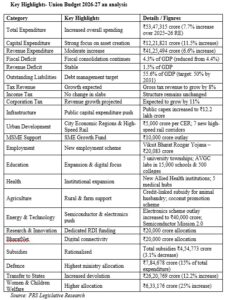
Budget 2026–27 keeps fiscal consolidation on the table while leaning harder on public investment. Total expenditure is budgeted at ₹53.47 lakh crore, up 7.7% over 2025–26 (RE). Capital expenditure rises to ₹12.21 lakh crore (11.5%), while revenue expenditure grows more moderately to ₹41.25 lakh crore (6.6%). The fiscal deficit is budgeted at 4.3% of GDP, marginally lower than the previous year’s 4.4%.
READ | Budget 2026: Tier II cities push lacks climate resilience
This is a familiar bargain: hold the deficit line, and let capex do the heavy lifting. The risk, as always, is not the arithmetic but execution. Capex only becomes growth when projects move from allocations to assets.
Infrastructure-led growth and urban ambition
The budget’s headline bet remains infrastructure. Higher public capex is designed to lift demand in the near term and expand capacity over time. The emphasis on transport networks—roads, railways, waterways—and urban development suggests an attempt to reduce logistics frictions and widen labour markets.
The urban agenda is explicit. Proposals such as City Economic Regions and new high-speed rail corridors aim to create larger, integrated economic zones. These are long-gestation promises. Their credibility will depend on land acquisition, state coordination, and the quality of project design, not the announcement value.

Employment schemes and the MSME channel
The budget signals job creation through two routes: a direct employment programme and an MSME-led expansion strategy. The Viksit Bharat Rozgar Yojana is budgeted at ₹20,083 crore, while an SME Growth Fund gets ₹10,000 crore.
The direction is sensible: most jobs are created by smaller firms, but most small firms struggle with credit, compliance, and market access. Yet the question that matters to young workers is not only “how many jobs” but “what kind”. If the policy stack produces short-term, low-productivity work without wage progression, the political headline will outlast the labour-market benefit.
READ | Budget 2026: Sandalwood revival hinges on farmer ownership
Skills, AVGC labs, and the education-to-work gap
Education and skilling are positioned as enablers of the same growth story. The budget proposes university townships and a large rollout of AVGC labs in schools and colleges. It also proposes a committee to strengthen the education-to-employment link.
This is the right diagnosis—India’s credential pipeline does not reliably map to employable skills—but the hard part is institutional. Labs and courses help only when industry partnerships are real, faculty is trained, and assessment is credible. Otherwise, skilling becomes another layer of expenditure without labour-market traction.
Semiconductors, R&D, and digital rails
The budget leans into technology as both a competitiveness strategy and a jobs narrative. The electronics scheme outlay is raised to ₹40,000 crore and Semiconductor Mission 2.0 is reiterated. RDI funding is allocated ₹20,000 crore, and BharatNet gets ₹20,000 crore.
The logic is clear: build domestic capability in strategic sectors, attract investment, and create higher-quality employment. But this is also where policy must be most honest. Semiconductor ecosystems are not built by incentives alone. They require reliable power, skilled technicians, stable trade policy, predictable taxation, and globally credible standards.
Rural productivity and limits of advisory tech
Agriculture and rural development measures lean on advisory and productivity programmes, including tools such as Bharat-VISTAAR and support for allied sectors. These measures can help raise yields and reduce information gaps.
But rural resilience is not solved by advice alone. Market access, storage, rural roads, price risk management, and non-farm employment determine whether higher productivity translates into stable income. The budget nods to these issues, but the durability of outcomes will depend on sustained policy attention beyond one year’s allocations.
Education costs and the digital divide
The budget keeps income tax slabs unchanged. It speaks of compliance simplification and some rationalisation of specific rates linked to foreign education and travel. For middle-class families, however, the binding constraint is often not the tax slab but the rising cost of education and the cost of maintaining mobility—coaching, degrees, rentals, and job search.
The budget’s push for digital education and access also runs into a stubborn reality: connectivity quality is uneven. Allocations for digital rails matter, but the digital divide is as much about reliability, devices, and local support systems as it is about backbone spending.
READ | Budget 2026: India needs urban governance, not big transport assets
What will decide success
Budget 2026–27 is best read as a continuation with sharper emphasis: fiscal consolidation, higher capex, and a technology-forward narrative tied to skills and jobs. The core judgment is straightforward. If implementation works, the budget can widen opportunity, especially for first-time job seekers. If it doesn’t, the headline schemes will not compensate for weak job quality, expensive education pathways, and uneven digital access.
For the youth, the test will be practical: better hiring prospects, wages that rise with skills, and public services that reduce the private cost of building a career. The budget’s intent is visible. The outcome will depend on delivery.
Sonal Rohatgi and Garvika Agarwal are 4 BA PECO Student, and Dr Savitha KL is Assistant Professor, Department of Economics, Christ University, Bangalore.