


Iran war exposes BRICS: More than two months after the US and Israel launched military attacks on Iran, the conflict is poised on the edge of a fragile ceasefire. The cost in human suffering for Iran and Lebanon has been high. Israel has also suffered civilian casualties from Iranian missile attacks. However, the economic pain caused by the closure of the Strait of Hormuz and the destruction of energy infrastructure on both sides of the Persian Gulf is already being felt around the world.
Fuel prices in the Philippines have more than doubled since the start of the conflict, affecting households across the country. A rise in LPG cylinder prices on the black market has forced migrant workers in India to leave cities. The odds of a US recession in the next 12 months have risen to nearly 50 percent. Food prices in Gulf countries, which import 70–80 percent of their food, have surged. Global food availability is also at risk, as fertiliser supplies that transit through the Strait remain disrupted.
READ I US superpower status will be diminished by any Iran exit
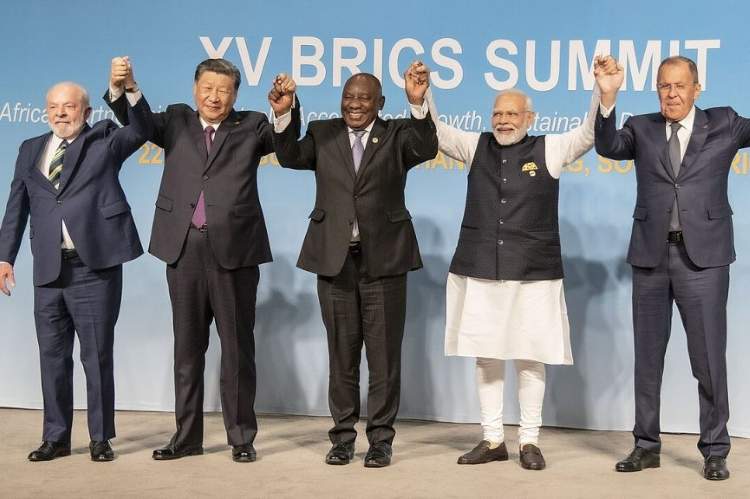
Amid all this, one influential grouping of countries—called upon by Iranian leaders including President Masoud Pezeshkian and Foreign Minister Abbas Araghchi to help end the conflict—has been notably silent: the BRICS grouping, comprising Brazil, Russia, India, China and South Africa. India is the current chair. Iran joined BRICS+ in 2024. The UAE and Saudi Arabia, which have faced Iranian attacks for hosting US bases involved in the war, are also members of the expanded BRICS+ grouping.
Both Pezeshkian and Araghchi called on India to play a role as BRICS chair. However, it was Pakistan that eventually took on a mediating role.
Under the fog of war BRICS has been seen as hesitant, fragmented and even irrelevant. Similar concerns emerged during the 12-day Israel–Iran war in 2025.
To the extent that BRICS has remained silent on the war, its major members have been able to secure selective benefits, even when belligerents were not satisfied. India, for instance, managed to secure safe passage for some of its ships via the Strait of Hormuz via direct talks with Iran. In a rare demonstration of their veto powers at the United Nations Security Council, China and Russia jointly undermined a Bahraini resolution supported by the Gulf states and USA that would authorise the use of force for “defensive purposes” in Hormuz. Afterwards, Trump backed off from his very aggressive rhetoric and announced a ceasefire with Iran.
Old BRICS habit
The lack of collective response on the part of BRICS is not new.
In 2014, the Russian annexation of Crimea drew only a muted response from BRICS, in contrast to its repeated criticisms of international financial institutions and its joint condemnation of NATO’s intervention in Libya during the Arab Spring. BRICS also remained largely silent in 2022, without seriously engaging the second Russian invasion of Ukraine, despite separate mediation efforts by Xi Jinping and Lula da Silva. In 2025, conflict in East Asia overshadowed the BRICS meeting in Brazil, which focused on environmental issues ahead of COP-30.
Discomfort with BRICS ambivalence may arise less from its member states and more from a broader demand in global politics for new institutional frameworks with stronger input from Global South powers.
There is a sense that the post-1945 liberal international order is both inefficient in a fragmented globalised world and biased towards the West. Over time, the United Nations has faced a prolonged period of institutional decline, against the backdrop of crises such as the war on terror, the 2008 financial crisis and COVID-19.
Meanwhile, expectations from BRICS have risen. Its members, however, remain devoted to their individual interests, and function like an informal grouping such as the G7, rather than a structured multilateral organisation like the UN or regional bodies such as ASEAN, the African Union or the European Union. While the group offers a platform for diverse powers and has expanded significantly in recent years, its loose, leader-driven format limits collective action, as each member retains room to pursue national interests.
This is not unique to BRICS; similar criticisms are directed at other groupings, including the G7 and G20.
India, which is a member of the Quad along with Australia, USA and Japan, also declined US calls for “friendly nations” to reopen Hormuz by force.
With the next BRICS leaders’ meeting set to take place in September or October in India—a major Global South economy with strong post-pandemic growth—the group’s focus may shift from the immediate energy crisis in West Asia to broader concerns about global economic stagnation.
Global attention will again turn to the Global South, although expectations are likely to remain tempered.
Carlos Frederico Pereira da Silva Gama is an Assistant Professor in the Department of International Relations and Governance Studies, Shiv Nadar Institution of Eminence, and the author of four books including Global Essays – From Arab Spring to Brexit, 2011-2020. Originally published by 360info
