


In December 2020, a New York Times report followed two children in Delhi for a day. Monu lived in a slum near the Yamuna. Aamya lived in a better-off neighbourhood. By day’s end, Monu had inhaled about four times as much pollution. Sustained over time, that gap could cost a child like him around five more years of life. That report did not merely humanise India’s air crisis. It exposed its social logic. Dirty air is not distributed evenly. It tracks income, housing, work and access to protection.
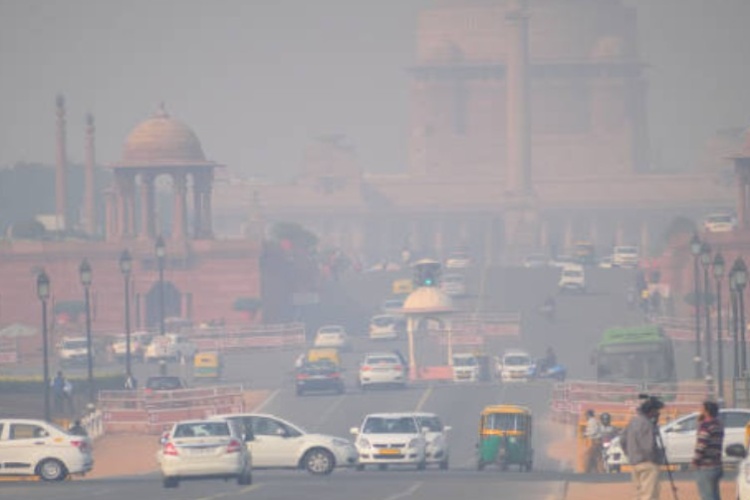
India’s air pollution problem is vast, chronic and national in scale. IQAir’s 2024 World Air Quality Report ranked India the fifth most polluted country in the world. Its average annual PM2.5 concentration was 50.6 micrograms per cubic metre, about ten times the World Health Organisation guideline of 5. Six of the world’s ten most polluted cities were in India. Delhi again stood near the top of that list.
READ | Delhi air pollution crisis a failure of prevention, not prediction
That headline figure, however, can mislead. It suggests a common atmospheric burden. In reality, Indians do not breathe the same air. The rich buy distance from exposure. The poor live inside it.
Air pollution inequality begins with where people live
Low-income households are more likely to live near arterial roads, industrial clusters, open waste burning sites, drains, brick kilns and construction corridors. Informal settlements are often pushed to land that formal planning has already treated as expendable. That is where pollution accumulates and enforcement thins out. For families living there, toxic air is not an emergency declared by an app. It is the background condition of daily life.
The inequality persists indoors. Many households still rely on biomass, coal or other dirty fuels for cooking and heating. That means women, children and the elderly often face high exposure even when they are inside the home. By contrast, middle-class households can retreat behind pucca walls, cleaner kitchens, closed vehicles, air filters and better medical care. The phrase “stay indoors” means very different things in a gated colony and in a one-room dwelling with a chulha.
PM2.5 deaths in India punish the poor more harshly
PM2.5 is small enough to enter the lungs, cross into the bloodstream and damage multiple organs. It is associated with cardiovascular disease, stroke, respiratory illness, cancer and adverse child health outcomes. Air pollution now accounts for more than 2 million deaths a year in India, making it one of the country’s gravest public-health risks.
READ | Air pollution, inequality, and collapse of accountability
Yet the true scandal is not only the scale of the damage. It is the inequality of it. Those who contribute least to emissions are often the least protected from them. Daily wage workers, street vendors, sanitation workers, traffic police, security guards, drivers, construction labourers and waste pickers cannot shift work online, cancel exposure or buy cleaner micro-environments. Their bodies absorb the cost of an urban model designed for other people’s convenience.
GRAP and NCAP still do not centre exposure justice
India is not short of programmes. It has the Air Act, the Environment Protection Act, the National Clean Air Programme, city action plans, the Commission for Air Quality Management in the NCR, and the Graded Response Action Plan in Delhi and adjoining areas. NCAP aims for up to a 40% reduction in particulate pollution by 2026 in non-attainment cities. But the architecture of control still focuses more on aggregate pollution than on unequal exposure.
That is why many interventions end up being socially selective. Construction bans, transport restrictions and relocations may look decisive, but their costs are rarely distributed fairly. Informal workers lose income first. Peripheral communities absorb displaced activity. The state often finds it easier to suspend small livelihoods than to confront entrenched sources such as private vehicle dependence, dirty freight, diesel generators, land-use failure or weak industrial compliance.
This is where air policy slides into class policy. Affluent India demands cleaner neighbourhood air, but often resists deeper changes in mobility, consumption and urban form. The result is a familiar pattern: visible pollution is pushed out of elite spaces, while vulnerable workers and settlements remain exposed. Clean air action becomes a politics of insulation.
READ | Delhi air pollution crisis exposes institutional breakdown
Environmental justice law in India remains underdeveloped
India’s constitutional framework offers more than is often acknowledged. The Supreme Court has long read the right to life under Article 21 to include a pollution-free environment, drawing support from Articles 48A and 51A(g). That gives courts and governments enough doctrinal room to think beyond narrow compliance and toward distributive justice.
But doctrine has outrun implementation. Indian environmental law still does not explicitly require regulators to test whether pollution burdens fall disproportionately on particular communities. Environmental impact assessment remains project-centred, not exposure-centred. Enforcement remains episodic. Penalties are often weak. Monitoring is uneven. Public participation is formal rather than consequential. In such a system, vulnerable communities remain visible to pollution but invisible to policy.
Clean air policy in India needs an equity test
India does not need to import foreign law wholesale to correct this. It does need to borrow one idea with seriousness: every major air-quality intervention should be tested for who benefits, who pays, and who remains exposed. That means mapping pollution hotspots by income and occupation, not just by geography. It means targeting schools, labour hubs, informal settlements and industrial peripheries for priority action. It means treating exposure reduction as seriously as source reduction.
A fairer clean-air regime would do three things. It would direct more monitoring and enforcement to places where poor households live and work. It would build livelihood safeguards into emergency restrictions that shut down economic activity. And it would require public agencies to assess distributive impact before approving projects or drafting city plans.
India’s air crisis is usually discussed as a technical problem. It is also a democratic one. The issue is not only how much pollution the country produces. It is whose lungs are made to carry it. Until that question sits at the centre of policy, clean air will remain what it already is for millions: not a right, but a privilege.
Bhavya Sharma and Vani Tyagi are undergraduate students, and Shreyansh Jain Assistant Professor in the Department of English and Cultural Studies, CHRIST University, Delhi NCR Campus.