



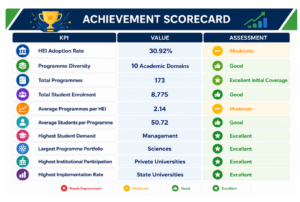
The National Education Policy 2020 has changed the vocabulary of Indian higher education: multidisciplinary courses, flexible curricula, research, technology, and closer links with industry. The harder question is how much of this has moved from policy documents into universities. The Apprenticeship Embedded Degree Programme offers one measure. A survey of 262 higher education institutions found that only 81, or 30.92%, had launched AEDP by May 2026.
The University Grants Commission introduced guidelines for AEDP in 2025 to bring workplace training into undergraduate education. The programme requires higher education institutions to work with companies and other organisations so that apprenticeship becomes part of the degree rather than an activity undertaken after graduation. Its immediate purpose is to narrow the distance between classroom education and the skills employers seek.
READ | Closing schools put the right to education at risk
AEDP adoption remains uneven across universities
The 262 institutions responding to the survey were spread across different categories. Private universities accounted for nearly 48% of responses and state universities about 30%. Central universities made up 8.4%, while state open universities accounted for just 1.15%.
Participation in the survey, however, did not translate into comparable adoption of AEDP. State universities recorded the highest implementation rate at 48.10%. Around 32% of central universities and 29% of deemed universities had introduced the programme.
Private universities present a different picture. They supplied nearly half the survey responses, but only 21.6% had launched AEDP. State open universities reported no implementation.
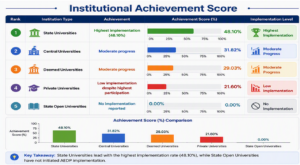
The numbers point to an uneven institutional response. State universities have moved faster despite the administrative and financial constraints often associated with the public university system. Private universities, which generally have greater freedom to alter courses and build industry partnerships, have been slower in this sample.
Table-1 Institutional Response Analysis
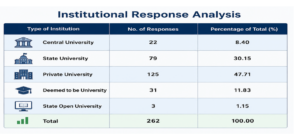

Table-2 Institution-wise Implementation
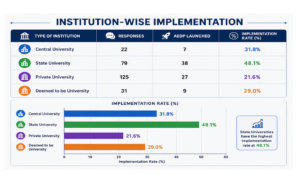

Table-3 Institutional Achievement Score

Sciences and management dominate AEDP programmes
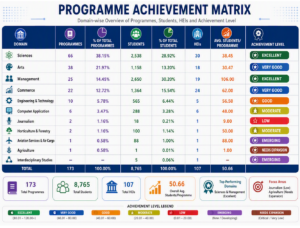
The programme mix is equally uneven. Sciences and management account for more than half of AEDP programmes and students covered by the survey. Management has the highest average enrolment per programme, while sciences account for the largest number of programmes.
Arts and commerce also have significant participation. Engineering and technology remain some distance behind the leading disciplines. Computer applications, horticulture and forestry have smaller footprints.
At the other end are journalism, agriculture, aviation services and air cargo, and interdisciplinary studies. Journalism has few programmes and low enrolment. Agriculture also has limited programme availability and student participation. Aviation and interdisciplinary programmes are still small.
This concentration matters because apprenticeship-linked education is intended to extend beyond a handful of professionally oriented subjects. The present distribution suggests that institutions find it easier to establish industry links in management and the sciences than in several other disciplines.
Table-4 Programme Achievement Matrix

AEDP has enrolment, but limited institutional reach
The survey covers 173 programmes across 10 academic domains with total enrolment of 8,775 students. Each participating institution offers an average of 2.14 programmes, while average enrolment works out to 50.72 students per programme.
These numbers indicate that programmes can attract students once institutions launch them. Institutional adoption is the bigger constraint. More than two-thirds of the surveyed HEIs had not introduced AEDP by May 2026.
The distinction is important. Expanding enrolment within the 81 participating institutions will not by itself broaden the programme’s reach. That requires more universities to offer apprenticeship-linked degrees and a wider spread of courses within those universities.
Table-5 Achievement Scorecard


Measuring AEDP implementation
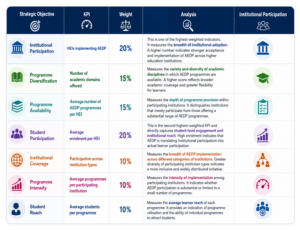
The proposed Composite Institutional Performance Index could make these gaps easier to track. The framework assigns 20% each to institutional participation and student participation. Programme diversification and programme availability receive 15% each. Together, these four indicators account for 70% of the proposed index.
Institutional coverage, programme intensity and student reach carry weights of 10% each.
Such an index would allow AEDP implementation to be judged on more than the number of institutions formally joining the programme. It would show whether universities are adding courses, whether students are enrolling, and whether apprenticeship opportunities extend across disciplines.
The survey leaves a clear agenda. Of the 262 institutions that responded, 181 had yet to launch AEDP. Private universities have considerable room to increase adoption, while state open universities have barely started. Agriculture, journalism and several emerging disciplines also remain thinly represented.
NEP 2020 has provided the policy framework for closer links between universities and workplaces. AEDP data now make it possible to judge implementation institution by institution. The numbers so far show progress, but they also show where the programme has yet to reach.