


With India being one of the countries most vulnerable to climate change, studies on how extreme weather events will affect Indians and how such risks can be reduced, are of real importance. One such study by the National Institute of Science Education and Research shows how climate change is actively reshaping the geography and intensity of deprivation across the country. It is no longer a distant environmental concern. Based on an analysis of 593 districts across 21 states, the study argues that poverty in India is increasingly becoming a climate-linked phenomenon that demands localised policy responses.
The study’s premise is that poverty is not merely a question of income. It is also about exposure to heat, floods, droughts and the slow violence of a changing climate. Policymaking, therefore, cannot be homogeneous. Climate change does not affect everyone equally.
READ | How climate change is making winters shorter and more extreme
That point needs to be taken a step further. Climate shocks do not affect only the chronically poor. They also hit households just above the poverty line, pushing them back through repeated income loss, crop damage, illness or forced migration. That is what makes climate change especially dangerous. It can turn vulnerability into poverty, and poverty into a trap. The World Bank has long warned that climate change could push more than 100 million additional people into poverty by 2030, with South Asia among the hardest-hit regions.
Climate shocks such as erratic rainfall, rising temperatures and recurrent floods are not isolated disruptions. They interact with pre-existing vulnerabilities and deepen and perpetuate poverty. Climate change is not creating poverty from scratch. It is hardening it, making escape more difficult and setbacks more frequent.
Extreme heat and livelihood stress
According to the study, temperature variability has the most severe impact among all climate variables. A rise in fluctuations significantly increases the likelihood of a district being classified as poor. Extreme heat reduces crop yields, stresses livestock and lowers labour productivity. For someone in Bundelkhand or Vidarbha, a few degrees of unexpected heat can mean the difference between subsistence and distress. Working in blistering heat is becoming more difficult across India, and the economic cost is rising with the health risk.
READ | Climate change threatens India’s farm income goals
This is not only a rural problem. Heat is also eroding livelihoods in cities, especially for workers in construction, transport, sanitation, street vending and other outdoor or poorly protected jobs. The International Labour Organisation has warned that heat stress affects outdoor workers above all, and that by 2030 the equivalent of more than 2% of total working hours worldwide could be lost each year, with Southern Asia among the worst-affected regions. Evidence from India’s urban informal workforce shows that heat waves reduce labour supply, raise coping costs and inflict direct health stress on low-income workers.
In Maharashtra’s Marathwada region, repeated droughts over the past decade have devastated rain-fed agriculture. Agriculture is no longer a pathway out of poverty for many households. It has become a source of repeated income shocks. Crop failures have forced families into debt and distress migration, with seasonal moves to cities for low-paying, insecure work. Climate variability is a lived economic shock for millions now. In that sense, climate change is perpetuating historical marginalisation and amplifying disadvantage. The study’s finding that districts with higher Scheduled Tribe populations are more likely to be poor points in that direction.
Floods, health shocks and repeated losses
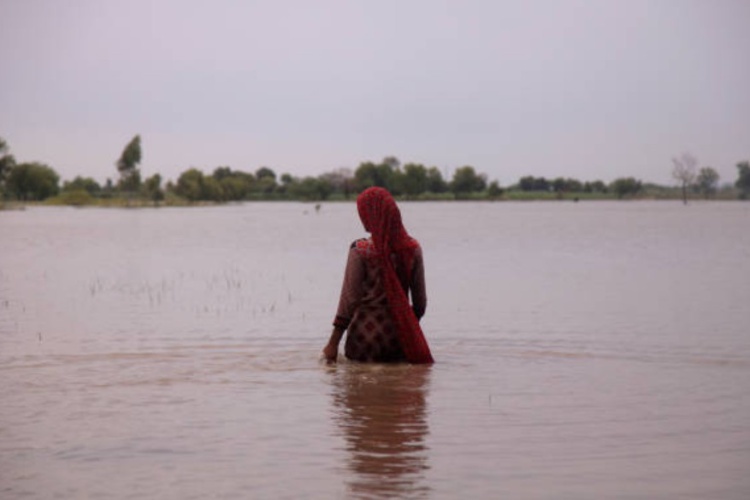
Beyond heat, flood-prone regions bring equally distressing situations. In Bihar and Assam, recurrent flooding damages crops as well as homes, roads and local markets. The study notes that even a small increase in flood-affected areas raises the probability of poverty. The result is a cycle in which families remain trapped, with too little time or capital to recover before the next monsoon brings the next shock.
The damage is not only to incomes and assets. It is also to health. The World Health Organisation has described climate change as a threat multiplier that affects health directly through extreme weather and indirectly through food systems, water stress, disease and pressure on health systems. For poor households, that means higher medical costs, lost work days, worsening nutrition and a faster slide into debt. A heatwave, a flood or a drought becomes not just a weather event but a compound livelihood shock.
However, India is no outlier. Globally, the pattern is similar. The World Bank has warned that climate change could push more than 100 million additional people into poverty by 2030. In sub-Saharan Africa, prolonged droughts have already led to food insecurity and displacement. In South Asia, rising temperatures are threatening labour productivity, particularly in outdoor sectors like agriculture and construction.
Economic diversification as climate resilience
The study says that not all regions are equally vulnerable. Districts with more diversified economies tend to have lower poverty rates. Simply put, when a state is not solely dependent on agriculture and has a stronger services or manufacturing base, poverty induced by climate shock can be mitigated to some extent. Southern states such as Tamil Nadu and Karnataka, and western states such as Gujarat and Maharashtra, have benefited from economic diversification, better infrastructure and higher human capital. These are buffers the government must strengthen if it wants to reduce future distress from climate shocks.
Climate resilience is not just about environmental management. It is also about economic structure. Regions that remain heavily dependent on climate-sensitive sectors such as agriculture are inherently more vulnerable. India must promote manufacturing, services and non-farm employment not merely as development goals but also as climate adaptation strategies.
READ | Climate change turns farms into migration corridors
Localised climate policy needs state capacity
Policymaking cannot work without proper insight, and studies like this help bridge that knowledge gap. The larger takeaway is that climate-induced poverty is highly localised, shaped by specific combinations of geography, livelihood patterns and social structure. A drought-prone district in Rajasthan requires a different strategy from a flood-prone district in Assam. Policy, therefore, has to be tailored.
But tailoring policy is not enough unless the state has the capacity to do it. District-level adaptation needs reliable local data, administrative coordination and the ability to respond quickly when shocks hit. It also requires stronger panchayats, urban local bodies, public health systems and disaster-response mechanisms. Without that institutional layer, calls for localised policy remain rhetorical rather than operational. The World Bank’s work on adaptive social protection makes the same point: resilience depends not only on programmes, but also on data systems, finance and institutional arrangements that help vulnerable households prepare for, cope with and adapt to shocks before they fall deeper into poverty.
And targeted interventions can achieve real gains. In parts of Andhra Pradesh, community-based natural farming has reduced input costs and improved resilience to erratic rainfall. In Gujarat, investments in irrigation infrastructure have helped stabilise agricultural output in some regions.
India also needs a stronger social protection architecture for a warming economy. If climate shocks are making poverty more persistent, then employment guarantees, crop insurance, cash support, health protection and fast post-disaster assistance become part of climate policy, not separate from it. That is especially important for vulnerable households that are not yet poor, but can be pushed into poverty by one or two successive shocks.
India over the past two decades has lifted millions out of poverty. But climate change can slow, if not reverse, this progress. The decline in poverty ratios is significant, but so is the growing fragility of livelihoods in many regions. India can no longer ignore that hard-won gains are at risk of erosion from climate change. Poverty is not just about how much people earn, but also about how exposed they are to forces beyond their control.
Climate policy and poverty policy can no longer operate independently. Environmental stress, economic vulnerability and social inequality are deeply interconnected. Future policymaking must recognise that climate change is not a future risk but a present driver of inequality. India must now rethink its development strategy and strengthen the economic and institutional buffers that can stop climate shocks from turning vulnerability into lasting poverty.