



Educated youth unemployment snowballing into a crisis: India has expanded higher education at speed. Employment outcomes have not kept pace. The result is a contradiction that no longer sits at the margins of the labour market: young Indians with college degrees are more likely to be unemployed than those with less schooling. This is not a transient outcome of a weak cycle. It has held through years of high headline growth, through the pandemic recovery, and through repeated rounds of policy emphasis on skills and employability. The evidence now points to a structural problem rather than a timing mismatch.
The inversion is visible in official data. The Periodic Labour Force Survey shows that among youth, unemployment rates rise with educational attainment and peak for general graduates and postgraduates. This pattern has remained broadly stable across recent survey rounds.
Such persistence weakens the claim that educated youth unemployment reflects temporary shocks or poor placement outcomes in a few disciplines. When higher education systematically raises the probability of joblessness for young entrants, the issue lies beyond individual choice or institutional quality alone.
READ I Official unemployment data misses the reality
Degree supply outpaces suitable jobs
India’s economy is generating employment, but not in segments that absorb educated labour at scale. Net job creation continues to be concentrated in construction, informal services, logistics, and petty trade. These sectors provide livelihoods, but they do not require or reward general degrees.
Graduate-intensive sectors tell a different story. Manufacturing has grown in output but not in employment intensity. High-productivity services—IT, finance, professional services—remain geographically and numerically narrow. Public sector recruitment, once a stabiliser for educated youth, has slowed for fiscal and administrative reasons. Together, these trends limit demand for graduates even as supply keeps rising.
Unemployment rate in India (%)
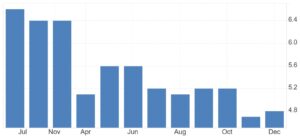

The India Employment Report, prepared by the International Labour Organisation and the Institute for Human Development, captures this imbalance clearly. India’s workforce is becoming more educated, but employment remains predominantly informal and low productivity. The erosion of the wage premium for general degrees is a signal the labour market is already sending.
READ I PLI scheme needs a jobs reset, not just exports success
Skills gaps are not the whole explanation
Employability surveys routinely attribute educated youth unemployment to poor skills. That explanation is convenient but incomplete. It assumes that graduate-level jobs exist in adequate numbers and remain vacant because candidates are unsuitable.
The data suggest otherwise. Even graduates with reasonable credentials from non-elite institutions face weak demand because the economy is not generating enough mid-skill, white-collar roles outside a small set of firms and cities. Skill deficits matter at the margin. They do not explain why unemployment is systematically higher among the educated.


Private estimates from the Centre for Monitoring Indian Economy reinforce this reading. Methodologies differ, but the direction is consistent: educated youth unemployment remains elevated, and job searches are lengthening. The problem is not placement efficiency. It is job availability.
READ I India unemployment data hides a job quality problem
Cost of educated youth unemployment
The consequences extend beyond labour statistics. Prolonged joblessness delays household formation and depresses consumption. It encourages credential inflation, as young people pursue additional degrees to compete for the same limited pool of jobs. It also sharpens inequality. Students from poorer households bear higher costs—tuition, debt, and lost income—for degrees that no longer deliver stable employment.
Over time, this weakens confidence in higher education as a channel of mobility. That erosion carries political and social risks, but its economic cost is more immediate. Idle educated labour is not neutral. It reflects foregone output and misallocated public and private investment.
Policy responses remain misaligned
Policy has addressed fragments of the problem without confronting its core. Skilling programmes focus largely on entry-level vocational roles rather than graduate pathways. Higher education reform emphasises expansion, accreditation, and institutional reclassification, with limited reference to labour market absorption. Industrial policy prioritises capital intensity and scale, often at the expense of employment elasticity.
What is missing is coordination. Educated youth unemployment cannot be reduced by education policy alone, nor by labour schemes that bypass educated workers. It requires aligning higher education capacity with sectors capable of absorbing graduates—healthcare, education services, urban infrastructure management, environmental services, and decentralised manufacturing ecosystems.
That alignment will demand trade-offs. Employment generation will need to matter alongside productivity and output growth. Without that shift, the economy will continue to produce degrees faster than it produces suitable jobs.
Educated youth unemployment is often discussed as a social concern or an electoral risk. It is more accurately read as an economic signal. When an economy fails to use its educated workforce, it reveals the limits of its growth model.
Those limits will not announce themselves dramatically. They will accumulate quietly—in lost earnings, delayed transitions, and declining returns to education. The data already point in that direction. Ignoring them will only raise the eventual cost of correction.