


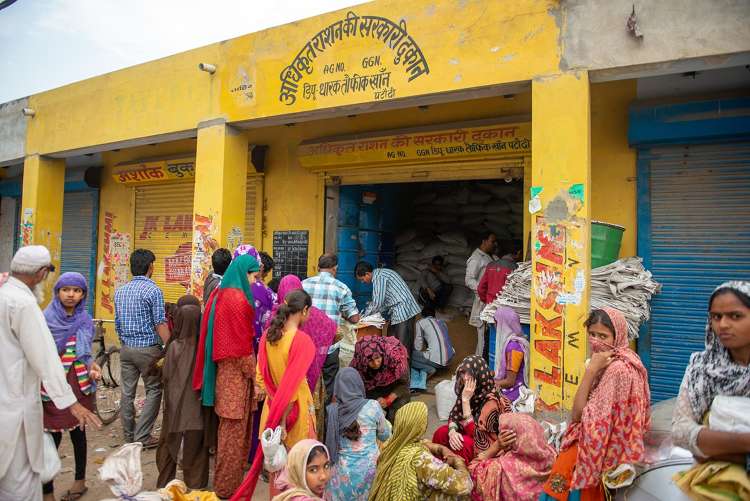
A welfare state is judged by how it protects the vulnerable. It is also judged by how it spends when money is tight. In India, that trade-off is sharpened by wide inequality and uneven access to public services. When subsidy bills swell without discipline, the first casualty is often the spending that reduces poverty over the long run viz health, education and infrastructure.
A joint study by the Asian Development Bank and PwC, submitted to the 16th Finance Commission, argues that India should move away from universal subsidies towards tightly targeted transfers, backed by stricter eligibility norms, sunset clauses and periodic audits.
READ I Budget 2026–27 signals slow return to fiscal discipline
Universal subsidies and development outlays
The study puts subsidies at roughly 7–10% of public expenditure—large enough to shape the quality of government spending, not just the size of deficits. The report’s core warning is familiar but still ignored: when subsidy commitments become open-ended, they crowd out capital expenditure and weaken the state’s capacity to invest in growth-enhancing sectors.
One complication is definitional. Not all subsidies sit neatly under budget heads. In power, large parts of the support are quasi-fiscal, pushed into discom losses, delayed payments and tariff under-recovery. In tax policy, concessions operate like subsidies but are recorded as revenue foregone. A subsidy overhaul that focuses only on explicit outgo will miss a material part of the fiscal story.
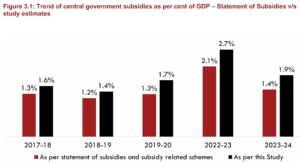

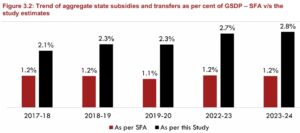

The post-pandemic path shows why this matters. At the Centre, subsidies peaked at about 2.7% of GDP in 2022-23 before moderating to around 1.7% in 2024-25 (revised estimates). State-level subsidies, however, have continued to rise—from about 2.1% of GSDP in 2017-18 to roughly 3% in 2024-25. Higher subsidy bills constrain the government’s ability to invest in growth-enhancing sectors.
The study flags a positive correlation between higher subsidies and wider revenue deficits at the state level. States that spend more on subsidies often have fewer resources left for capital expenditure. While consumption spending rises, development spending stagnates. Over time, this leads to a weakening of the quality of public expenditure. In India’s federal fiscal framework where states carry the bulk of responsibility for sectors such as health, education and agriculture, this imbalance can have long-term developmental consequences.
READ I Budget 2026: The hidden costs of India’s fiscal consolidation
Food, fertiliser and electricity subsidies
The case for a subsidy overhaul is strengthened by composition. At the central level, food and fertiliser subsidies together account for more than 70% of total outgo. Despite years of being in existence, there is continued reliance on large-scale price support and public distribution systems (PDS). At the state level, electricity subsidies, financial assistance schemes, pensions, subsistence support and food subsidies together make up a large share of total subsidy spending.
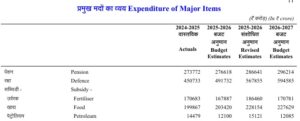

A newer state-level problem is now hard to ignore. Unconditional cash transfers are no longer marginal: they account for about one-fifth of state subsidies, and the 16th Finance Commission’s discussions have already turned to exit clauses to prevent such schemes from becoming permanent liabilities by default.
Power-sector reforms and Finance Commission
In several states, free or highly subsidised electricity results in higher-consumption households receiving a disproportionate share of benefits. Consumption-based subsidies without targeting tend to become regressive over time because households with greater consumption capacity naturally capture a larger share of the subsidy. Similarly, some income-support schemes designed as universal subsidies dilute efficiency by extending benefits to households that may not require them.
Reform of electricity subsidies is emphasised in the report. Power sector losses, tariff distortions and free electricity commitments have strained state finances and weakened discom balance sheets. The government must look at incentivising power-sector reforms through Finance Commission-linked fiscal incentives. States must be encouraged to gradually move toward targeted electricity support such as direct transfers to small farmers or low-income households.
Leakages, list revision and exclusion
Leakages continue to exist in certain subsidy channels. Food subsidies, for instance, still show inclusion errors, particularly in relatively wealthier regions where household income growth has outpaced beneficiary list revisions. These inefficiencies not only waste resources but weaken the credibility of welfare systems by diverting funds away from the poorest households.
But tighter targeting has its own failure mode. When eligibility becomes stricter and authentication becomes mandatory, exclusion errors rise in salience—missing names, outdated lists, failed authentication and weak grievance redress. If the argument is for sharper eligibility, the administrative safeguards must be equally explicit, or the reform will be judged by the denials it produces, not the leakage it prevents.
DBT and the promise of digital welfare
A pivot towards targeted transfers via Aadhaar-linked systems and direct benefit transfers (DBT) is presented as the better route. Over the past decade, India has built digital public infrastructure that combines identity verification, financial inclusion and mobile connectivity, enabling beneficiary targeting at a scale few countries have achieved.
Expanding DBT coverage across more schemes can reduce duplication, eliminate ghost beneficiaries and allow periodic updating of eligibility lists based on changing socioeconomic conditions. If the government is able to plug gaps, even modest improvements can translate into significant savings.
Sunset clauses, audits and impact assessments
The government can also introduce sunset clauses and mandatory impact assessments for new subsidy programmes. In India, subsidies are often launched due to populism or other pressures and are rarely phased out even after their original purpose has faded. Sunset clauses will entail automatic expiration dates and require policy review before extension. This can ensure that schemes remain aligned with current economic needs. Ex ante and ex post evaluations can provide evidence on whether programmes are achieving their intended objectives and allow governments to redesign or discontinue underperforming schemes.
There is also the possibility of introducing performance-linked or conditional transfers, where benefits are tied to measurable outcomes such as school attendance, maternal health check-ups or skill certification. Conditional cash transfers are already used in programmes such as the Janani Suraksha Yojana and can align public spending with developmental outcomes. The logic is simple: if the government is spending, it must translate into immediate welfare gains and long-term human capital improvements.
The politics of subsidy reform cannot be ignored. Subsidies are social contracts between governments and citizens, especially when they are central to electoral competition. Abrupt withdrawal of universal subsidies without credible alternatives can generate political resistance and social anxiety. The next stage of reform is not reducing welfare commitments but improving their precision and accountability while supporting the vulnerable and preserving the sustainability of public finances.