


India’s PLI schemes had reached 76% of their investment target by March 2026, while delivering 28% of the jobs envisaged over their full tenure. An assessment released by NITI Aayog on November 12 and prepared with IIM Ahmedabad puts employment at 8.49 lakh across the 14 schemes, against a target of about 30 lakh. Investment reached ₹2.40 lakh crore, while production and sales reached ₹22.66 lakh crore, or 64% of target. Several schemes still have years to run. Even so, the gap between investment and hiring raises a question for the next phase of industrial policy. Where can public incentives do the most to create manufacturing jobs?
The PLI programme had an attractive proposition when it began in 2020. By linking incentives to production, the government could encourage companies to manufacture more in India, reduce dependence on imports and make industry a bigger source of employment. By March 2026, the government had disbursed ₹35,354 crore, about 19% of the approved ₹1.91 lakh crore outlay. That figure measures payouts to date against the budget for the full programme. The employment figures pose a different problem. New factories can raise output substantially while absorbing relatively few of the workers looking for more productive jobs outside agriculture.
READ | PLI scheme needs a jobs reset, not just exports success
Why PLI investment and hiring move at different speeds
A battery cell plant and a garment factory have different capital requirements and hiring needs. A battery project may take years to reach commercial production, while a garment factory needs workers on the floor as orders come in. The assessment notes that 578 months had elapsed out of a combined implementation period of 996 months. With 42% of the aggregate scheme duration still to run at the March cutoff, judging every industry against its final target would be premature. Equally, that aggregate tells policymakers little about which projects should already be hiring. Progress is better judged against each scheme’s commissioning and hiring milestones.
There are sound reasons to back advanced manufacturing. India may want battery capacity for strategic reasons even if it generates fewer jobs per rupee invested than garment manufacturing. Where employment is the aim, however, the choice of industry matters. A December 2025 study by the National Council of Applied Economic Research argued that directing more attention to textiles, garments, footwear and food processing could generate more jobs. The PLI assessment offers a reason to take that argument seriously. Food products were among the schemes broadly on track across key indicators.
READ | PLI scheme for batteries falters as companies miss deadlines
Mobile phone exports and domestic value addition
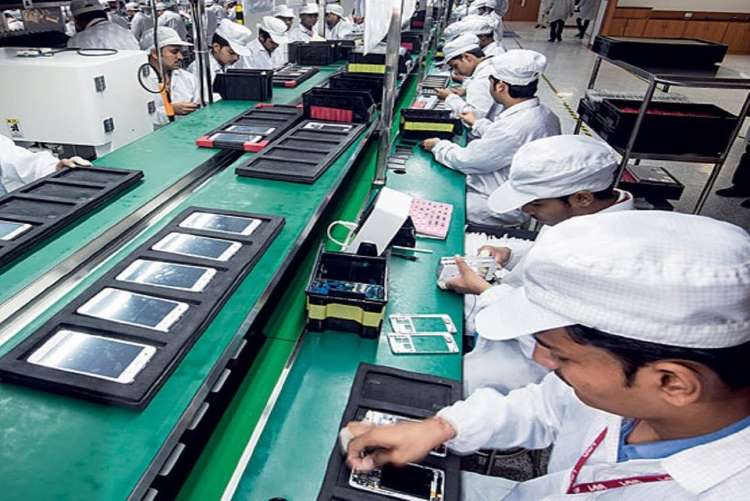
Mobile phones show what manufacturing at scale can achieve. India’s mobile phone exports rose from about ₹27,000 crore in 2019–20 to ₹2 lakh crore in 2024–25, according to the Ministry of Electronics and Information Technology. The large-scale electronics scheme was among the stronger performers in the assessment. The export gains give component makers a larger market in India, provided they can meet the price and quality requirements of phone manufacturers.
The export value of a phone includes the cost of its imported parts. As assembly expands, the industrial gains depend in part on how much of the work involved in making components can be done competitively in India. That is where smaller manufacturers come in. A large company can expand output and qualify for an incentive while its potential Indian suppliers still need equipment, testing and time to win their first orders. Supplier development should be judged by whether those firms secure repeat orders on commercial terms.
READ | PLI scheme @5: India’s manufacturing gamble needs a strategic reset
What the next phase of PLI should reward
The assessment found that large-scale electronics, pharmaceuticals, telecom and networking products, and food products were broadly on track across key indicators. The weaker results varied by scheme. Bulk drugs lagged on exports, medical devices on employment, and IT Hardware 2.0 on investment. Those gaps call for different responses. A larger payout tied to production may do little for a medical devices scheme whose weakness is hiring.
The next round of incentives should make clear what the government expects from each industry. Where jobs are the priority, firms receiving support should report how many workers they hire and retain. Where the aim is to build a domestic supply chain, the government should track what manufacturers source from Indian suppliers and how much value is added here. India has good reasons to finance some capital-intensive projects. It should be equally deliberate about backing industries that can put more people to work.