



Kerala ageing population: The world has conventions on women, children and persons with disabilities. It still has no binding UN treaty devoted to the rights of older persons. That gap is becoming harder to defend. By 2030, one in six people will be aged 60 or above, and the global population in this age group will rise to 1.4 billion. The number of people aged 80 and above will grow even faster.
The UN system has now moved beyond discussion. On April 3, 2025, the Human Rights Council adopted Resolution 58/13, creating an open-ended intergovernmental working group to draft a legally binding instrument on the human rights of older persons. The resolution was presented by Argentina, Brazil, The Gambia, the Philippines and Slovenia, and adopted by consensus.
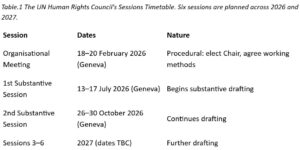
The first substantive session of the working group will be held in Geneva from July 13 to 17, 2026. A second session is scheduled for October 26 to 30, 2026. The Office of the High Commissioner for Human Rights has already called for inputs on the framework, architecture and guiding principles of the proposed instrument.
Kerala should not treat this as a remote Geneva process. It is India’s most advanced ageing society. It has also taken the first steps towards a state-level rights architecture for older persons. The question is whether Kerala can turn demographic pressure into institutional leadership.
READ I India’s ageing population demands a universal pension plan
Kerala ageing population and the rights gap
Kerala’s ageing is not a sign of failure. It is the result of its own development success: longer life expectancy, lower fertility, higher literacy and better public health. But the same success has created a new policy frontier.
The state has moved faster than most of India. It has enacted the Kerala State Elderly Commission Act, 2025, creating a statutory commission for the welfare, protection, rehabilitation and rights of older persons. The state’s Social Justice Department describes Kerala as the first Indian state to establish such a commission.
This matters. India’s national framework still rests largely on the Maintenance and Welfare of Parents and Senior Citizens Act, 2007. That law places enforceable duties on children and heirs. It is important, but narrow. It treats elder welfare mainly as a family obligation, not as a full rights question involving autonomy, non-discrimination, care, income security, participation and protection from abuse.
Kerala’s new commission can investigate complaints, support legal aid, coordinate rehabilitation and issue guidelines. But its effectiveness will depend on funds, staffing, political backing and cooperation across departments. A commission without implementation power becomes another advisory layer.
The wider policy challenge is already visible. Kerala’s elderly face abuse, property disputes, abandonment, widowhood poverty, social isolation, digital exclusion and uneven access to geriatric and palliative care. Out-migration has weakened family support systems. Many older women spent their working lives in unpaid or informal work and therefore remain outside contributory pension systems.
These are not isolated welfare problems. They are rights questions.
READ I Kerala’s ageing crisis needs a governance reset
UN convention on older persons
The proposed UN convention could change the terms of debate. Existing human rights instruments protect everyone in principle, but older persons are rarely named. Age discrimination is not treated with the same clarity as sex, race or disability discrimination.
That legal silence has consequences. It weakens advocacy on age-based exclusion in employment, healthcare, housing, financial services, digital access and public schemes. A convention would not solve these problems by itself, but it would create a common standard against which governments can be measured.

The 2025 report of Claudia Mahler, the UN Independent Expert on the enjoyment of all human rights by older persons, is relevant here. The mandate itself was created by the Human Rights Council in 2013; Mahler has held it since 2020. Her 2025 report examines the intersection between older persons’ right to social protection and their right to work.
Its central point is sharp: poverty in old age is often the accumulated result of lifelong disadvantage. Poor education, informal work, unpaid care, gender inequality, weak pensions and ageist labour markets converge at retirement. This has direct relevance for Kerala, where older women form a large and vulnerable group.
A convention could push states to move beyond family-based welfare. It could require laws against age discrimination, stronger social protection floors, rights-based long-term care, participation of older persons in policy design, and better protection during disasters and climate shocks.
READ I The ageing truth: Care and policy for India’s silver future
India’s cautious stance
India has not been at the front of the campaign for a binding convention. It did not co-sponsor the April 2025 Human Rights Council resolution. But the new working group is open-ended, which means all UN member states can participate.
India has strong reasons to engage. Its elderly population is already large and will grow rapidly in the coming decades. The domestic framework has serious gaps: weak enforcement of maintenance orders, inadequate geriatric care, low pension adequacy, poor age-disaggregated data, and no comprehensive national law against age discrimination.

A treaty process can help India frame these issues before they become unmanageable. It need not be seen as an external burden. It can become a policy discipline: requiring governments to report, measure, consult and correct.
Kerala can help shape that position. It has demographic experience, local government capacity, civil society networks, palliative care models and now a statutory commission. These are precisely the assets the Global South needs to bring into the drafting process.
Kerala’s policy test
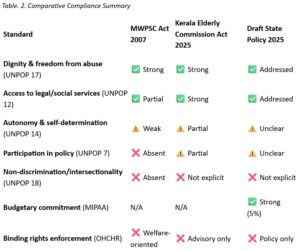
Kerala’s laws and policies show partial alignment with global standards. The Maintenance and Welfare of Parents and Senior Citizens Act addresses neglect and maintenance. The Kerala Elderly Commission Act creates a dedicated institution. The state’s revamped senior citizens’ policy, approved in 2026, emphasises dignity, active ageing, integrated healthcare, social inclusion, grievance redress and age-friendly systems.
But three gaps remain.
First, autonomy is underdeveloped. Older persons must be treated as rights-bearing individuals, not only as dependants within families.
Second, non-discrimination is not explicit enough. Ageism, gender, disability, caste, widowhood, poverty and digital exclusion intersect. Policy must name these disadvantages before it can address them.
Third, implementation remains the weak link. Kerala has often announced progressive social policies before building the administrative machinery to deliver them. Elder care will require money, trained personnel, data, local institutions and grievance systems that work outside the capital.
The 2026 Kerala budget’s dedicated elderly component is a useful step. It reportedly identifies expenditure across healthcare, pensions, infrastructure, palliative care and senior support programmes. But budget tagging must lead to outcomes, not just classification.
Civil society and academics
The next opportunity is immediate. The July and October 2026 IGWG sessions will shape the first substantive contours of the treaty. Kerala’s civil society, universities, public health experts and elder rights groups should submit evidence.
Their strongest contribution will not be rhetoric. It will be documentation: cases of elder abuse, pension inadequacy, digital exclusion, gaps in palliative care, the situation of widowed women, informal workers, older persons with disabilities, and elders living alone because of migration.
The Kerala Elderly Commission can also become a source of evidence. It should publish complaints data, identify recurring violations, recommend changes to state rules, and prepare the ground for a periodic State of Elderly Report.
Academics should map Kerala’s laws against the UN Principles for Older Persons, the Madrid International Plan of Action on Ageing, and the emerging convention process. Public health institutions should treat ageism as a determinant of health. Law schools should bring elder rights into teaching on equality, dignity, social security and access to justice.
Civil society should also press New Delhi to participate actively in the IGWG. India’s position should not be limited to observing. It should argue for a convention that is ambitious, but sensitive to developing-country realities: informal work, family-based care, fiscal constraints, rural ageing and climate vulnerability.
Kerala’s opportunity
Kerala cannot stop ageing. Nor should it want to. Longer lives are a mark of social achievement. The task is to ensure that longer life does not mean longer insecurity.
The proposed UN convention gives Kerala a rare opening. It can show that elder policy in the Global South need not be charity, nor only family duty. It can be built on rights, local government, public health, gender sensitivity and community care.
That will require restraint as well as ambition. Kerala does not need another grand declaration. It needs enforceable standards, credible data, funded programmes and older persons at the table.
If it does that, Kerala can shape India’s national response and contribute meaningfully to the UN treaty process. Its ageing society can then become not a warning, but a working model.