


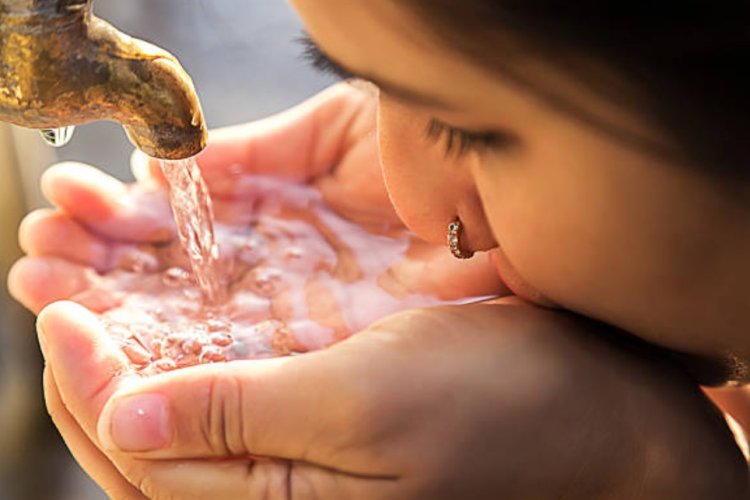
Water scarcity is among India’s most discussed crises. The more basic failure is less often confronted: millions still cannot rely on a safe glass of drinking water.
World Bank data show that 76% of Indians used safely managed drinking water services in 2024. That leaves roughly one in four citizens outside the assurance of safe, accessible and reliable drinking water. For the world’s most populous country, this is not only an infrastructure gap. It is a public health risk.
Union minister for Jal Shakti C R Patil recently launched the ninth edition of India International Water Week, scheduled for September, with climate-resilient water management as its theme. The choice is apt. India’s water challenge is no longer only about expanding tap connections. It is about ensuring that the water reaching households is fit to drink.
READ | Jal Jeevan Mission complaints expose governance strain
Safe drinking water gap persists
India has narrowed the rural-urban divide in water access over the past decade. Urban areas, where piped networks and municipal treatment systems are more established, have reached much higher access levels. Rural India has also seen rapid expansion of tap connections under the Jal Jeevan Mission.
The government says that, as of March 3, 2026, 15.82 crore of India’s 19.36 crore rural households had tap water supply, compared with 3.23 crore households when the mission began in 2019. That is a major achievement in physical access.
But access is not the same as safety. A household tap does not guarantee potability. Water can be contaminated at the source, during storage, through damaged distribution lines, or by poor treatment and maintenance. The next phase of India’s drinking water policy must therefore move from connection counts to verified water quality.
Jal Jeevan Mission needs a quality test
The Jal Jeevan Mission has changed the scale of rural water delivery. Its objective is to provide safe and adequate drinking water through individual household tap connections, while also making source sustainability measures such as recharge, rainwater harvesting and greywater management part of the programme design.
The harder task begins after the pipeline is laid. Groundwater depletion, contamination and weak local maintenance can undo capital expenditure. NITI Aayog’s Composite Water Management Index had warned that 54% of India’s groundwater wells were declining. It also flagged severe stress in major cities, although the government later clarified that the warning about 21 cities running out of groundwater by 2020 was based on annual replenishment and extraction estimates and did not account for deeper aquifers.
This matters because drinking water systems in many parts of India remain heavily dependent on groundwater. Declining aquifers raise costs, increase dependence on deeper sources, and worsen the risk of chemical contamination.
READ | Jal Jeevan Mission faces credibility crisis in rural India
Groundwater contamination a hidden risk
Improved pipes and protected wells reduce exposure, but they do not eliminate risk. Biological pathogens, industrial pollutants, and naturally occurring contaminants such as arsenic and fluoride continue to affect water supplies in several states. West Bengal, Bihar, Rajasthan and parts of Karnataka have long faced such problems.
For households, this creates a familiar contradiction. A tap may exist, but the water may still be boiled, filtered, avoided, or supplemented by tanker supply. The cost is transferred from the state to the household. Poorer families pay twice: first through public expenditure on water schemes, and then through private spending on filters, fuel, healthcare or bought water.
Water governance adds another layer of weakness. Policy and funding come from the Union government. Implementation rests with states and local bodies. Testing, repair, chlorination, source protection and grievance redress depend on local capacity. Many panchayats and urban local bodies lack the technical staff and funds to maintain reliable systems. Where monitoring is irregular, contamination is detected late, if at all.
The sharper policy test is functionality. A tap connection must be judged not by its existence, but by whether it delivers adequate water at regular intervals and of tested quality. The government has created the Jal Jeevan Mission Water Quality Management Information System, and the public health engineering and rural water supply departments operate 2,870 water quality testing laboratories, as reported on February 4, 2026. States have also trained about 24.80 lakh women to use field-testing kits as of March 12, 2026. These are useful steps.
They also show the size of the task. Water quality monitoring must become routine, public and enforceable. A village or ward should not have to wait for a disease outbreak before contamination is detected. India’s next water mission must move from counting assets to guaranteeing service.
Climate-resilient water management is now central
Climate change is aggravating both water availability and water quality. Erratic rainfall, longer dry spells, intense floods and heat stress are no longer exceptional events. Floods can contaminate surface and groundwater sources with sewage, chemicals and waste. Droughts reduce dilution and concentrate pollutants in shrinking sources.
This is why climate-resilient water management cannot remain a conference slogan. It must shape project design. Treatment plants, storage systems, aquifer recharge, drainage, sewage treatment and flood protection have to be planned together. A drinking water scheme that ignores local hydrology will not be durable.
Urban India shows the risks clearly. Delhi, Bengaluru and Chennai have all faced severe water stress. Rapid urbanisation has increased demand faster than supply systems, lakes, aquifers and sewage networks can handle. Ageing pipelines and inadequate sewage treatment raise the risk of cross-contamination. In many cities, water security now depends on tankers, borewells and distant transfers.
The problem is not merely shortage. It is reliability. A city can have a network and still fail to deliver safe water every day. Intermittent supply allows contaminants to enter pipelines when pressure drops. Old drains and water lines often run close to each other. Without continuous monitoring and repair, safety remains uncertain.
Rural water security needs maintenance
Rural India faces a different challenge. The Jal Jeevan Mission has expanded household connections, but many villages still depend on overdrawn aquifers or seasonal sources. Newly created assets can deteriorate quickly if pumps fail, pipes leak, tariffs are not collected, or water quality is not tested.
Community management is essential, but it cannot be romanticised. Village water and sanitation committees need training, funds and technical support. Local institutions can monitor use and report breakdowns, but they cannot be expected to solve fluoride, arsenic, salinity or aquifer depletion without state support.
This is where policy must shift from construction to service delivery. The relevant metric is no longer whether a tap exists. It is whether water is available in adequate quantity, at regular frequency, and of tested quality. That requires recurring expenditure, not just capital expenditure.
READ | Jal Jeevan Mission may help govt allay quality concerns about piped water
Waterborne disease is an economic cost
Unsafe drinking water increases the burden of diarrhoea, cholera, typhoid and other waterborne diseases. These illnesses damage health, reduce school attendance, cut workdays and add pressure on public health systems. The poor bear the highest cost because they are more likely to depend on unsafe sources and less able to absorb healthcare expenses.
The economic loss is wider than household distress. Illness and absenteeism reduce productivity. Women and children lose time collecting water or managing sickness. Small firms and informal workers suffer when water stress disrupts daily life. Safe drinking water is therefore not a welfare add-on. It is basic economic infrastructure.
India needs larger investments in water treatment, but the investment must be better targeted. Urban areas need upgraded treatment plants, continuous supply systems, leakage control and sewage separation. Rural areas need community filtration, household-level solutions where appropriate, and source-specific treatment for arsenic, fluoride, iron, salinity and bacterial contamination.
Low-cost technologies such as membrane filtration, chlorination systems and solar disinfection can help, but technology is not a substitute for governance. A filter that is not maintained fails. A treatment plant without trained operators becomes another stranded asset.
India’s dependence on groundwater also has to be reduced. Rainwater harvesting, watershed management, aquifer recharge and wastewater reuse must move from scattered initiatives to routine planning. Source sustainability should be treated as part of drinking water policy, not as an environmental add-on.
The persistence of a large population without assured safe drinking water shows that India’s water mission remains incomplete. The first phase expanded access. The next phase must guarantee safety. A tap connection is progress. A safe, reliable glass of water is the test.