


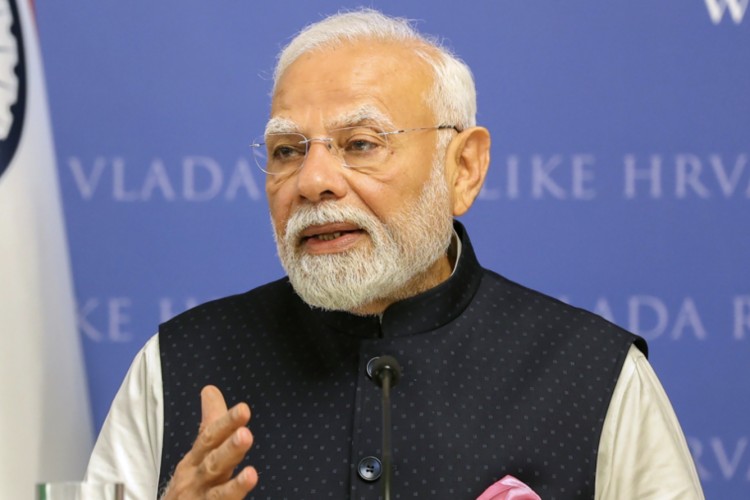
India’s current account deficit: India’s 7.8% GDP growth in the April-June quarter gave the government reason to celebrate. PM Narendra Modi used the occasion to renew his swadeshi appeal, asking Indians to buy domestic products, avoid unnecessary gold purchases, holiday at home and hold weddings in India rather than abroad.
The appeal has some economic logic. India faces a more difficult external environment, particularly because the West Asia conflict has pushed up its energy bill. Yet household austerity can do only so much. India will strengthen its external position mainly by earning more foreign exchange, through exports of goods and services, tourism and sustained capital inflows.
READ | Capital goods imports test India’s self-reliance push
Forex pressure is genuine
India is heavily dependent on imported crude oil, fertilisers, electronics, machinery and industrial inputs. The vulnerability is clearest in energy. Its energy import bill rose 26% to $49 billion in the June quarter despite an 18% fall in import volumes. High crude prices turned fewer barrels into a much bigger bill.
The balance-of-payments numbers carry the same message. The current account deficit widened to $4.2 billion, or 0.5% of GDP, in the first quarter of FY27. The merchandise trade deficit rose more sharply, from $68.9 billion to $86.1 billion. Net services receipts of $51.6 billion and personal transfers of $42.9 billion prevented the goods deficit from producing a much larger current account deficit.
There is no balance-of-payments crisis. Foreign exchange reserves reached a record $729.3 billion in August, helped by the RBI’s measures to attract foreign-currency deposits. The central bank nevertheless remains active in the currency market. Its net short forward position rose to a record $136.7 billion in July, although much of the increase reflected swaps associated with the drive to attract overseas deposits rather than conventional defence of the rupee.
So the concern over foreign exchange is justified. The question is whether exhorting households to change their spending habits offers a durable answer.
Gold and travel can help, but only so far
Foreign travel does result in a foreign-exchange outflow. The travel account showed a net outflow of $3.4 billion in the June quarter. That is hardly irrelevant when the current account deficit itself was $4.2 billion. More Indians holidaying at home and more foreign tourists spending money in India would improve the services balance.
The weakness lies in treating such restraint as economic strategy. People travel abroad because their incomes permit it and because other countries offer experiences they want to buy. A government can ask them to stay home for a period of exceptional stress. It cannot build a strong external account around the assumption that rising Indian incomes should not translate into rising demand for foreign services.
READ | India GDP growth: Private capex is the real test
Gold presents a bigger problem. Imports rose 32.4% to $15.2 billion during April-July. The government therefore had stronger grounds for acting on gold than on holidays. On May 13, it raised the import duty from 6% to 15%, the steepest increase on record.
But India has run this experiment before. High duties widen the gap between domestic and international prices, making smuggling more profitable. After the May increase, Reuters reported grey-market discounts of more than $200 an ounce and industry estimates that illicit imports could exceed 100 tonnes this year. Formal imports may fall while some demand simply moves outside the customs system.
Nor is Indian demand for gold simply frivolous consumption. Weddings and festivals account for part of it, while households also buy gold as savings. The World Gold Council estimates that Indian demand was 131 tonnes in the June quarter, 6% lower than a year earlier. Yet spending reached a Q2 record of ₹1.98 trillion because prices were so high. Wedding and festive demand has proved relatively resistant to both prices and government appeals.
Self-reliance depends on competitiveness
The larger problem with the swadeshi argument begins when a sensible preference for building domestic capacity turns into an indiscriminate preference against imports.
Consumers will buy Indian products when they offer the combination of price, quality and availability they want. More important, a large part of India’s import bill does not consist of consumer products that households can patriotically refuse. Indian factories import machinery, components, technology and raw materials because they need them to produce.
This distinction becomes particularly important when investment is accelerating. Manufacturing GVA grew 9.2% in the June quarter, while gross fixed capital formation rose 11.9% in real terms. Cutting firms off from internationally competitive capital goods at such a moment could make domestic industry less productive rather than more self-reliant.
Import substitution makes economic sense where Indian firms can eventually compete without permanent protection. It becomes expensive when tariffs and controls allow inefficient producers to charge consumers more while using inferior technology. India tried that model for decades before 1991.
A useful test for swadeshi is therefore straightforward: does a policy help Indian producers become internationally competitive? If it does, domestic production can replace imports and create exports. If it merely keeps foreign competition out, the foreign-exchange saving may come at the cost of productivity.
READ | India’s basmati exports boom faces a West Asia problem
Growth must generate foreign exchange
The Prime Minister’s call contains one particularly useful idea: Indians need not spend every additional rupee of income abroad. Yet the larger objective should be to give foreigners more reasons to spend in India and buy from Indian companies.
That requires better tourism, stronger manufacturing and larger exports of sophisticated services. India already demonstrates the importance of the last of these. Services earnings and remittances are the reason an $86.1 billion merchandise trade deficit produced a current account deficit of only $4.2 billion.
A growing economy will import more energy, machinery, components and technology. Trying to suppress all such imports would constrain growth itself. The more sustainable course is to raise the economy’s capacity to pay for them.
Japan, South Korea and China built powerful domestic industries while using foreign markets, imported technology and international investment. Their success came from acquiring capabilities and then selling competitively to the world. Self-reliance was an outcome of industrial strength, rather than economic withdrawal.
India’s 7.8% growth therefore offers a reason for confidence, but also a test. The economy has to convert rapid domestic growth into greater export capacity. Persuading a family to postpone a holiday can conserve some dollars this year. Building firms capable of selling higher-value goods and services across the world will earn them for decades.