



India must raise education spending: India’s education system is again under scrutiny as recent budget discussions and state expenditure data highlight a persistent gap between aspirations and actual investment. Learning deficits remain wide even as the economy expands, and the labour market demands stronger foundational and digital skills. The latest updates from the ministry of education and international databases such as the World Bank’s EdStats confirm that India’s public spending on education has stayed below 3 per cent of GDP for several years, well short of the 6 per cent benchmark articulated in national policy.
This shortfall matters now because demographic pressures are intensifying, with more than 250 million school-age children requiring consistent quality improvements. The core argument is straightforward: inadequate and uneven public financing is constraining India’s human-capital formation and weakening its long-term growth prospects.
READ | Judicial independence: Why India needs a fresh reform push
Low spending and the learning crisis
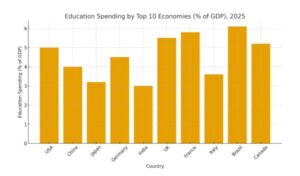
India allocates a smaller share of national income to education than many economies at a similar stage of development. A CII study shows that Sweden spends 6.7–6.9 per cent of GDP, the United Kingdom 5.3–5.6 per cent, and Indonesia and Thailand over 4 per cent. India remains stuck below 3 per cent. This chronic underinvestment has clear consequences. World Bank data show that India’s Learning Poverty — the share of 10-year-olds unable to read a simple text — remains above 55 per cent, far higher than East Asia’s average. These gaps reflect inadequate spending on teacher training, school infrastructure, digital classrooms, and early-childhood programmes.
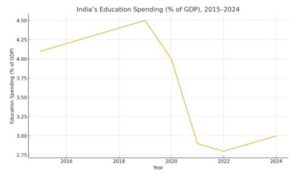

The National Education Policy (NEP) 2020 recognises these weaknesses and recommends public expenditure at 6 per cent of GDP. However, the fiscal commitment has not followed. The centre and states continue to prioritise revenue expenditure over long-term human-capital formation. Without structural correction, India risks slower productivity growth and weaker competitiveness in a knowledge-driven global economy.

Federal fragmentation and inequitable outcomes
Public spending on education is fragmented across levels of government. States account for nearly 85 per cent of total expenditure, according to the Reserve Bank of India’s State Finances Report. Yet state budgets vary widely. Kerala, Himachal Pradesh, and Odisha spend more than 15 per cent of their budgets on education, while several large states remain below 12 per cent. The result is uneven access to quality schooling. MoSPI data show that states with higher per-student spending record better learning outcomes and lower dropout rates.
Fiscal constraints further limit the ability of poorer states to invest in teachers, digital infrastructure, and skilling programmes. The Finance Commission has highlighted the need to link intergovernmental transfers to educational performance, but implementation remains partial. The federal structure demands stronger coordination between the centre and states, particularly on financing norms, vocational training, and monitoring frameworks. Without predictable funding and shared accountability, NEP 2020’s outcomes will remain aspirational.
READ I Higher education: How to turn scale into quality
Global benchmarks and India’s aspirational gap
International comparisons reveal India’s challenge. UNESCO data show that Bhutan spends 7.5 per cent of GDP, Kazakhstan 7.2 per cent, and Uzbekistan 5.2 per cent — all higher than India. Even China, despite slower growth in spending, operates a school system with stronger teacher support and better learning assessment systems. OECD countries invest heavily in early-childhood education because evidence shows that each dollar spent generates high returns in future productivity.
The IMF’s Fiscal Monitor emphasises that human-capital outlays improve long-term growth more reliably than subsidies or tax incentives. India’s ambition to become a $10-trillion economy by the early 2030s depends on a workforce equipped with cognitive, digital, and vocational skills. Underinvestment in education weakens that foundation. With public debt stabilising and revenue buoyancy improving, the window for recalibrating spending priorities is open. A shift towards human-capital-driven development is not only desirable but essential.
READ I How nations use education policy to shape identity
Digital and vocational education need stable funding
The NEP 2020 framework prioritises digital literacy, multidisciplinary learning, and vocational education. These reforms require predictable financing, especially for teacher development, broadband access, and district-level skilling centres. India’s digital divide remains significant. According to the National Sample Survey, only one in three rural households has internet access. The pandemic revealed how unequal digital access can widen learning gaps. Countries that invested early in digital systems — such as Australia, which increased education spending by 8% — managed the transition better.
India must now scale blended-learning models, develop regional learning platforms, and equip teachers with digital tools. Vocational education also demands higher investment. Only about 5 per cent of India’s workforce has formal vocational training, compared to 52 per cent in the United States and 75 per cent in Germany. A more skilled workforce will enhance competitiveness in manufacturing, services, and the green economy.
India’s education challenge is financial, structural, and institutional. Spending has not kept pace with global standards or domestic needs. Learning deficits persist, digital access remains uneven, and vocational training is limited. These weaknesses have serious economic implications: slower productivity growth, weaker employability, and reduced competitiveness.
India must raise education spending to at least 6 per cent of GDP and ensure predictable intergovernmental transfers. Resources must be directed toward foundational learning, early-childhood care, teacher development, and digital infrastructure. A sustained financial commitment is essential to realising the country’s demographic dividend. Human-capital investment will determine India’s ability to expand opportunities, accelerate growth, and strengthen global competitiveness.