


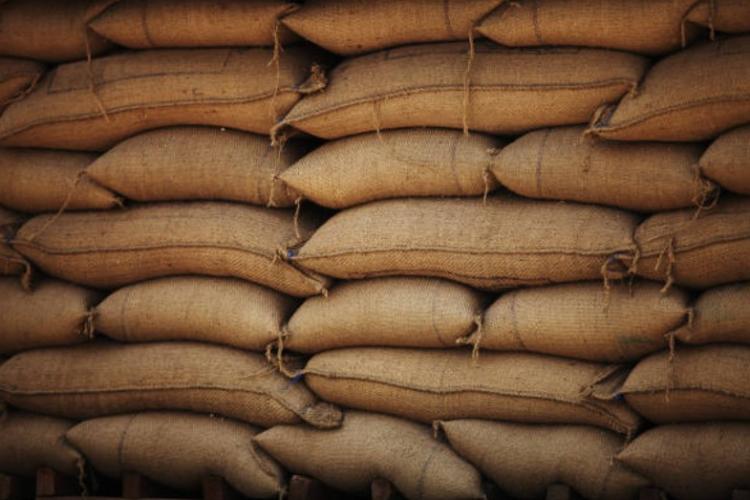
India food procurement policy: India’s granaries are overflowing. On January 27, 2026, central pool stocks stood at 33.15 million tonnes of rice and 26.10 million tonnes of wheat, against a combined buffer norm of 21.41 million tonnes for January 1. India is not facing a cereal shortage. It is carrying a cereal surplus. That is no small distinction. It suggests that a food security system built to prevent scarcity is now producing excess, with rising fiscal and ecological costs.
India’s food economy rests on public procurement and distribution. The state buys rice and wheat at the minimum support price, stores them largely through the Food Corporation of India, and distributes grain through the public distribution system. The arrangement has helped stabilise prices and prevent hunger. But it has also created a habit of accumulation.
READ | Can digital food currency address PDS design flaws
Open-ended procurement lies at the heart of the problem. If farmers bring rice or wheat that meets quality norms, public agencies buy it. That protects farm income. It also weakens any discipline between what the state needs for the PDS and buffer stocks, and what it keeps acquiring. The result is visible in the stock numbers.
That excess is expensive. Food subsidy remains among the Union government’s largest expenditure items. The subsidy does not cover only cheap grain for beneficiaries. It also covers storage and buffer-holding costs. The economic cost of grain includes MSP, handling, transport, storage and carrying charges. Once stocks stay well above norms, the state is paying not only for food security, but also for inertia.
NFSA demand and cereal-heavy food security
The stock problem is usually discussed as a procurement problem. It is also a distribution problem. The National Food Security Act still covers up to 75% of the rural population and 50% of the urban population, based on the 2011 Census, with around 80.60 crore persons currently covered. That is a vast safety net. It may still be necessary in a country with deep poverty and income volatility. But it also means the demand side of the system is tied to an old population base and a cereal-first design.
This is where the distinction between food security and nutritional security matters. A system that guarantees rice and wheat at scale can prevent hunger. It cannot by itself solve deficiencies in protein, fats and micronutrients. India has cereal abundance, but it still depends heavily on imports of pulses and edible oils. That is why the present system looks increasingly misaligned with current needs.
READ | India’s food waste is turning into an environmental time bomb
MSP incentives have locked in the rice-wheat cycle
The bigger distortion lies in incentives. In Punjab and Haryana, assured procurement at MSP has entrenched the rice-wheat cycle for decades. Farmers are responding rationally. The state has made these crops the lowest-risk choice.
That logic now shapes the structure of production. Wheat procurement remains heavily concentrated in a handful of states. In the 2025-26 rabi marketing season, Punjab, Haryana and Madhya Pradesh alone accounted for most of the procurement reported by the Centre. Once that procurement system hardens, it creates its own constituency: farmers, commission agents, state agencies and political parties all become invested in its continuation. Reform, then, is not only an economic question. It is a political one.
Ecological stress is now built into procurement policy
The ecological cost is no longer incidental. Paddy is water-intensive, and its expansion in north-western India has deepened pressure on already stressed aquifers. The problem is not confined to groundwater depletion. The rice-wheat cycle also reinforces power subsidies, encourages inefficient input use, and leaves states trapped in a production model that is harder to defend each year.
The point is not that procurement caused all ecological stress. It is that public policy keeps rewarding the pattern that worsens it.
Crop diversification is the obvious answer, but not an easy one
The case for diversification is straightforward. India remains structurally short of pulses and oilseeds. Government itself now speaks of reducing import dependence in both. Pulses are less water-intensive than paddy in many regions, and they improve soil health through nitrogen fixation. Oilseeds matter for import substitution. On paper, the shift is obvious.
In practice, diversification has repeatedly stalled. Farmers do not move out of rice and wheat because economists urge them to. They move when the alternative offers comparable price assurance, procurement credibility, local mandi depth, storage, processing and market access. Those conditions are still weak for many crops. That is why appeals to diversify have produced more rhetoric than acreage change.
Some movement is visible in niche, high-value crops. But that is not yet a system-level answer. The larger challenge is to make pulses, oilseeds and millets commercially viable at scale, not merely agronomically desirable.
READ | Food safety failures mar India’s festive season
India is overstocked in cereals and underprepared elsewhere
Ashok Gulati’s line that India is “buried under rice” remains apt. Even after providing free foodgrain support to more than 81 crore beneficiaries under PMGKAY, the state still holds rice and wheat stocks far above norms. India can export rice, but exports do not remove the contradiction. Domestic procurement and carrying costs often exceed international prices, making surplus disposal neither easy nor especially profitable.
That contradiction should force a policy rethink. The country is not short of cereals. It is short of balance.
Procurement reform must be gradual, but it must begin
Procurement should not be dismantled. A country of India’s scale still needs a public grain system. Millions remain vulnerable to inflation and income shocks. But a framework built in the Green Revolution era cannot be treated as beyond revision when its present form rewards overproduction, distorts cropping patterns, and imposes rising carrying costs.
The answer lies in gradual reform. Procurement should be aligned more closely with actual PDS and buffer requirements. States where production persistently exceeds these needs should not expect unlimited absorption forever. At the same time, the state must offer credible support for pulses, oilseeds and millets, not symbolic encouragement. That means procurement where feasible, better price support, stronger local value chains, and less tolerance for state-level incentives that intensify cereal overproduction.
India’s food policy was designed for scarcity. Today, the problem in rice and wheat is excess. Policy has not caught up. Until it does, overflowing granaries will remain a sign not only of state capacity, but also of state refusal to adapt.