


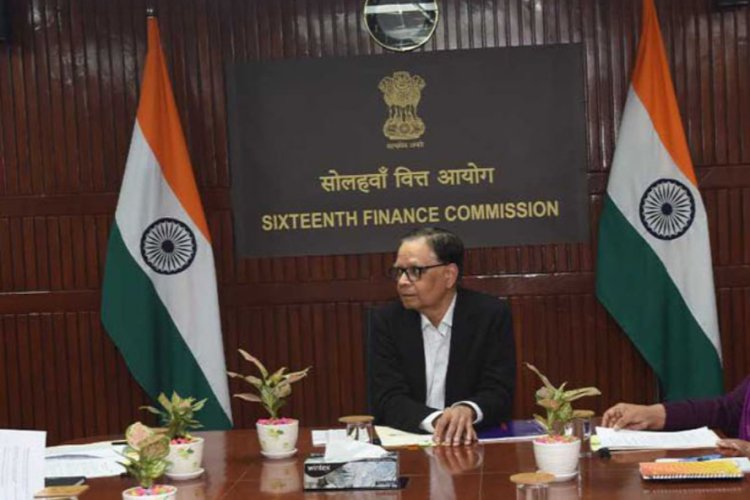
The Sixteenth Finance Commission’s report has reopened a familiar question in Indian fiscal federalism- how far should tax devolution correct inter-state inequality, and how far should it reward economic performance. The Union government accepted the Commission’s recommendation to retain the states’ vertical share at 41% of the divisible pool in the Union Budget 2026–27, and provided ₹1.4 lakh crore as Finance Commission grants for FY2026–27. The Commission had submitted its report to the President on November 17, 2025.
A recent discussion among economists, fiscal experts and former Finance Commission members examined the implications of this shift. Its main concern was not the headline number. It was the method, the incentives, and the quiet change in the normative basis of Indian fiscal federalism.
READ | 16th Finance Commission: Why the north-south tax row has shifted
Finance Commission devolution and the 41% question
The Commission has retained the 41% vertical share recommended by its predecessor. On paper, this is continuity. In practice, it reflects a cautious reading of what followed the Fourteenth Finance Commission’s sharp increase in devolution from 32% to 42%.
That increase did not merely expand the states’ share. It also encouraged the Centre to rely more on cesses, surcharges and expenditure outside the divisible pool. These instruments are not shared with states. The result is a divergence between the formal devolution ratio and the states’ effective share in gross central tax revenue.
This is the real distortion. The divisible pool excludes cesses and surcharges. As their share rises, a 41% devolution promise becomes less meaningful. The effective transfer to states has been estimated at around 29–30% of gross tax revenue. Reuters reported, after the 2026–27 Budget, that several states criticised the retention of 41% because their actual share had eroded with the Centre’s growing use of cesses and surcharges.
Participants in the discussion argued for a sunset clause or negotiated cap on cesses and surcharges. The point is constitutional, not accounting. If the Centre can expand non-shareable levies at will, the Finance Commission’s role in correcting vertical imbalance is weakened. The Sixteenth Commission’s silence on this matter is one of its most consequential omissions.
Horizontal devolution and GDP contribution
The bigger change lies in horizontal devolution. The Commission has introduced a new criterion: a state’s contribution to national GDP, with a 10% weight. This is the first explicit use of economic output in the inter-se distribution formula. PRS notes that the Sixteenth Commission replaced the earlier tax and fiscal effort criterion with contribution to GDP, while discontinuing revenue deficit, sector-specific and state-specific grants recommended by the Fifteenth Commission.
This is a qualitative shift. Finance commissions have traditionally pursued equalisation. The core idea has been that a citizen’s access to basic public services should not depend too heavily on the fiscal capacity of the state in which she lives. Richer states could raise more of their own resources. Poorer states needed larger transfers.
READ | 16th Finance Commission: New devolution formula, tighter grants
The new GDP criterion moves in another direction. Its defenders argue that economically advanced states have long felt penalised by income-distance formulas. If productive states see the system as excessively redistributive, their political buy-in weakens. A growth signal, they argue, is needed in the devolution architecture.
That argument cannot be dismissed. But the design creates a conceptual problem. Per capita income now enters the formula in two opposing ways. Through income distance, it penalises richer states. Through GDP contribution, it rewards them. The same economic fact is being used to pull the formula in opposite directions.
This is not a minor technical inconsistency. It changes the distributive logic of the award. Middle-income states may gain from the dual treatment. The poorest and most populous states could lose twice: once because they have low income and again because their contribution to national output is weaker. Estimates presented in the discussion suggested cumulative losses of about ₹14 lakh crore for the eight poorest states over the award period, compared with what they might have received under the previous framework.
The question, therefore, is not whether performance should matter. It already has, through tax effort and demographic performance. The question is whether output should be rewarded in a formula whose central purpose has been fiscal equalisation.
Revenue deficit grants and fiscal discipline
The Commission has discontinued revenue deficit grants. These grants, permitted under Article 275 of the Constitution, were used by successive commissions to support states whose revenue expenditure exceeded revenue receipts after devolution. The Sixteenth Commission’s decision is based on two claims: aggregate state finances are expected to show revenue surpluses, and gap-filling grants weaken fiscal discipline.
There is some force in this argument. States have repeatedly failed to meet the revenue surplus paths projected by earlier commissions. Election-cycle spending, subsidies and weak own-tax mobilisation have left many states returning to each new commission with similar deficits.
Still, ending revenue deficit grants carries risks. Aggregate projections can hide state-level stress. The northeastern and hill states face higher service delivery costs because of terrain, sparse population and weak revenue bases. A consolidated estimate of state surpluses says little about these structural disadvantages.
The Commission’s projections may also be vulnerable to later revisions. A change in the GDP base year to 2022–23 could alter nominal GDP and revenue assumptions. The Eighth Pay Commission could raise committed expenditure for states. The absence of a state-wise impact assessment weakens the case for a clean break.
The previous framework was not without results. Between 2005 and 2014, several states moved towards revenue surpluses. That experience suggests that better-designed incentives may work better than withdrawal of support. The problem was not the existence of revenue deficit grants alone. It was the absence of strict, transparent conditions attached to them.
Fiscal federalism and missing data architecture
The Commission appears to assume that states will now undertake structural adjustment. They must rationalise subsidies, reform power distribution companies, improve public financial management, and bring off-budget liabilities into the fiscal frame. The action-taken memorandum says the Commission recommended a 3% of GSDP cap on state fiscal deficits, discontinuation of off-budget borrowings, and amendments to state Fiscal Responsibility Legislation to align them with the fiscal consolidation roadmap. The government has accepted the borrowing-ceiling recommendation in principle, while saying other recommendations will be examined separately.
This is sensible as far as it goes. But the burden has been shifted to states without a strong enforcement mechanism. Finance Commission recommendations in these domains are not self-executing. They require Union-state coordination, audit discipline, and comparable fiscal data.
That last condition is missing. Subsidy definitions vary across state budgets. Off-budget borrowings often become visible only after audit scrutiny. State fiscal responsibility laws do not use identical debt concepts. Power-sector losses are not always transparently captured. Without standardised fiscal data, claims about solvency, adjustment and discipline become conjecture.
This is the area where reform should have been sharper. India needs a real-time, comparable state fiscal database. It should capture explicit debt, guarantees, off-budget liabilities, power-sector dues, subsidy commitments and contingent liabilities. Without that architecture, a tougher devolution design may punish weak states without improving fiscal conduct.
READ | Fiscal federalism: Karnataka demands a fairer deal from the 16th Finance Commission
Sixteenth Finance Commission and the federal compact
The Sixteenth Finance Commission has not merely adjusted weights. It has changed the tone of fiscal federalism. It has moved the system away from a pure equalisation frame and towards a compact that gives greater recognition to economic contribution.
That shift may be defensible. But it should not happen quietly. The constitutional purpose of finance commissions has been to ensure that wide differences in state income do not translate into unacceptable differences in public services. A growth-oriented formula must be judged against that standard.
The report has also exposed unfinished work. Local body grants remain burdened by conditions that impair utilisation. State finance commission reports still do not meaningfully shape national transfer design. Cesses and surcharges continue to weaken the divisible pool. Fiscal transparency remains inadequate.
The Commission has surfaced the tensions. It has not resolved them. That task now belongs to Parliament, state governments and public finance institutions. India’s fiscal federalism cannot be allowed to drift from equalisation to competition without debate, data and constitutional clarity.
This article is based on a discussion among fiscal economists and former finance commission members, and reflects the analytical positions aired in that forum rather than any individual attribution.