


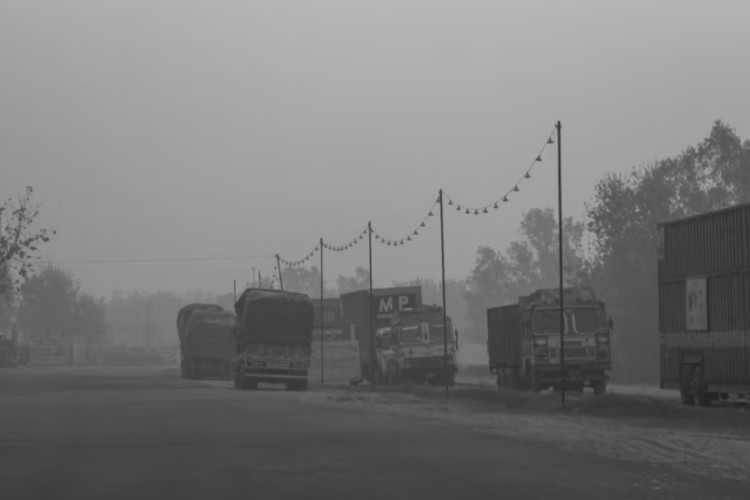
The Union Cabinet has approved a ₹9,585 crore, two-year cleaner mobility scheme for Delhi-NCR. It will incentivise owners of old buses and trucks to replace BS-IV and older vehicles with BS-VI, cleaner fuel or electric alternatives. The scheme will be funded through the National Capital Region Planning Board under the Ministry of Housing and Urban Affairs, and implemented with the ministries of road transport and petroleum, and the governments of Delhi, Haryana, Rajasthan and Uttar Pradesh.
Delhi’s air pollution crisis returns every winter with familiar images: smog, school closures, construction curbs and emergency restrictions under the Graded Response Action Plan. The official debate often turns to private cars. The heavier pollution load sits elsewhere: trucks, buses, industrial activity, dust, waste burning and seasonal farm fires.
READ | Air pollution is now a drag on India’s economic growth
The new scheme tackles one part of that problem through incentives. It also sits behind a hard regulatory deadline.
Cleaner mobility scheme targets old NCR fleets
The scheme covers about 2.07 lakh vehicles in Delhi-NCR: 1.91 lakh trucks and 16,329 buses. The Centre will provide ₹5,041 crore. The NCR states are expected to provide about ₹1,601 crore in tax concessions. The package also includes interest subvention, fuel vouchers, EV-linked benefits, state fee waivers and discounts from automobile manufacturers.
The scheme is not a general subsidy. It has a filter. BS-III and older vehicles must be scrapped at registered vehicle scrapping facilities. BS-IV vehicles may either be scrapped or sold outside NCR and non-NCAP cities. Replacement vehicles must be bought and registered within NCR. In Delhi, light goods vehicles bought under the scheme must be electric. Buses must be BS-VI CNG or electric. Government vehicles are excluded.
That design is more precise than earlier scrappage rhetoric. It names the fleet, the emission category, the replacement rule and the payment channels. That matters. Delhi’s previous pollution interventions have often suffered from weak targeting.
READ | Air pollution inequality is turning clean air into a class privilege
Delhi air pollution and heavy vehicles
Official assessments cited by the government show that transport contributes 14% of PM2.5, 40% of carbon monoxide and 63% of nitrogen oxide emissions in Delhi-NCR. Within transport, trucks and buses account for 36% of PM2.5 emissions while forming only 3% of the total fleet. A pre-BS heavy-duty vehicle can emit as much as 14 BS-VI vehicles. A BS-IV vehicle emits 2.7 times as much as a BS-VI vehicle.
This is why fleet replacement is not cosmetic. Heavy commercial vehicles are a small share of the vehicle population, but a large source of toxic emissions. They also move across state borders, which makes city-level regulation blunt.
The Commission for Air Quality Management had already directed that, from November 1, 2025, commercial goods vehicles entering Delhi must be BS-VI, CNG, LNG or electric, with specified exceptions. The new scheme therefore softens a compliance shock already written into regulation.
It does not remove compulsion. It attaches financial support to it.
Clean mobility needs finance, not slogans
Electric vehicle adoption has grown fastest in two-wheelers, three-wheelers and passenger cars. Heavy commercial vehicles remain harder. The reason is not lack of awareness. It is cost, charging infrastructure and financing risk.
Truck and bus operators work on thin margins. Many are small fleet owners. A ban without transition support would push costs on to operators least able to absorb them. Lenders have also been cautious about battery life, resale values and residual demand.
The scheme addresses part of that problem through interest subvention, fuel vouchers and purchase incentives. It cannot settle the economics of heavy-duty electrification. It can reduce the first barrier.
The harder task lies in infrastructure. Electric trucks require high-capacity charging, land for depots, reliable power supply and distribution upgrades. CNG and LNG may remain transition options for heavy goods movement, especially before charging networks mature.
A cleaner fleet without refuelling and charging infrastructure will remain an accounting achievement.
Cleaner mobility scheme is not an airshed policy
The scheme will not solve Delhi’s pollution crisis. Vehicular emissions are one part of a regional airshed problem that includes industrial emissions, road dust, construction dust, waste burning, biomass combustion, thermal power plants and crop residue burning.
Delhi’s winter pollution is produced by emissions and weather. Local vehicular and industrial emissions combine with farm fires in neighbouring states. Low wind speeds and temperature inversion trap pollutants close to the ground. The result is not merely bad air, but repeated institutional failure.
The Commission for Air Quality Management was created to coordinate action across states. Its record remains mixed. Enforcement varies. States still blame one another during pollution spikes. Long-term measures move slowly.
That is the larger test for the cleaner mobility scheme. Its strength lies in regional design. Delhi, Haryana, Uttar Pradesh and Rajasthan are part of the same transport market. Commercial vehicles do not stop polluting at state borders. A state-only approach would fail.
READ | Delhi air pollution crisis a failure of prevention, not prediction
Delhi-NCR pollution needs execution
The scheme shows that regional coordination can work when money is aligned. It also shows how limited such coordination remains. Fleet replacement is easier to monitor than dust control, industrial compliance, waste burning or crop residue management. That may be why it has moved first.
Delhi has one of India’s highest vehicle densities. Congestion raises emissions through idling. Night freight traffic adds another layer. Cleaner buses will help only if public transport remains frequent, reliable and sufficient to reduce private vehicle dependence.
The usual risks remain. Eligibility checks must be clean. Scrapping must be real. Certificates must not become tradable paperwork. Vehicles removed from NCR must not return through informal routes. Benefits must reach small fleet owners, not only large transporters. The digital portal must not become another compliance hurdle. State concessions must be delivered, not announced.
The cleaner mobility scheme is not a substitute for an airshed strategy. It is a narrow, useful intervention. If it works, Delhi-NCR will have fewer dirty trucks and buses on its roads. That is not enough to clean the air. It is still worth doing.