


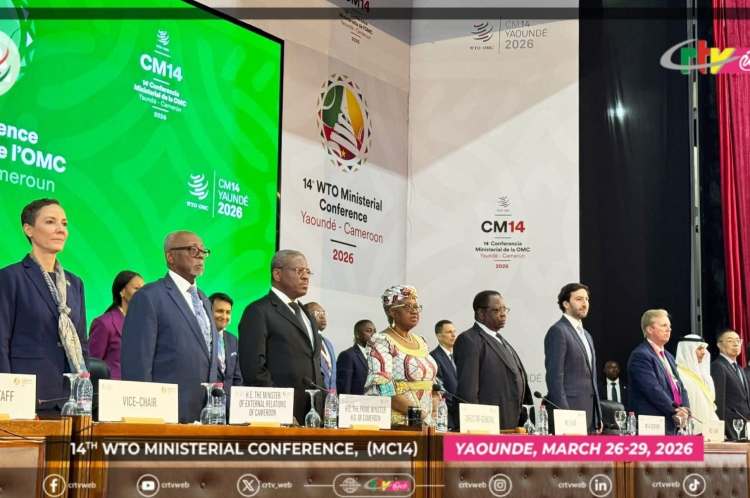
India and the WTO e-commerce deal: The declaration on interim arrangements for the Agreement on Electronic Commerce at the WTO Ministerial Conference in Yaoundé is less a triumph than a signpost. It shows that digital trade rules can be written. It also shows that the WTO can no longer rely on universal consensus to write them.
Electronic commerce is now central to trade. Goods are ordered online, services are delivered across networks, payments move through digital systems, and data supports everything from cloud computing to design, logistics, advertising and finance. The old trade architecture was built for ships, containers, tariffs and customs posts. It now has to contend with software, streaming, online contracts, electronic invoices and cross-border digital services.
For nearly three decades, this space rested on a fragile WTO understanding: members would not impose customs duties on electronic transmissions. That moratorium began in 1998 and was renewed repeatedly. At Yaoundé, the multilateral moratorium failed to survive. The e-commerce agreement tries to preserve a duty-free digital trade environment among its own parties. That is useful. It is not the same as a WTO-wide rule.
READ I Trade negotiations and the fear of exclusion
WTO e-commerce deal and digital trade rules
The agreement creates baseline rules for trade by electronic means. Its scope covers measures affecting trade conducted digitally, but it leaves out government procurement, government services and government-held information. It also preserves exceptions for security, prudential regulation, personal data protection and other public policy concerns.
The useful parts are practical. The agreement deals with electronic authentication, electronic signatures, electronic contracts, e-invoicing, electronic payments, paperless customs procedures and single windows. These are not abstractions. They reduce transaction costs, cut paperwork and make it easier for firms to trade across borders without being trapped in incompatible systems.

The agreement also recognises that digital trade depends on trust. It contains provisions on online consumer protection, spam, personal data protection and cybersecurity. These are modest disciplines, not a digital constitution. But even modest disciplines matter when firms face a patchwork of domestic rules.
The commitment not to impose customs duties on electronic transmissions is the most politically visible part of the agreement. It gives participating firms some certainty that software, digital media and other electronic transmissions will not face customs duties between parties. Internal taxes, fees and charges are not barred. That distinction matters. Governments retain tax policy space. What is constrained is the use of customs duties on electronic flows.
READ I India-US trade deal runs into USTR tariff wall
WTO consensus problem
The weakness lies in the legal form. The agreement is not yet part of the WTO’s formal rulebook. Its supporters will continue to seek its incorporation into Annex 4 of the Marrakesh Agreement. That requires consensus. Consensus is precisely what the WTO now finds hardest to produce.
The interim route is therefore both ingenious and revealing. The agreement will apply only among those members that accept it. It will not create rights or obligations for members outside it. This avoids paralysis. It also marks a shift from the WTO as a universal rule-maker to the WTO as a venue where willing coalitions move ahead.
That shift is not new. The Agreement on Government Procurement and the Agreement on Trade in Civil Aircraft are also plurilateral. But digital trade is not a narrow sector. It runs through services, manufacturing, payments, retail, media, education, healthcare and public administration. Fragmentation here carries wider consequences.
For business, the danger is regulatory complexity. A company may face one set of digital trade disciplines among participating WTO members, another under regional trade agreements, and a third in markets that stay outside such arrangements. For the WTO, the danger is institutional. If the most dynamic areas of trade are governed by clubs, the multilateral system becomes less central.
READ I Indian Ocean trade can anchor India’s growth aspirations
US absence, Indian dilemma
The most striking absence is the United States. The US helped build the internet economy and remains home to the largest digital platforms. Yet it did not join the main e-commerce agreement, citing unresolved concerns, including security exceptions and domestic policy space. Washington later joined a separate group that agreed not to impose e-commerce duties among themselves. That keeps part of the duty-free arrangement alive, but through an even narrower patch.
India faces a different dilemma. It has long objected to plurilateral agreements being folded into the WTO without consensus. The objection is not procedural nit-picking. India worries that rules written by others could later become the default standard for all, especially when digital trade rules touch data, taxation, competition policy and industrial strategy.
Staying outside has a cost. India’s services exports, start-ups, fintech firms and IT-enabled businesses benefit from predictable digital trade rules. Participation could improve market access and reduce compliance frictions. But joining too early could limit room to shape rules on data governance, platform regulation, taxation and domestic digital capability.
India should not confuse caution with strategy. The choice is not between surrender and obstruction. It is between engaging early enough to shape rules, and staying out until rules become facts. A large digital economy cannot remain a rule-taker in a domain that will define future trade.
Developing country concerns
The development question cannot be waved away. Digital trade can open markets for smaller firms, women entrepreneurs, rural producers and service exporters. But those gains do not arise automatically. They require broadband, payments infrastructure, digital identity, cyber resilience, interoperable regulation and skills.
The agreement offers implementation periods, needs assessments, technical assistance and capacity building for developing and least-developed economies. These provisions are necessary. They are not sufficient. Without credible financing and domestic institutional capacity, digital trade rules may favour countries and firms already equipped to use them.
The debate over customs duties also reflects a deeper fiscal concern. Some developing countries fear that a permanent bar on duties narrows future revenue options. Supporters respond that tariffs on electronic transmissions would be hard to administer, distortionary and ultimately paid by consumers and small firms. Both points cannot be dismissed. The better answer lies in modern domestic taxation, not customs duties on data packets.
WTO’s digital test
Yaoundé has produced a limited advance and a larger warning. The advance is that a group of WTO members has agreed on a workable baseline for digital trade. The warning is that the WTO’s consensus machinery could not deliver a universal outcome on one of the most important trade questions of the age.
This does not make the WTO irrelevant. It makes reform unavoidable. The organisation must find ways to accommodate variable geometry without hollowing out multilateralism. Plurilateral agreements should remain open, transparent and non-discriminatory. Non-participants should not be bound by rules they did not accept. At the same time, permanent vetoes cannot be allowed to freeze rule-making in fast-moving sectors.
Digital trade will not wait for institutional comfort. Firms, platforms and consumers are already operating across borders. Governments are already writing data, tax, cybersecurity and platform rules. The question is whether these rules will converge through the WTO or splinter into rival blocs.
The Yaoundé declaration points both ways. It gives digital trade a partial rulebook. It also exposes the cost of a trading system that cannot make collective decisions. The real test is no longer whether the WTO can preserve old disciplines. It is whether it can write new ones without losing its claim to universality.
Dr Jadhav Chakradhar is Assistant Professor of Economics, Centre for Economic and Social Studies (CESS), Hyderabad, Telangana. Dr Jayanti Mala Nayak is Deputy Director, District Planning & Monitoring Unit (DPMU), Nabarangpur, Odisha.