



India’s wellness industry has moved beyond spas, yoga retreats and alternative medicine. It now sits at the intersection of healthcare, tourism, employment, digital technology, retail trade, and exports. The shift is being driven by a stronger demand for preventive healthcare, mental well-being, fitness, organic products, and holistic recovery.
The wellness industry is broad. It includes yoga, Ayurveda, naturopathy, fitness services, meditation, wellness travel, nutraceuticals, beauty and personal care, mental health support, digital wellness apps, and preventive healthcare platforms. Its distinct advantage lies in the meeting of traditional knowledge and modern business models.
The global market gives this shift scale. The Global Wellness Institute estimates that the wellness economy reached $6.8 trillion in 2024 and is projected to grow to $9.8 trillion by 2029. That makes wellness one of the world’s largest consumer-facing economic sectors.
India is not a marginal player in the wellness industry. Its strength comes from yoga, Ayurveda, spiritual traditions, natural therapies, and a growing domestic consumer base. Rising incomes, urban stress, lifestyle diseases, and post-pandemic health awareness have widened the market for preventive and non-hospital health services.
READ I Why textiles should be treated as a public health issue
Yoga market and India’s soft power
Yoga remains the strongest pillar of India’s wellness economy. The United Nations General Assembly adopted the resolution declaring June 21 as International Day of Yoga on December 11, 2014, with wide international support. Since then, yoga has become both a global practice and an instrument of Indian soft power.

The economics of yoga now extends well beyond physical instruction. It supports teacher training, certification, retreats, studios, online courses, digital subscriptions, publishing, merchandise, and wellness tourism. One market estimate says India’s yoga and meditation services industry could grow from $81.7 billion in 2025 to $155.2 billion by 2035.
These estimates should be read with care because market definitions vary. But the direction is clear. Yoga has moved from the margins of lifestyle consumption to a recognised services industry.
READ I Healthcare real estate is driving costs, access, priorities
Wellness tourism creates local jobs
Wellness tourism is the next major growth channel. India is increasingly positioned as a destination for Ayurvedic treatment, yoga retreats, naturopathy, spiritual travel, stress management, and long-stay recovery programmes. Rishikesh, Kerala, Mysuru, Varanasi, Goa, and parts of the Himalayan belt already draw domestic and foreign visitors.


The India wellness tourism market was estimated at about $27.9 billion in 2025 and is projected to reach $38.2 billion by 2030. Another estimate places the 2025 market at $28.3 billion, with faster growth over the following decade.
The multiplier effect is visible. Wellness tourism supports hotels, homestays, transport, local food businesses, handicrafts, therapists, guides, and small service providers. Unlike capital-intensive sectors, it can create livelihoods in smaller towns and rural locations. This is why the sector matters beyond its market size.
READ I Costly healthcare: Why out-of-pocket spending remains high
AYUSH policy and the credibility gap
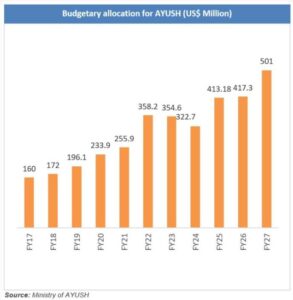
Government policy has helped formalise the wellness industry. The Ministry of AYUSH has promoted Ayurveda, Yoga and Naturopathy, Unani, Siddha, and Homoeopathy through public campaigns, research support, institutional expansion, certification, and international engagement. The AYUSH market was estimated at about $43.3 billion in 2024, with projections of significant expansion by 2030.

The government has also introduced an AYUSH visa category for foreign nationals seeking treatment under Indian systems of medicine. The Medical and Ayush Visa Portal is meant to streamline entry for patients and connect them with authorised hospitals and wellness centres.
This policy support gives India an opening in medical value travel and preventive care. But scale without standards can damage credibility. The sector still suffers from uneven certification, weak quality control, exaggerated claims, shortage of trained professionals, and regulatory gaps. These weaknesses matter because wellness is a trust-based business.
Digital wellness widens access
Digital platforms have changed how wellness services are consumed. Fitness apps, meditation platforms, online yoga classes, AI-enabled health trackers, nutrition tools, and telehealth services have lowered entry barriers. They have also helped wellness companies reach smaller cities and younger consumers.
This does not replace traditional practice. It changes its delivery. A yoga teacher can now build a national clientele from a small town. A nutritionist can run a subscription model. Ayurveda and preventive care brands can combine e-commerce, diagnostics, and personalised advice.
The opportunity is real, but so is the risk. Digital wellness can spread useful habits. It can also spread misinformation. Platforms that make medical claims without evidence will invite regulatory scrutiny and consumer distrust.
Ayurveda exports need science and standards
International demand for Ayurvedic, herbal, organic, and plant-based products is rising. Indian brands have benefited from this shift. So have multinational companies entering natural care, beauty, nutrition, and preventive wellness segments.
The export opportunity is large. But it cannot rest on nostalgia alone. Foreign markets require clinical evidence, labelling discipline, ingredient traceability, safety testing, and regulatory compliance. India’s comparative advantage will weaken if traditional knowledge is not backed by modern science and manufacturing standards.
For India’s wellness exports, evidence will matter as much as inheritance. The Ayush Research Portal now hosts a large body of studies, and the WHO’s Global Traditional Medicine Strategy 2025–2034 also stresses evidence, safety, regulation and integration into health systems. But databases and declarations are only a start. Foreign regulators, insurers and hospitals will look for clinical validation, pharmacovigilance, safety data, labelling discipline and ingredient traceability. India’s advantage will endure only if traditional knowledge is backed by modern proof.
This is the central challenge for Ayurveda-led exports. India must protect authenticity, but it must also meet the evidentiary and safety requirements of global markets.
Wellness industry needs regulation
The wellness industry faces a familiar Indian problem. It has enterprise, demand, cultural depth, and export potential. But it also has fragmentation, informality, and weak enforcement.
Many operators function without credible certification. Some make claims that should be tested. Others commodify traditional practices without regard for their philosophical or therapeutic context. The commercialisation of yoga and Ayurveda has also triggered debates over cultural appropriation and dilution.
The answer is not heavy-handed regulation. It is a layered framework. Basic consumer protection must be non-negotiable. Medical claims must be evidence-based. Training standards must improve. Certification must be credible. At the same time, small practitioners should not be buried under compliance costs.
India’s wellness industry needs a strategy
The future of India’s wellness industry looks promising, but not inevitable. Demand will rise because of ageing, lifestyle disease, mental stress, pollution, and greater awareness of preventive health. India has an advantage because its wellness traditions are already recognised worldwide.
But advantage is not strategy. India needs better standards, stronger institutions, skilled workers, scientific validation, export discipline, and smarter branding. It must also keep wellness affordable. If the sector becomes only a premium urban product, it will lose much of its social and economic value.
Wellness is no longer a passing health fad. It can support jobs, tourism, entrepreneurship, exports, and soft power. It can also reduce pressure on an overburdened healthcare system if it promotes prevention without pretending to replace medicine.
India has the raw material to become a global wellness industry hub. What it needs now is credibility. That will come from evidence, regulation, skills, and honest claims. The world is ready to buy wellness. India must make sure it is selling trust, not just tradition.
Sandhya is a second year Student; Anjali PK is Assistant Professor at Department of Economics; and Leena N Fukey is Professor, School of Business Management, at Christ University, Bengaluru.