


UPI MDR: Why the govt cannot ban a price rise: On September 15, the government set out the new rules for UPI merchant payments. From October 15, specified person-to-merchant transactions above ₹2,000 will attract a Merchant Discount Rate of 0.4%, capped at ₹300 per transaction from ₹75,000. The MDR will be borne within the merchant-payment ecosystem. Banks have been advised to ensure that merchants do not pass it on to customers, while UPI application providers have been barred from imposing platform or hidden charges.
That settles the rule. It does not settle the economics. “Customers will not pay MDR” has two possible meanings. The first is straightforward: a merchant cannot add a payment-specific fee to a bill because the customer chose UPI. The second is harder to enforce: that the general prices charged by the merchant will never reflect the cost of accepting UPI.
READ | UPI MDR explained: What changes from October 15
The distinction matters because the government estimates that about 96% of P2M transactions will remain unaffected by the new framework. The MDR will apply to only about 4% of merchant transactions, concentrated among payments above ₹2,000 that fall outside the zero-MDR provisions for small merchants.
A surcharge is easier to detect than a price increase
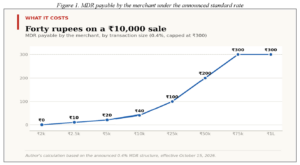
Consider a ₹10,000 purchase. At an MDR of 0.4%, the merchant would incur a ₹40 payment cost. If the merchant adds ₹40 to the bill only when the customer pays through UPI, the violation is clear. The receipt or checkout screen would show a payment-specific charge.
The situation changes if the merchant instead prices the product at ₹10,040 for every customer, regardless of whether the payment is made through UPI, cash or card. The customer using UPI would still bear part of the economic cost, but there would be no identifiable “UPI charge”. The payment expense would have become one of the merchant’s operating costs, alongside rent, wages, logistics, electricity and taxes.
Figure 1. MDR payable by the merchant under the announced standard rate

This is the central limitation of the government’s promise. It can prohibit a merchant from adding MDR as a separate charge. It cannot determine how every business sets its prices.
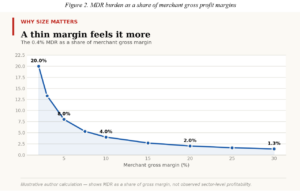
The burden can also vary sharply with margins. On a ₹10,000 sale carrying a 20% gross margin, the merchant’s gross profit is ₹2,000 and an MDR of ₹40 represents 2% of that amount. At a 2% gross margin, gross profit is only ₹200, making the same MDR equivalent to 20% of gross profit. The incentive to absorb the cost is therefore not the same across businesses.
That does not mean that merchants will necessarily pass the cost on to customers. Competitive pressure may force them to absorb it. A merchant that depends heavily on UPI may prefer to treat the MDR as the price of retaining a convenient payment channel. A business with stronger pricing power may have more room to recover it through its overall pricing.
The incidence of the MDR will therefore depend on market structure, margins, transaction values and the importance of UPI to the merchant.
READ | UPI at 10: Financial inclusion needs a second act
Other payment systems show the limits of a no-surcharge rule
International experience points to a broader lesson: banning payment-specific surcharges is only one part of consumer protection.
The European Union combines restrictions on surcharges for covered consumer cards with caps on interchange fees. The European Commission says the rules limit interchange fees for consumer debit and credit cards and prohibit retailers from imposing surcharges on customers using those cards.
Australia is moving in a similar direction, but with a stronger emphasis on the cost faced by merchants. From October 1, 2026, designated card networks will no longer be able to impose rules that permit surcharging, while the Reserve Bank of Australia is also lowering interchange caps. It is introducing greater transparency around merchant service fees, with some disclosure requirements beginning later.
Figure 2. MDR burden as a share of merchant gross profit margins

Indonesia offers another relevant comparison. Bank Indonesia is expanding its zero-MDR QRIS regime from October 1, 2026: all merchant categories will pay zero MDR on transactions up to Rp100,000, while micro merchants retain zero MDR up to Rp500,000. The policy therefore reduces the cost at the lower end rather than relying solely on a prohibition on consumer charges.
Brazil’s Pix illustrates a different model. Individuals generally use Pix without transaction charges, while businesses can face fees for certain commercial transactions. The central bank’s rules require payment institutions to disclose applicable tariffs, and commercial recipients can be charged for receiving payments.
The systems are not directly comparable with UPI. Their regulatory structures, payment networks and fee arrangements differ. But they illustrate an important point: consumer protection can involve restrictions on surcharges, lower underlying payment costs and greater transparency. A ban on an explicit fee does not by itself determine the final economic incidence.
India already uses more than one of these mechanisms. It prohibits merchants from passing MDR directly to customers and bars UPI applications from imposing platform or hidden charges. It also keeps payments up to ₹2,000 outside the standard MDR regime and protects eligible small merchants receiving up to ₹1 lakh a month through UPI QR codes.
The next question is whether those safeguards are sufficient once merchants begin paying for higher-value transactions.
READ | UPI MDR debate shifts from users to large merchants
The real test will be what merchants do
The policy should therefore be evaluated through evidence rather than the wording of the rule.
The first indicator is explicit surcharging. Complaints, receipts and transaction-level observations can show whether merchants are attempting to add a UPI-specific fee.
The second is merchant behaviour. Businesses may respond by continuing to accept UPI without changing prices, refusing some higher-value UPI payments, encouraging customers to use cash or another payment method, or offering discounts for alternative modes.
The third is the distribution of the cost. Merchant data can show whether the MDR has a materially different effect on small and large firms or across industries with different margins and payment patterns.
The fourth is retail pricing. A rise in prices after October 15 would not by itself establish that MDR was passed on to consumers. Prices change for many reasons. A meaningful test would compare price movements in sectors and businesses with high exposure to qualifying UPI transactions with those facing much less exposure, while controlling for other relevant changes.
This is where the distinction between incidence in law and incidence in economics becomes important. The law can place the MDR on the merchant and prohibit a separate charge to the customer. The economic burden may still be divided between the merchant and consumer depending on competition and pricing power.
The government can make a defensible promise that consumers will not be charged an explicit UPI fee. It cannot credibly promise that a new business cost will have no effect on prices.
The better test of the new framework is narrower and more measurable: whether customers face UPI-specific charges, whether merchants alter their willingness to accept higher-value UPI payments, and whether prices behave differently in businesses most exposed to the MDR.
That is also where the international comparisons matter. A payment system can protect consumers without pretending that payment infrastructure is costless. The policy challenge is to keep the payment choice simple for users while ensuring that the cost of running the network is visible, contained and borne in a way that does not undermine its adoption.
Ankita Gupta is Assistant Professor (Economics) and Neha Jain Assistant Professor (Management) at the Delhi Technological University.