


Tamil Nadu’s NCD burden demands better long-term care: Tamil Nadu has made substantial progress in preventing early deaths and expanding access to healthcare. The state’s latest National Family Health Survey (NFHS-6), however, points to a growing challenge: the accumulation of metabolic and behavioural risks among adults. The policy test is whether people identified with hypertension, diabetes and related conditions receive continuing treatment, achieve disease control and avoid complications that can shorten their lives.
The World Health Organisation’s Sustainable Development Goal indicator 3.4.1 measures the probability of dying between the ages of 30 and 70 from cardiovascular disease, cancer, diabetes or chronic respiratory disease. NFHS-6 does not measure this mortality outcome. It does, however, reveal the prevalence of several risk factors that contribute to the burden of chronic disease. Mortality statistics and health-system records are needed to establish whether prevention and treatment are reducing premature deaths.
READ | Tamil Nadu welfare programmes need a stronger revenue base
Tamil Nadu’s metabolic risk is rising
NFHS-6 records a substantial burden of excess weight, elevated blood sugar and high blood pressure. Among women aged 15–49, 44.2% are overweight or obese, compared with 40.5% in NFHS-5. The proportion among men in the same age group has risen from 37.1% to 38.8%.
Among adults aged 15 and above, 25.2% of women and 26.7% of men have high or very high blood sugar, or report taking medication to control it. Elevated blood pressure or medication use is reported by 24.2% of women and 28.2% of men. These indicators cover different age groups and should not be read as estimates of diagnosed disease alone. Taken together, they point to a substantial burden of cardiometabolic risk.
Selected NFHS-6 indicators for Tamil Nadu
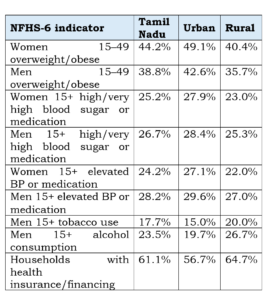

Source: NFHS-6, Tamil Nadu fact sheet, 2023–24.
The state’s 2020 STEPS survey provides complementary evidence. Among adults aged 18–69, current tobacco use was reported by 40% of men and 7.9% of women, while 39.1% of men reported current alcohol consumption. Inadequate physical activity affected 21.1% of men and 10.5% of women. The survey estimated hypertension prevalence at 33.9% and diabetes prevalence at 17.6%. Nearly 28% of participants had three or more NCD risk factors, with the proportion approaching 40% among men aged 45–69.
The STEPS findings need to be interpreted with one qualification: the COVID-19 lockdown restricted the survey to 68% of its intended sample. Even so, they reinforce the case for combining risk reduction with disease management. Tobacco cessation, healthier diets, physical activity and effective control of blood pressure and blood sugar need to form part of routine primary care. A review of Indian tobacco-treatment practices found that only 22% of daily tobacco users reported being asked about tobacco use by a healthcare provider, while 19% said they had been advised to quit. Brief cessation advice remains an underused intervention.
READ | Tamil Nadu debt puts welfare spending under strain
Must reduce Tamil Nadu’s NCD burden
Tamil Nadu has an established delivery platform in Makkalai Thedi Maruthuvam (MTM), the state’s doorstep healthcare programme. By bringing screening and medicines closer to households, the programme can reduce barriers to diagnosis and continuing treatment, particularly for people who find repeated visits to health facilities difficult.
A published evaluation of MTM, based on a household survey of 6,856 adults aged 30 and above across the state’s 38 districts, found that 79.4% had been screened for diabetes and 82.6% for hypertension. More than 95% of people diagnosed with these conditions were receiving treatment. Yet only 9.8% of those with diabetes had their condition under control, compared with 35.4% of those with hypertension.

These findings expose a weakness in relying on screening and treatment initiation as the principal measures of programme performance. A patient may be screened, diagnosed and prescribed medicines without achieving control. The reasons can include interruptions in medication, inadequate follow-up, difficulty obtaining diagnostic tests, treatment costs or clinical complications. The evaluation identifies the gap in outcomes; further investigation is needed to determine the relative contribution of these factors.
The programme’s next phase should therefore track the full course of care. After screening, patients need diagnostic confirmation and treatment initiation, followed by regular monitoring and support to maintain control. Records should show whether patients return for follow-up, continue taking medicines, achieve blood pressure and blood glucose targets, complete referrals and receive appropriate management when complications arise.
This requires coordination among MTM field staff, primary health centres, NCD clinics and hospitals. Referral should be treated as an unfinished task until the receiving facility has assessed the patient and the treatment plan is reflected in the patient’s continuing care. Programme managers should also examine whether outcomes differ by income, caste, sex, age and place of residence.
Differences between urban, rural Tamil Nadu
NFHS-6 shows higher levels of overweight and several metabolic risk indicators in urban areas. Tobacco use and alcohol consumption among men are more prevalent in rural areas. These differences argue for adapting prevention and follow-up to local conditions rather than applying an identical intervention everywhere.
Urban primary care should give greater attention to obesity prevention, physical activity, healthier food choices and sustained management of hypertension and diabetes. Coordination with private providers is also important where patients move between public and private facilities. Rural services need to address tobacco and alcohol use alongside reliable access to medicines and chronic-disease monitoring.
Workplaces offer another opportunity to reach people during their working years, when risks may go undetected and the demands of employment can make regular medical visits difficult. Screening at work can help identify people who need care, but its value depends on whether they are referred for diagnostic confirmation and connected to treatment. A one-day health camp cannot substitute for continuing clinical supervision.
Prevention also needs to reach beyond individual counselling. Primary care can identify risk and help people change their behaviour, but local governments, schools, employers and food-service providers influence the choices available to them. Measures to improve access to healthier food and opportunities for physical activity should complement clinical services. Tobacco and alcohol control require sustained public-health action alongside advice offered during consultations.
READ | High voter risk appetite behind Bengal, Tamil Nadu verdicts
Financial protection is part of NCD control
Only 61.1% of Tamil Nadu households reported that a usual member was covered by health insurance or a financing scheme in NFHS-6, down from 66.5% in NFHS-5. This measure does not establish whether the remaining households lack all forms of financial protection, nor does coverage alone show whether treatment is affordable. It does, however, raise a question that the state’s NCD programme should be able to answer: can people diagnosed with chronic disease sustain treatment over many years without incurring unaffordable costs?
Diabetes and hypertension often require long-term medication and repeated diagnostic monitoring. Patients who develop cardiovascular disease, stroke or kidney complications may also need costly hospital care. When households pay for medicines and tests out of pocket, the cumulative burden can become substantial, especially when treatment must continue alongside lost earnings or other household expenses.
Monitoring should therefore include the financial consequences of chronic disease. The state needs information on patients’ access to prescribed medicines and diagnostic tests, continuity of treatment, referral completion, hospitalisation costs, household out-of-pocket expenditure and catastrophic health spending. These indicators would help distinguish nominal insurance coverage from protection that enables patients to continue care.
Make disease control the measure of performance
Tamil Nadu’s next-generation NCD dashboard should report more than the number of people screened or enrolled in treatment. It should track diagnostic confirmation, treatment initiation, retention at six and 12 months, blood pressure and blood glucose control, tobacco users receiving cessation support, completed high-risk referrals and avoidable NCD-related hospitalisations. Premature mortality between ages 30 and 70 should remain a central population-level outcome, assessed using reliable cause-of-death statistics.
The state should publish these results by district and, where the data permit, by sex, age, rural or urban residence and socioeconomic group. This would help identify where screening is failing to lead to treatment, where patients are dropping out of care and which groups are least likely to achieve control.
Tamil Nadu already has the outreach platform needed to connect people with care. Its public-health challenge is to make that connection last. The measure of MTM’s success should increasingly be whether patients remain in treatment and avoid complications, while the state demonstrates a sustained reduction in premature NCD mortality. That shift would make screening the beginning of an accountable care system rather than its principal achievement.
Dr R Sujatha is a Development Sector professional and working with the UNICEF, Corporate sector, Civil Society Organisations and the Government for more than three decades. Dr R Vijayaraghavan is a Monitoring and Evaluation professional and National Lead for GIST at CRISP.