


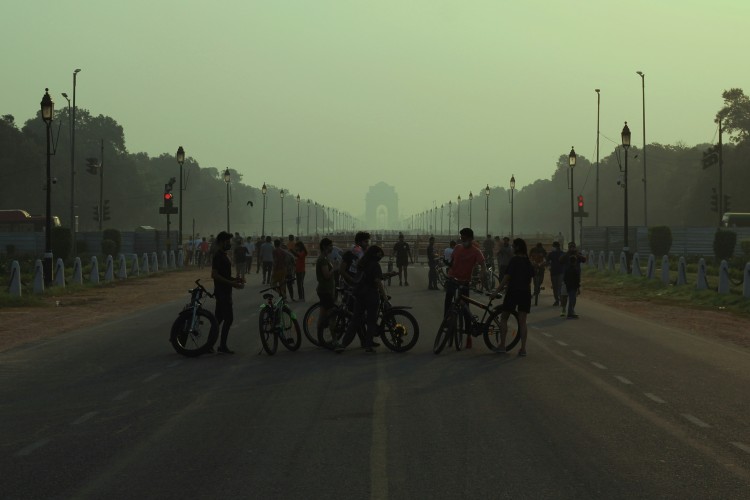
Can pollution pricing help Delhi-NCR clean its air? Every breath in Delhi-NCR carries a cost, much of which is borne by people who have little responsibility for the pollution. A study published in The Lancet Planetary Health estimated that air pollution cost India $36.8 billion in lost economic output in 2019, equivalent to 1.36% of GDP. Delhi recorded the country’s highest per capita economic loss. The study also attributed 1.67 million deaths across India to air pollution that year, accounting for 17.8% of total deaths. The study provides an estimate of the damage that existing pollution-control policies have failed to prevent.
Economists describe this as a negative externality. A factory accounts for the cost of fuel, labour and machinery when deciding how much to produce, but the damage its emissions cause to public health is largely borne by others. These costs include medical expenses, lost working hours and premature deaths. Because the factory does not bear the full social cost of its emissions, it has an incentive to pollute more than is economically efficient. The resulting production decisions impose losses on society.
READ | Delhi air pollution plan may still fall short
Governments have traditionally addressed pollution through prohibitions, restrictions and penalties. Such measures can reduce emissions, but they do not necessarily achieve a given reduction at the lowest possible cost. Two factories may face very different expenses in cutting emissions by the same amount. Requiring both to make identical reductions can be considerably more expensive than allowing the factory with lower abatement costs to undertake a larger share.
This weakness in conventional regulation has been demonstrated in India. An emissions trading experiment in Surat, Gujarat, found that industrial plants operating under a market-based system achieved substantial reductions in particulate emissions at lower abatement costs than plants subject to conventional regulation. The findings offer Delhi-NCR a policy option worth considering.
How pollution pricing changes industrial incentives
A pollution tax charges firms for each unit of emissions, giving them a financial incentive to reduce pollution whenever the cost of doing so is lower than the tax. In principle, the charge should reflect the damage caused by emissions. In practice, estimating that damage and setting an appropriate tax are difficult, particularly when the effects on poorer households must also be considered.
Tradable emissions permits work differently. The regulator sets a ceiling on total emissions and distributes or auctions permits corresponding to that limit. Firms can then buy and sell permits according to their individual abatement costs. A company that can reduce emissions relatively cheaply has an incentive to do so and sell surplus permits. Another company facing higher abatement costs may find it economical to purchase permits.
The distinction is important. A pollution tax fixes the price of emissions while leaving the quantity to respond to that price. A cap-and-trade system fixes the permitted quantity and allows the market to determine the price, subject to any price controls imposed by the regulator.
The appropriate instrument depends on the source of pollution, the reliability of emissions measurement and the administrative capacity of the regulator. Emissions trading is particularly suitable for large industrial facilities where pollution can be continuously monitored. Taxes on fuels, together with emissions standards, may be more practical for dispersed sources.
Both approaches have figured in international climate policy. At COP29 in Baku in November 2024, governments agreed on rules to operationalise carbon-market mechanisms under Article 6 of the Paris Agreement. Those arrangements concern greenhouse gases, whereas Surat’s experiment addressed particulate pollution. Nevertheless, the underlying economic principle is similar: imposing a cost on emissions can encourage firms to find cheaper ways of reducing them.
READ | Air pollution is now a drag on India’s economic growth
Surat’s emissions market offers evidence
India has already tested whether emissions trading can improve industrial pollution control. In 2019, the Gujarat Pollution Control Board introduced an experimental cap-and-trade programme for particulate emissions from coal-burning industrial facilities in Surat.
Of the 318 plants included in the experiment, 162 were randomly assigned to the emissions market, while the remaining plants continued under conventional regulation. Participating facilities were required to use continuous emissions monitoring systems, enabling the regulator to measure pollution more reliably than periodic inspections.
The results, published in the Quarterly Journal of Economics in 2025, were significant. Participating plants reduced particulate emissions by 20–30% relative to the control group. Their estimated abatement costs were 11% lower for a given level of emissions. Plants in the trading programme also held sufficient permits to cover their emissions 99% of the time, compared with compliance with conventional pollution standards of 66% among control plants.
The research, conducted by Michael Greenstone, Rohini Pande, Nicholas Ryan and Anant Sudarshan, provides unusually strong evidence because the programme was evaluated through random assignment. The differences between the two groups can therefore be attributed with greater confidence to the regulatory arrangement.
Continuous monitoring was central to the experiment. Conventional inspections measure emissions at particular moments, leaving considerable scope for violations between visits. In Surat, the regulator could track emissions throughout the compliance period and compare them with the permits held by each facility.
The market also allowed firms to respond according to their costs. Plants capable of reducing pollution relatively cheaply could sell permits, while those facing higher costs could purchase them. The regulator retained control over the overall emissions ceiling and could penalise firms that exceeded their permit holdings.
The evidence supports the case for emissions trading where monitoring is reliable. It does not establish that markets can replace environmental regulation. Indeed, Surat’s success depended on regulatory investment in monitoring systems, enforcement and the institutions required to operate the market.
Why Delhi-NCR presents a harder problem
Surat’s experience cannot be transplanted wholesale to Delhi-NCR. The experiment covered identifiable industrial facilities with measurable emissions. Pollution across the National Capital Region comes from a much wider range of sources, including industrial activity, vehicles, power generation, construction dust, household fuel use and agricultural burning in neighbouring states.
Many of these emissions cannot readily be brought into a permit market. The costs of continuously monitoring small and dispersed sources could exceed the benefits of trading. Different pollutants also require different regulatory treatment. A market designed for industrial particulate emissions cannot automatically regulate nitrogen oxides, sulphur dioxide or other pollutants.
This suggests a gradual approach. Emissions trading could first be considered for large industrial facilities where reliable continuous monitoring is feasible. Other sources would require conventional emissions standards, fuel-related charges or incentives to adopt cleaner technologies.
Distributional consequences also deserve attention. Pollution charges can increase production costs, some of which may be passed on to consumers. The burden can fall disproportionately on poorer households, particularly where essential goods and services become more expensive.
Free allocation of permits raises another concern. In Surat, permits representing 80% of the emissions cap were initially allocated without charge, while the remaining 20% were auctioned. Such arrangements can ease the transition for industry but may also confer valuable benefits on existing polluters.
An expanded system could progressively increase the auctioned share of permits, with part of the revenue used to protect low-income households and finance cleaner public transport. The allocation mechanism would need to avoid rewarding firms simply because they have historically polluted more.
Geography presents an even greater difficulty. Air pollution travels across administrative boundaries, and Delhi’s air quality depends heavily on activities outside the city.
The World Bank has argued that effective pollution control requires action across an entire airshed. Its modelling indicates that Delhi would be unable to achieve the relevant WHO interim air-quality target by 2030 through local measures alone if neighbouring states and countries failed to strengthen pollution controls.
This creates a coordination problem. One state may incur the expense of reducing emissions while neighbouring states receive some of the benefits through cleaner air. Conversely, Delhi can impose charges on pollution generated within its jurisdiction but cannot directly price emissions originating elsewhere.
READ | Air pollution inequality is turning clean air into a class privilege
Delhi needs an airshed-wide pollution policy
The policy choice, therefore, concerns which instruments should apply to different pollution sources and how their implementation should be coordinated.
For large industrial emitters in the NCR, a carefully designed permit-trading programme could build on the Surat experiment. Continuous monitoring would be a prerequisite, and the emissions ceiling would need to reflect the region’s air-quality objectives. The system should also account for the location of emissions, since allowing excessive pollution in a densely populated industrial cluster could create serious local health risks even if the overall cap were respected.
Small and dispersed sources would require a different approach. Fuel taxes, tighter emissions standards and incentives for cleaner alternatives could help address pollution that cannot be measured economically at individual source level. The objective should be to reduce emissions at the lowest feasible social cost rather than impose identical obligations irrespective of abatement costs.
Regional coordination is equally necessary. The Commission for Air Quality Management provides an institutional framework for addressing pollution across Delhi-NCR and adjoining areas, but the effectiveness of regional policy ultimately depends on implementation by the participating governments. The geographical reach of pollution-control measures must correspond more closely to the airshed than to administrative boundaries.
The distribution of costs must also be considered. Revenue from pollution charges and permit auctions could support low-income households and improve public transport, reducing the burden on people who contribute relatively little to the problem. A polluter-pays system will lose much of its public legitimacy if its costs are transferred indiscriminately to consumers.
Delhi-NCR already pays a substantial economic price for polluted air. Much of that burden falls on people who cannot influence the decisions that generate emissions. Surat has shown that changing the financial incentives facing industrial polluters can produce measurable reductions at lower cost. Extending that lesson to Delhi-NCR will require better monitoring, credible enforcement and cooperation among state governments. Without those conditions, pollution pricing will achieve little more than the restrictions it is intended to improve upon.
Anika Verma is an economics student, and Dr Isha Sharma Assistant Professor at School of Social Sciences and Fellow at Centre for Studies in Population and Development (CSPD), CHRIST University Delhi-NCR Campus.