


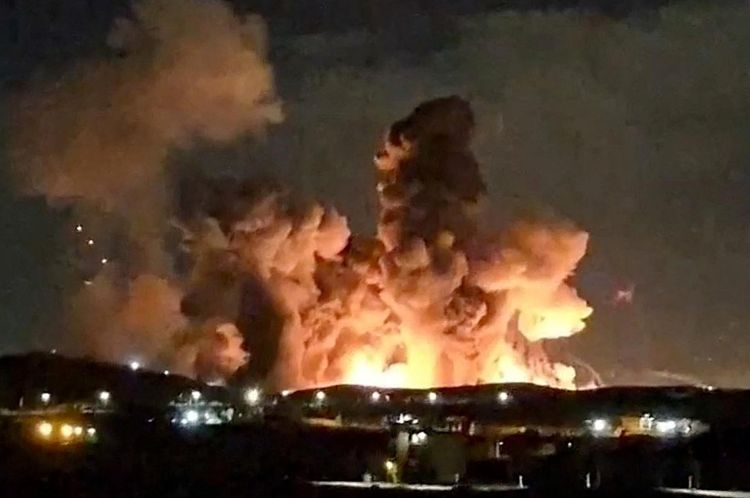
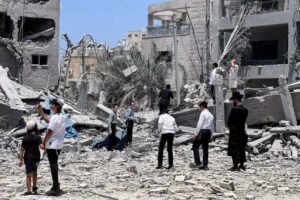
Iran war escalation follows Gaza playbook: The war images coming out of West Asia today carry a disturbing weight. Cities reduced to rubble, children pulled out of debris, hospitals turned into targets, and entire populations pushed into fear and displacement. It raises a troubling question – Is the world witnessing the spread of a new model of war, one that resembles what happened in Gaza? If that is the case, the consequences will be far-reaching. But, even within this grim possibility, Iran is not Gaza. Its history, scale, geography, and state capacity make the situation far more complex and potentially more dangerous.
What is unfolding today indicates a change in how war is being imagined and conducted, says Branko Marcetic who wrote an article reflecting this trend.
READ I US superpower status will be diminished by any Iran exit
Gaza war template in Iran
According to Marcetic, the experience of Gaza appears to have moved beyond a single conflict and is being treated as a template. During the Gaza war, more than 10 percent of the population was killed or injured. Entire neighbourhoods were wiped out, and civilian infrastructure—schools, hospitals, water systems—was systematically damaged. What made it more disturbing was the suggestion, even within sections of US strategic thinking, that this was not an aberration but a model. Reports indicated that some military planners saw Gaza as a kind of rehearsal for future wars, where legal and moral restraints would be loosened, especially against powerful adversaries.

This has come as a major departure from earlier historical attitudes. The carpet bombing campaigns of the Second World War, once justified in wartime, were later widely recognised as moral failures and even war crimes. There was, at least, a degree of hesitation in publicly defending such actions. Today, that hesitation seems to be fading. Instead, the language around war has become more direct, even harsh, with open threats of widespread destruction, as observed by Marcetic.
READ I India’s fertiliser imports hit by Iran war’s quiet shock
Iran war escalation and bombing scale
The current war involving Iran shows this change in a striking manner. In its early phase, the scale of bombardment was intense. Reports suggest that around a thousand munitions were dropped per day in the initial days. Over a span of twenty-six days, Israel is estimated to have dropped around 15,000 bombs, averaging roughly 577 bombs daily. This rate exceeds even the early bombing intensity seen in Gaza, which itself had already been one of the most heavily bombed conflict zones of the century.
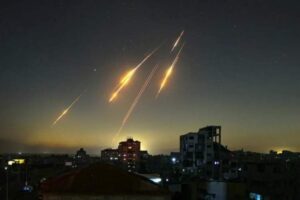
As noted by Marcetic, the scale becomes clearer when looking at targets. In the first four days alone, around 4,000 targets were struck. Within the first hundred hours, the intensity of attacks was reportedly twice that seen in Gaza during a comparable period. These figures are significant because Gaza had already surpassed many recent wars—including Iraq, Afghanistan, and Syria—in terms of bombing intensity.
The human cost has also been severe. One early strike reportedly hit a school, killing more than one hundred young girls. Another attack on a sports hall and an elementary school killed twenty-one people, including children. These were not isolated incidents. Entire residential buildings and blocks have been destroyed, burying civilians under rubble.
READ I Petrodollar power: Venezuela and Iran may extend greenback dominance
Civilian infrastructure destruction
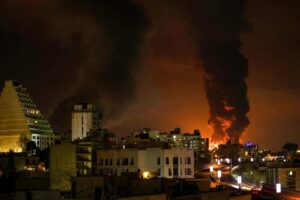
Marcetic wrote that the damage to civilian infrastructure in Iran is also extensive. Estimates indicate that more than 90,000 residential units have been damaged or destroyed. Over 300 health facilities and more than 700 schools and universities have been affected. Essential systems – pharmacies, water infrastructure such as desalination plants, and even historical heritage sites – have not been spared. Nuclear facilities have reportedly been targeted many times, raising the risk of a catastrophic accident. Oil installations in Tehran have been hit, leading to toxic fumes and environmental hazards. Food supply systems, medical production units, and industrial facilities like steel plants have also been attacked.
According to Marcetic, a notable feature of this phase of warfare is the growing reliance on technology and scale. Artificial intelligence is being used for targeting decisions. At the same time, the use of large bombs—ranging from 500 to 2,000 pounds—has increased, especially as precision munitions become scarce. These weapons, by their nature, cause widespread destruction and are difficult to contain within military targets, especially in densely populated areas.
Lebanon displacement pattern
Marcetic said that what is happening in Lebanon follows a similar pattern. Large sections of the population have been displaced, over one million people, which is roughly 20 percent of the country. Evacuation orders have been issued under conditions where civilians have little safe space to go. Entire areas are being cleared and, in some cases, flattened to create buffer zones.
There have also been repeated strikes on healthcare workers and journalists. Dozens of medical personnel have been killed, along with several journalists. In one instance, nine paramedics were killed in a single set of strikes. There are also allegations of the use of white phosphorus in residential areas. Infrastructure essential for daily life—power plants, water systems, and agricultural land—has been repeatedly targeted.
The trend is difficult to ignore. The methods used in Gaza—heavy bombardment, targeting of civilian infrastructure, large-scale displacement, and high civilian casualties—are now visible across multiple theatres. This suggests a major turn in the norms of warfare.
International law and global order
The larger concern is what Iran war escalation means for international law and global order. The idea behind humanitarian law is simple: certain actions must remain unacceptable, regardless of who is fighting. Once exceptions are made, those limits begin to disappear. If one side justifies attacks on civilian infrastructure, others may do the same. This creates a cycle where restraint becomes rare, and escalation becomes easier.
There are already signs of this dynamic. Retaliatory strikes have begun to target similar civilian systems. The logic of war begins to change – from limiting damage to expanding it. In such an environment, the distinction between military and civilian spaces becomes blurred, and societies as a whole become targets.
Iran state capacity
Nonetheless, it is important to recognise that Iran is not Gaza. The differences are significant. Iran is a large, sovereign state with a long history, a complex political structure, and considerable military capability. Its geography alone makes it difficult to contain or isolate in the way Gaza was. Its population is far larger, and its institutions, despite internal challenges, remain functional. Iran also operates within a wider regional and global network, with alliances and strategic depth that Gaza did not possess.
These factors mean that the consequences of applying a “Gaza-style” approach to Iran could be far more unpredictable. The scale of retaliation, the risk of regional spillover, and the potential for long-term instability are all much higher. What may have been seen as a contained strategy in one context can become a far more dangerous gamble in another.
War has always been destructive, but there have been attempts, however imperfect, to place limits on that destruction. What we are witnessing now suggests those limits are weakening. The normalisation of extreme violence against civilian life risks reshaping not just this conflict, but future ones as well.
The images from West Asia today point to a direction in which warfare itself may be heading. If the methods seen in Gaza become standard practice, the cost will not be confined to one region. It will determine how wars are fought elsewhere, affecting societies far removed from the current conflict.
The fear, therefore, is certainly about the scale of destruction, which will undoubtedly be immense. But it will also be about the kind of world that may emerge from it. Iran will not be Gaza, but if the same logic is applied, the consequences may be far more severe, spreading instability across regions and generations.