


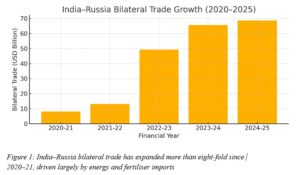
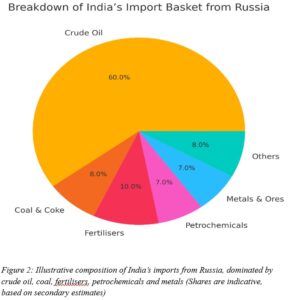
Visa-free travel under India-Russia tourism pact: India and Russia remain close partners in energy, defence, and trade. Bilateral commerce touched $68.7 billion in FY 2024–25, driven by India’s rising dependence on Russian crude and fertilisers. Crude oil accounted for more than a third of India’s import basket from Russia, while fertiliser shipments rose by nearly 370% in two years. India exported barely $5 billion in goods, largely pharmaceuticals, tea, engineering products, and marine items — revealing a wide structural imbalance.
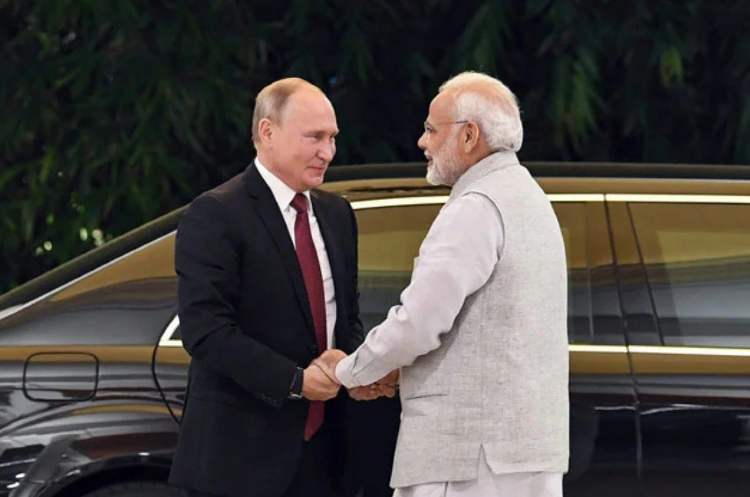
This backdrop explains why both governments are now turning to mobility and tourism to broaden engagement. Tourism is a low-friction economic lever that supports aviation, hospitality, education, and small business linkages. It creates people-to-people familiarity that cannot be replicated through strategic or energy cooperation alone. With President Vladimir Putin scheduled to visit India this week, the planned visa-free group travel agreement is emerging as a significant step in diversifying the bilateral relationship.
READ I India-EU FTA and CBAM: The coming carbon tax shock


Mobility architecture in a skewed trade relationship
Tourism flows between India and Russia remain modest relative to potential. About 120,000 Indians visited Russia in 2024, while over 50 lakh Indians travelled to Southeast Asia in the same year. Russian arrivals in India stood at 175,000, concentrated in Goa, Kerala, and wellness circuits. The disparity suggests that the travel market is underdeveloped, not undersupplied.
The proposed visa-free group travel framework, expected in 2025, is designed to simplify documentation and reduce processing costs. The mechanism will allow organised groups to travel without individual visas. Industry associations such as the Indian Association of Tour Operators (IATO) describe it as a game-changer for students, MSME delegations, families, and budget travellers deterred by cumbersome procedures.
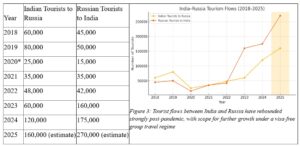

Direct travel volumes have already doubled. Indian arrivals in Russia grew from 60,000 in 2023 to 120,000 in 2024, while Russian arrivals climbed steadily. Combined flows could reach 4.3–4.5 lakh passengers by 2025 if current trends continue. Moscow also recorded a 26% rise in Indian business travellers in 2023, pointing to a steady revival of corporate interest.
Tourism as an economic diversifier
The tourism corridor is gaining momentum for three reasons. First, direct flight connectivity has improved, with Indian and Russian carriers exploring seasonal expansions on the Delhi–Moscow and Mumbai–Moscow sectors. Second, pent-up travel demand has lifted outbound movement among India’s middle-income households. Third, Russia introduced e-visas for Indian citizens in 2023, sharply lowering access barriers.
Industry estimates suggest the visa-free proposal could expand the bilateral tourism economy by $80–110 million a year, driven by higher spending on aviation, hotels, tours, and local services. Hospitality operators expect greater winter traffic from Russia and more youth-focused group travel from India. Travel firms believe the change will bring first-time passport holders from Tier-II and Tier-III cities into international travel — a direction consistent with India’s broader outbound tourism trends, as noted in UN Tourism reports.
Tourism also offers diversification benefits. India’s engagement with Russia is often dominated by energy, defence procurement, and commodities. A larger travel corridor can reduce the narrowness of the economic partnership and build new channels for services, education, and MSME-led trade engagement. For Russia, India represents a large, stable source market at a time when global tourism flows remain uneven.
Aviation, education, wellness, and business travel
The strongest gains may emerge in four sectors.
Aviation: Additional seat capacity on India–Russia routes will support a predictable flow of travellers. Airlines are monitoring demand for new charters, seasonal winter flights, and expanded frequencies. According to DGCA data, outbound India travel continues to scale rapidly, providing a strong base for route planning.
Education: Russia remains a major destination for Indian students in medicine, engineering, and technical sciences. University fairs, winter schools, and immersion programmes are expanding in Moscow, St. Petersburg, Kazan, and the Russian Far East. Simplified travel will support short-term courses and institutional partnerships.
Wellness and medical tourism: Russian travellers show sustained interest in Ayurveda, yoga, and long-stay wellness programmes, especially in Kerala and Goa. India can strengthen this segment through dedicated medical visas, packaged wellness circuits, and improved English-language support services.
Business travel and MSMEs: Corporate movement is rising in pharmaceuticals, energy services, and technology. Visa-free group travel can help build mid-sized trade delegations and encourage cross-border procurement. Dedicated business zones and showcase spaces in each other’s markets would strengthen MSME participation.
India-Russia trade: What governments should do
The proposed travel mechanism is an important beginning, but deeper reforms are required to unlock the corridor’s full potential.
First, the two governments should develop subsidised travel corridors for educational and youth exchanges, modelled on country pairs in East Asia and Europe. Such corridors have a strong multiplier effect on long-term travel demand. Second, both sides can consider pilot visa-on-arrival schemes for select categories such as wellness travellers, medical patients, or academic participants.
Third, tourism promotion needs sharper institutional support. Joint marketing campaigns, bilingual digital platforms, and simplified customs rules for group travel can reduce friction for first-time travellers. Fourth, MSME-focused trade facilitation should be strengthened. Dedicated business centres in major commercial hubs — Delhi, Mumbai, Moscow, and St. Petersburg — would support long-term commercial partnerships.
Finally, safety, insurance coverage, and information support must be expanded to encourage first-time travellers. Clear protocols will be essential if India aims to widen participation beyond metropolitan travellers.
India and Russia are preparing for a new phase of economic engagement centred on mobility and people-to-people linkages. The visa-free group travel proposal can reshape the bilateral tourism engagement, expand economic diversification, and mitigate the structural imbalance in the trade relationship. The measure widens economic benefits beyond energy and defence, and opens new avenues for aviation, education, wellness, and MSME sectors. If implemented with supporting reforms, the India-Russia travel corridor could become one of the most dynamic bilateral mobility partnerships in the coming years.
Dr Priya Gupta is Associate Professor at Atal Bihari Vajpayee School of Management and Entrepreneurship, Jawaharlal Nehru University, New Delhi.