


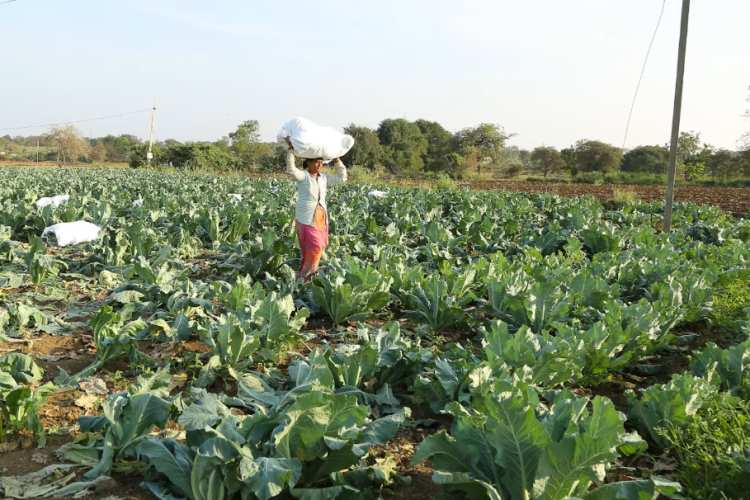
Farm income gains: Mangalsingh Ganaga cultivates six bighas of irrigated land in Phalwa village in Rajasthan’s Banswara district. He grows maize, black gram, sesame and patharia rice during the kharif season, and chickpea and wheat in winter. The family also keeps buffaloes, bullocks, cows and goats. In July 2025, Ganaga tried turmeric on a 20 ft by 25 ft plot. The crop brought in Rs 15,000.
The amount is modest in absolute terms. The experiment is useful for another reason. Ganaga did not replace his regular crops or commit much land to turmeric. He added a small commercial crop to an existing farm economy built around grain and livestock, and processed part of the harvest before selling it.
READ | Why fertiliser subsidy reform is vital for Indian agriculture
Phalwa lies in Anandpuri tehsil, where many households depend on farming and animal husbandry. Ganaga had wanted to try crops outside his established rotation but had little technical guidance. Lalita Makwana, a community facilitator with VAAGDHARA, introduced him to the organisation’sGram Swaraj Samuh and its Sachchi Kheti programme. He later reduced the use of chemical fertilisers and pesticides and began relying more on cow-dung manure and dashparniextract.
VAAGDHARA supplied five kilograms of turmeric seed. Ganaga planted it in the first week of July 2025 and used about 400 kg of manure from his livestock. Training came through the organisation’s Farmer Field School. The crop was harvested in May 2026. Five kilograms of seed yielded 60 kg of turmeric.
A small plot, a higher-value crop
Ganaga sold 20 kg of raw turmeric at Rs 150 a kg and received Rs 3,000. He ground another 30 kg into powder and sold it at Rs 400 a kg, earning Rs 12,000. The remaining 10 kg was kept for household use and for seed.
The sale figures show the advantage he obtained from processing. Thirty kilograms sold as powder brought four times the revenue earned from 20 kg sold raw. The comparison has limits. The available account does not separate the cost of grinding, packaging or labour, so Rs 15,000 cannot be treated as net profit. Still, the difference in realised prices explains why processing made sense for a farmer with a small quantity to sell.
Ganaga also kept maize on the same land. That reduced his exposure to an unfamiliar crop. If turmeric had failed, the household would not have lost the output of the entire plot. Small farmers have little room for an experiment that displaces established food crops and then goes wrong.
The turmeric found buyers locally. According to VAAGDHARA’s account, Ganaga did not have to take the produce to a distant market. Buyers came through word-of-mouth. There is no evidence yet that the same market can absorb much larger quantities. If several farmers increase production, prices and demand may look different.
Processing and farm income
A small holding puts a limit on how much income can be raised through higher output alone. Ganaga’s turmeric patch covered only 500 sq ft. Processing allowed him to obtain a better price from part of what he produced.
That is a familiar problem in agriculture. The farmer often sells the least processed form of a crop, while much of the subsequent value is captured in cleaning, processing, packaging and retail. Ganaga performed only one additional step, grinding turmeric into powder, but the selling price rose from Rs 150 to Rs 400 a kg.
The case does not establish turmeric as a particularly profitable crop across regions. Yield, labour, input costs and market prices will vary. It shows something more limited. A farmer can test a higher-value crop without shifting a large share of land into it, and processing can improve the price realised from a small harvest.
The scale of the trial helped. Ganaga began with seed supplied by the programme and cultivated a small plot under technical supervision. A failed crop would have hurt, but it would not have jeopardised the season’s entire production.
His livestock also reduced the cost of adopting organic cultivation because manure was available on the farm. Another cultivator may have to buy the same input. Any attempt to replicate the model has to account for that difference. A cropping practice that works with manure, labour and animals already available within a household may produce different economics where those inputs must be purchased.
Several sources of farm income
Turmeric is only one part of the Ganaga household’s earnings. Mangalsingh’s wife, Shantidevi Ganaga, received a vegetable kit under VAAGDHARA’s Poshan Vatika programme. She grew vegetables including okra, cowpea, bottle gourd, ridge gourd, tomato, brinjal, cluster beans, fenugreek, spinach and chilli.
Shantidevi reported earning Rs 60,000 from vegetable sales during the year, apart from the produce consumed by the family. Her reported earnings were considerably higher than the cash income from turmeric. The comparison is useful because it shifts attention away from the search for one superior crop.
The household continues to grow grain. Vegetables bring cash income. Livestock supplies milk and manure. Turmeric provides another saleable crop. A poor return from one activity does not wipe out the income from the others.
This is also why crop diversification cannot be reduced to moving farmers from lower-value crops into commercial crops. A small farmer who replaces too much of an established cropping pattern takes on price and production risks that a larger farmer may be better able to absorb. Ganaga limited that risk by trying turmeric on a small area while leaving the rest of the farm largely unchanged.
The Farmer Field School addressed another constraint. Advice was available during the trial rather than after the farmer had already committed land and money. For an unfamiliar crop, errors in sowing, manure application or crop management can wipe out the expected return. Extension support reduces some of that risk.
The next crop will provide a better indication of whether turmeric can become a regular part of Ganaga’s farm. He has retained seed from the first harvest and will no longer depend on the initial seed supplied by the programme. Future returns will depend on yield, his own input costs and the price he can obtain from buyers.
One successful harvest cannot settle those questions. It does show how a small farmer can add a commercial crop without dismantling an existing farming system. In Ganaga’s case, the gains came from keeping the experiment small, using resources already available on the farm and selling part of the crop in processed form.
Vikas Parashram Meshram is an independent journalist and development-sector writer with more than 14 years of field experience. His work focuses on rural development, tribal communities, agriculture, and sustainable farming.