


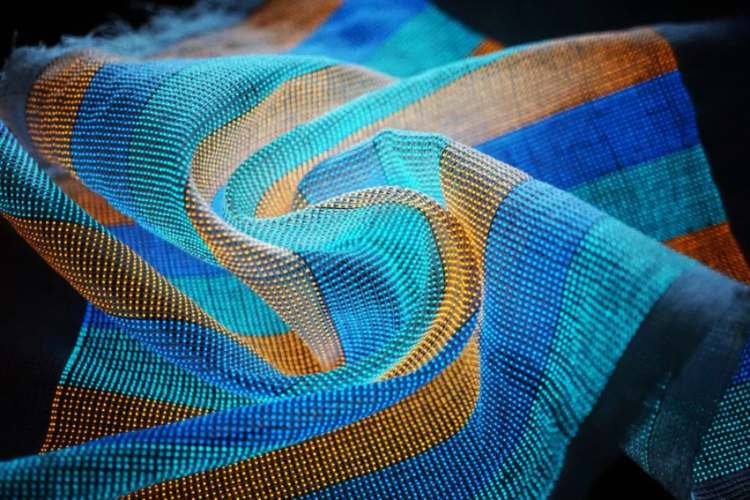
Electrogenic textiles and India’s industry In the heart of India’s industrial hubs, a silent crisis flows through the waterways. Textile industries, the backbone of our economy, produce millions of liters of wastewater daily, laden with toxic dyes and organic pollutants such as methylene blue and congo red. These dyes block sunlight, hindering photosynthesis in aquatic plants and depleting dissolved oxygen, leading to “dead zones” where fish and other aquatic life cannot survive.
Many of these synthetic dyes are carcinogenic and mutagenic, that seep into the groundwater and enter the food chain. With millions of liters of wastewater produced daily, traditional infrastructure often fails to keep pace, leading to direct discharge into local rivers.
Traditional methods to clean waters such as activated sludge process or advanced oxidation processes do exist, but they are often energy-intensive and expensive. These systems require massive amounts of electricity to pump air into tanks, supplying oxygen to help waste-eating bacteria break down the pollutants.

READ I Clean energy: A national roadmap for affordable power
The costs are high too: high energy bills and the need for expensive chemical coagulants makes it difficult for smaller dyeing units to maintain these treatment plants. Besides, many traditional chemical treatments produce toxic sludge that requires expensive disposal mechanisms, creating a new environmental problem.
Turning this environmental burden into a source of clean energy could be a gamechanger. This author’s research shows that by merging the world of advanced materials such as microfibers, carbon nanotubes and conducting polymers with the power of nature’s smallest workers – bacteria – a flexible, fabric-based system can be created that not only cleans wastewater, but simultaneously generates electricity.
Germs that breathe electricity
Traditional water treatment systems rely on rigid, heavy electrodes that are difficult to scale and often fail to support microbial growth. In their work, this author and his team have reimagined the electrode as a flexible textile that removes pollutants and also generates electricity.
The researchers began by using a polyester microfiber nonwoven fabric made from waste PET plastic bottles. The fabric was made by the Department of Textile and Fibre Engineering, IIT Delhi, using the PET microfibers sourced from recycled plastic bottles.
Similar to high-tech industrial fabrics such as those used in smart wearable electronics and specialized industrial filtration, they integrated carbon nanotubes (CNTs) and a conductive polymer called polyaniline (PANI) to produce a ‘smart’ fabric that cleans, and generates electricity too.
Nanotubes provide a high surface area for transporting electrons, like cars speeding on a highway. But speeding cars need bridges or entry ramps to get onto highways, and PANIs act like these bridges to help the electrons attach securely to the CNTs.
The star of this clean-up job though is specialized bacteria known as exoelectrogens. Unlike typical germs, these microbes have the unique ability to “breathe” electricity. As they consume organic pollutants in textile wastewater, they release electrons, which are captured by the textile fabric and turned into a steady stream of power.
This process is aided by two factors: a massive surface area that enables more space for bacteria to attach and form dense biofilms, and increase the rate at which they consume pollutants.
High conductivity, enabled by materials like carbon nanotubes and polyaniline, ensures the electrons released by these microbes are captured and transported efficiently.
Polyaniline is hydrophilic – loves water – and biocompatible, qualities that help the bacteria transfer the electrons produced as a bio-product of the clean-up job, more easily.
Together, these properties allow the textile to generate nearly 2,000 times more electricity than normal materials, even as it effectively cleans wastewater.
Previously used materials include rigid graphite rods and carbon cloth, which offer significantly lower surface areas for microbial growth. The energy generated can only potentially power low-energy sensors or LED indicators within the treatment plant.
Researchers including this author have discovered that what helps electrogenic (electricity generating) textiles raise their ‘power quotient’ is a specific, uncultured strain of dye-degrading bacteria called Lysinibacillus.
While using real wastewater from local dyeing factories, they found that this strain naturally dominated electrogenic textiles.
Lysinibacillus bacteria are biological marvels – they grow tiny, conductive “nanowires” and secrete redox molecules that act like microscopic power lines, shuttling electrons from their bodies to the fabric with incredible efficiency.
Electrogenic textiles: Fabrics as electrodes
Treating wastewater is challenging, given the high costs and the polluting by-products of the process. Smart textiles with high surface area and conductivity can be scalable options in solving the problem.
This author and his team’s latest experiment uses several similar pieces of textiles as electrodes in a reactor designed to produce electricity from polluted water, even as it cleans. Each fabric is coated with slightly different materials to attract various electrogenic microbes.
The experiment showed very promising results — besides doing the main job of removing over 82 percent of harmful dyes from real industrial wastewater, this reactor was able to remove about 86 percent of the Chemical Oxygen Demand (COD).
COD is a key indicator of the level of pollutants present in industrial wastewater; it tells us how much oxygen would be required to chemically break down contaminants. A large reduction in COD suggests a substantial improvement in water quality.
Unlike conventional wastewater treatment systems which consume large amounts of electricity, this reactor produced enough electrical power to potentially offset part of its own operating costs. In other words, instead of using energy to clean water, the system begins to recover energy from waste.
The microbes also produced useful chemical byproducts during the treatment process. One of these was malonic acid, an industrially valuable compound used in the manufacture of pharmaceuticals, perfumes and specialty plastics.
The textile-based electrodes are flexible, inexpensive, and easier to manufacture in large areas. More importantly, the system operates using real industrial wastewater rather than carefully prepared laboratory solutions, bringing the technology closer to practical, real-world use.
Towards a truly circular economy
In India, where industrial growth must be balanced with environmental preservation, electrogenic or ‘smart’ fabrics offer a viable option. Its flexible, scalable nature means it can be adapted to various reactor designs from small-scale units for local dyers to large industrial treatment plants.
By looking at wastewater not as a problem to be discarded into the rivers but as a resource to be harvested, we could move towards a truly circular economy. The clothes we wear may have once polluted our rivers, but through this smart fabric technology, the waste from their production can help power a cleaner, greener tomorrow.
Rahul Kandpal is a PhD candidate at the School of Interdisciplinary Research, Indian Institute of Technology (IIT), Delhi. Dr ZA Shaikh is Professor, Department of Biochemical Engineering and Biotechnology, IIT, Delhi. Dr S Wazed Ali is Professor, Department of Textile and Fibre Engineering, IIT, Delhi. This article has been commissioned in conjunction with Prototypes for Humanity, a global initiative that showcases and accelerates academic innovation to solve social and environmental challenges.