



Domestic investors cannot shield rupee from FPI outflows: Indian households have become substantial buyers of shares just as foreign investors have demonstrated how readily they can sell them. In August 2026, monthly contributions through systematic investment plans reached ₹32,297 crore, with more than 10 crore contributing SIP accounts, according to the Association of Mutual Funds in India. These are accounts, not individual investors, but the growth in regular investment has broadened the domestic market’s base.
That gives India some protection against foreign selling. It does not remove the demand for foreign exchange when investors repatriate their money. Domestic savings can help absorb the shares they sell while the rupee remains under pressure.
READ | India’s crypto regulation vacuum leaves investors exposed
The distinction has become more pressing as foreign exchange reserves have declined. Reserves stood at $726 billion in the week ended October 9, according to RBI figures reported on October 16. A stronger domestic investor base should therefore prompt a more careful assessment of external vulnerability, rather than confidence that India has outgrown it.
Domestic savings absorb shares, not dollar demand
Every sale of shares requires a buyer. When a domestic mutual fund buys from a foreign portfolio investor, Indian household savings help finance the transaction. Sustained domestic buying can cushion the effect of foreign sales on prices, although it cannot guarantee that prices will hold.
The transaction has another stage if the foreign investor decides to take the proceeds abroad. The buyer pays in rupees; the departing investor seeks foreign currency. Selling shares does not automatically entail repatriation, since the proceeds may be reinvested in India. When repatriation occurs, however, domestic buying has supplied no corresponding foreign exchange.

That demand must be met by someone willing to sell foreign currency. Export earnings and remittances provide it, as do fresh capital inflows. Banks intermediate these transactions, and the RBI can supply dollars from its reserves when it judges intervention necessary. Otherwise, the exchange rate adjusts until demand and supply come into balance.
The growing participation of Indian households is a considerable financial achievement. It gives companies access to a broader pool of savings and makes the equity market less dependent on the decisions of overseas funds. But the ability to finance domestic investment in rupees cannot be treated as an ability to meet every claim denominated in dollars.
READ | Will India’s financial sector reforms win back investors?
What the balance of payments reveals
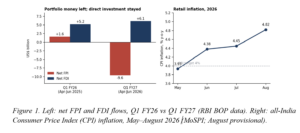
The April–June 2026 figures illustrate the distinction. Net portfolio investment recorded an outflow of $9.6 billion, against an inflow of $1.6 billion a year earlier. Net foreign direct investment remained positive at $6.1 billion, up from $5.2 billion. The current account deficit was $4.2 billion, or 0.5% of GDP. Foreign exchange reserves nevertheless declined by $8.1 billion on a balance-of-payments basis, which excludes valuation changes.
A modest current account deficit can therefore coexist with pressure on reserves when capital inflows fail to cover the country’s external financing requirement. Portfolio outflows contributed to that pressure. They cannot, by themselves, explain the entire balance: borrowing and other financial transactions also enter the calculation.
The subsequent weekly reserve figures require similar care. The reported stock fell from about $780.8 billion on September 11 to $726 billion on October 9. Those headline numbers include changes in the dollar value of gold and assets held in other currencies. The difference cannot be read as the amount the RBI spent defending the rupee, much less as a direct measure of foreign equity withdrawals.
Reserve adequacy also depends on the obligations those assets may have to meet. Import requirements, short-term external debt and potential capital outflows all deserve attention. A large reserve stock provides substantial protection, but its headline value alone cannot settle how much protection is sufficient.
A weaker rupee raises the oil bill
The household consequences become clearer when currency depreciation coincides with a rise in crude prices. India imports most of its crude oil, whose international price is generally expressed in dollars.
Consider an illustration, not a forecast. If crude rises from $80 to $100 a barrel while the rupee weakens from ₹90 to ₹95 per dollar, the rupee cost rises from ₹7,200 to ₹9,500 a barrel. A 25% increase in the dollar price becomes an increase of almost 32% in rupees, before freight, taxes and other costs.
The increase does not pass through mechanically to petrol prices or consumer inflation. Taxes and pricing decisions can absorb part of it, while businesses may accept lower margins. Even so, someone bears the cost, whether through higher prices, reduced profits or a fiscal concession.
READ | Sovereign green bonds: Why investors are holding back
Retail inflation reached 5.54% in September, according to the government’s October 12 release. That strengthens the case for limiting additional imported price pressures, without implying that depreciation caused the rise in inflation.
A weaker rupee can also help exporters by raising the domestic value of foreign-currency receipts. The benefit varies with imported input costs and the terms on which firms sell abroad. Depreciation can assist adjustment, but it does not improve every exporter’s competitiveness by the same amount.
For the RBI, higher interest rates may help contain inflation and support the currency, while also raising borrowing costs for domestic activity. Dollar sales can moderate abrupt exchange-rate movements, but repeated intervention uses reserves. Neither instrument removes the underlying trade-off.
Stable capital must strengthen foreign exchange earnings
India’s vulnerability should consequently be assessed through its external accounts as well as its stock indices. The relevant question is whether recurring foreign exchange earnings and sustainable capital inflows can meet external payments without prolonged reserve depletion.
Encouraging patient domestic capital remains worthwhile. It can finance productive investment and reduce companies’ reliance on volatile funding. Its contribution to external resilience depends on what that investment produces. Financing an exporter or an economically viable substitute for imports has a different foreign exchange consequence from financing an activity that generates rupee revenues while requiring imported equipment and fuel.
Foreign direct investment can provide more durable funding than portfolio flows, particularly when it establishes productive capacity and brings access to overseas markets. It also creates future claims through dividends and eventual repatriation. Policy should favour investment that expands the economy’s capacity to earn foreign exchange, rather than judge success solely by the size of the initial inflow.
The RBI should retain room for gradual exchange-rate adjustment while curbing disorderly movements. Trying to preserve a particular rate indefinitely can become expensive; allowing abrupt depreciation can impose avoidable costs on firms with foreign-currency obligations.
The government’s task takes longer. More competitive exports and lower oil dependence would reduce the frequency with which the RBI must choose between reserve sales and currency adjustment. Domestic investors can buy the shares foreign investors sell. India must still earn, attract or borrow the foreign exchange those investors take home.
Prachi Khanna is a student and Dr Shivani Chaudhry Associate Professor at Christ University Delhi NCR campus.