


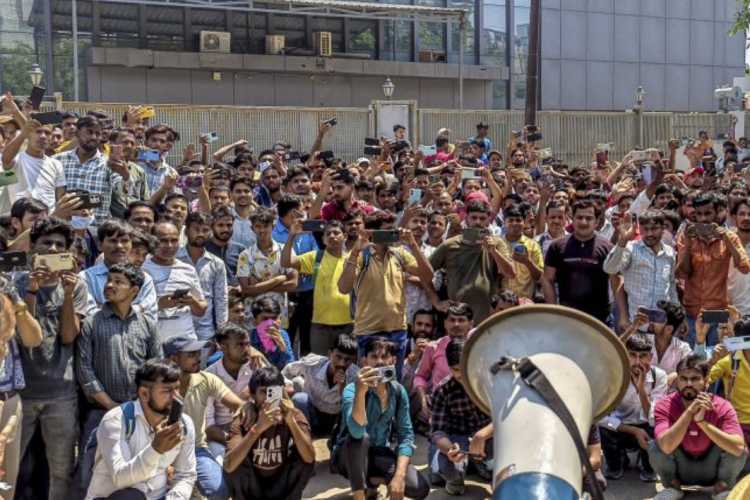
Delhi-NCR labour unrest: The industrial belt of Delhi-NCR was recently shaken by spontaneous and violent labour protests. These wildcat strikes led to arson, vandalism, and clashes. Factory workers were demanding higher wages and better working conditions. Their grievance was real. Low wages had made even basic survival difficult. Their demands were eventually accepted. The protests died down. But the larger question remains: at what cost?
Labour rights and violence
Workers have the right to protest, strike and organise around their demands. These rights are protected by labour laws, the Constitution and international labour standards. But no credible theory of labour relations treats violence as a legitimate instrument of struggle.
READ | Migrant labour shortage exposes South India’s industrial vulnerability
This does not diminish the workers’ cause. It recognises a boundary. Violence cannot become a tactic to pressure employers, governments or labour authorities. A legitimate demand loses moral force when pursued through arson, intimidation or physical assault. Even radical labour thinkers have drawn this distinction. The ILO’s Committee on Freedom of Association recognises broad rights of association and protest, but violent strikes fall outside that protection.
Scenes of workers pelting stones, torching vehicles, abusing officials or threatening life and limb weaken their own case. They erode public confidence in strikes as a valid instrument of labour justice. They also give the state justification to deploy police, armoured vehicles and armed personnel. A workplace then becomes a fortified battlefield.
International labour standards discourage excessive police intervention in strikes. But violence by strikers gives the repressive machinery its opening.
Delhi-NCR’s labour flashpoints
Violent labour unrest has surfaced repeatedly in Delhi-NCR and nearby industrial belts. The Maruti Manesar violence, where a senior HR executive was killed, remains a grim marker. At the Nippon Allied plant in Ghaziabad, a head of HR was fatally injured. More recently, a bitter contractual labour dispute at BPCL in Uttar Pradesh led to the killing of two managers.
These episodes cannot be dismissed as isolated breakdowns. They point to a deeper failure of industrial relations. Even routine labour rights such as minimum wages, overtime and bonus often seem difficult to secure without militant mobilisation. That raises a harder question. Why do labour conditions return to the old state even after periodic, vehement strikes?
The first layer of enforcement begins with workers themselves. This is best understood by comparing the northern industrial belt with the industrial relations culture in southern India, where I worked for years as a conciliation officer.
READ | Labour codes begin India’s harder reform phase
Southern labour struggles show another path
Southern states see frequent labour protests. They cover electronics, aviation, manufacturing, municipal work, mining, anganwadi services and transport. Recent examples include workers of KMML in Kerala, Samsung India in Tamil Nadu and transport workers in Karnataka. The Samsung India strike, in particular, became a case study in how labour struggles can be launched and sustained.
What is striking is not the absence of conflict. It is the absence of chaos. Labour struggles in the South are intense, but they usually remain within the industrial arena. A strike means refusal to work. Protest means organised dissent against management. Workers and unions generally keep their action within that framework.
This discipline matters. Collective action rarely spirals into a law-and-order crisis. The principles of labour movement are preserved even when the struggle is sharp.
Trade unions and the art of negotiation
The difference is not only higher industrial development or relatively better labour prosperity. It is a different view of labour struggle. Workers and trade unions are not focused only on immediate relief. They seek a lasting structure of union-management engagement.
That requires method. Workers tend to have greater awareness of legal entitlements and available remedies. Their first effort is usually bipartite settlement between management and workers. If that fails, they approach labour authorities. Even then, dialogue continues.
This culture of conversation is the hallmark of southern labour struggles. It reduces the temptation of instant militancy. It also prevents disputes from sliding into violence.
READ | Women entrepreneurs grow, but labour gaps persist
Strikes are used after other means are exhausted. Banners, placards, speeches and assemblies form part of the protest. But communication with employers does not end. In an Air India strike at Thiruvananthapuram in 2024, the union moved to strike after negotiations failed. Its methodical and legalistic approach forced a settlement within 48 hours.
The lesson is simple. Labour struggle is not a ready-to-serve item where a demand is made and instantly delivered. It is a long effort, backed by pressure, law, organisation and continuous conversation.
Labour enforcement needs worker discipline
This sustained approach is reflected in statutory entitlements in many southern states. Minimum wages, bonus payments and leave accounts are often better protected than in several other regions.
An effective labour struggle requires clarity about ends and discipline in the choice of means. Workers and unions driven by emotive outbursts may secure short-term relief. But they cannot build a durable labour structure. They cannot compel labour authorities to discharge their duties consistently. Nor can they force employers to stop evading statutory obligations.
Violence may produce an immediate concession. It rarely produces lasting justice. Workers need stronger organisation, sharper legal awareness and a culture of negotiation backed by credible collective action. Without that, each eruption will end in exhaustion, repression and a return to the same old conditions.
Rohit Mani Tiwari is Regional Labour Commissioner, Thiruvananthapuram. Views are personal.