


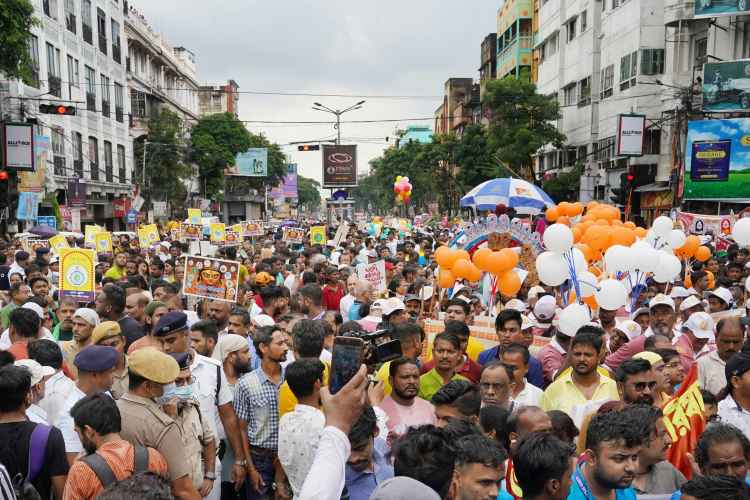
Algorithmic transparency: Democracies have always debated who gets to speak. Increasingly, however, the more important question is who gets heard and how? As tents are folded at Jantar Mantar and barricades come down, the protests that began as anger over the leaked NEET paper throws up this fascinating question. And the answer lies not in what happened on the streets, but in what happened on our screens.
The mode of engagement amongst citizens and, more importantly, between citizens and the state has fundamentally altered. A notification, a reel, a trending hashtag or a forwarded message today can metamorphose into civic participation. For perhaps the first time at this scale, the digital conversation did not merely accompany the protest. In many ways, it became the protest. That transformation is worth celebrating. During the protests, students documented events in real time, organised support, shared legal information, mobilised peacefully and, true to their generation, even found moments of humour through memes and reels.
READ | Income inequality: What India’s tax data conceals
Social media lowered the barriers to participation and gave young citizens a voice that traditional institutions failed to provide. But it also raised a difficult policy question: who decides which conversations reach us in the first place? That question becomes especially important when misinformation enters the mix.
As the old saying goes, ‘a lie gets halfway around the world before the truth has its shoes on’. Like almost every major public event today, the protests were also accompanied by misinformation. AI-generated videos were knocked down by PIB, claims of a woman police officer losing her unborn child debunked and the police traced more than 400 accounts pushing fabricated content, some linked to handles operating out of Pakistan. But here is the uncomfortable part: even people who later learned a video was fake often couldn’t fully unsee it.
Psychologists call this the ‘continued influence effect’. In other words, corrections matter but they rarely erase first emotional impressions completely. This is particularly significant in an age dominated by short-form video. We often say that a picture is worth a thousand words. Today, a fifteen-second video may be worth thousands more. It evokes emotion before it invites reflection.
READ | India-UK CETA puts exporters’ capacity to test
Now scale this up. With over a billion internet users and nearly half a billion social media users, cheap data and widespread smartphone access have democratised information like never before. For India’s Gen Z especially, spending well over three hours a day on these platforms, social media is no longer just a place to stay connected. It is where news breaks, opinions are formed, communities emerge and civic participation begins. As a handful of platforms increasingly mediate everyday communication, questions of transparency as well as that of market concentration become pertinent.
I noticed something odd on Reddit and in WhatsApp groups during these weeks. Profession-based, city-based, even lifestyle and hobby-based groups suddenly turned, almost overnight, into hunger strike discussion threads. That’s not necessarily manipulation; it may just be how attention moves now. But it’s also a reminder that platforms built for niche conversation can be repurposed, in a day, into engines of a single narrative and we have no visibility into why that happens. Is it genuine public interest, algorithmic amplification or coordinated activity? There’s no way to know.
Importance of algorithmic transparency
This is where algorithmic transparency has a role to play. The idea that platforms should have to explain, in terms a regulator or researcher can actually audit, how their ranking systems decide what gets amplified and what gets buried. Not the source code, but the logic. What signals determine whether one post reaches ten people while another reaches ten million? Why is one narrative repeatedly recommended while another quietly disappears? Why does one citizen see one version of reality while another sees something entirely different? Which factors influence what appears on a user’s feed, and to what extent are commercial or political considerations embedded in those recommendations?
READ | Unemployment crisis: Exam queues are wasting away demographic dividend
These questions sit at the heart of democratic accountability. The Cambridge Analytica scandal demonstrated how digital platforms could be exploited to influence political behaviour through highly targeted messaging, pushing algorithmic accountability into mainstream policy debates across the world. Since then, jurisdictions such as the European Union have moved towards greater transparency obligations for very large online platforms through the Digital Services Act, recognising that recommender systems themselves deserve public scrutiny.
India isn’t starting from zero here. The Digital Personal Data Protection Act and its 2025 Rules require ‘Significant Data Fiduciaries’, which includes large social media platforms, to undertake periodic audits and maintain due diligence mechanisms around the processing of personal data. Amendments to the IT Intermediary Rules earlier this year mandated labelling of AI-generated content and faster takedown timelines for unlawful material. What’s still missing is teeth around the ranking algorithm itself, and a genuine competitive check to the concentration of power in the hands of a few platforms. The next frontier of regulations should discuss independent audits of recommendation systems, greater disclosure around ranking criteria, meaningful user choice over recommendation settings and stronger competition across digital platforms.
None of this is an argument for greater censorship. The digital platforms gave a genuinely disorganised, decentralised protest its energy, its memes, its story, and its ability to out-organise a government machine. That is worth celebrating, not policing away. But a generation that can mobilise a nation through a feed deserves to know why that feed appears on their screen.
Sakshi Abrol is a doctoral researcher at the Right Livelihood College (RLC), Center for Development Research, University of Bonn, Germany.