


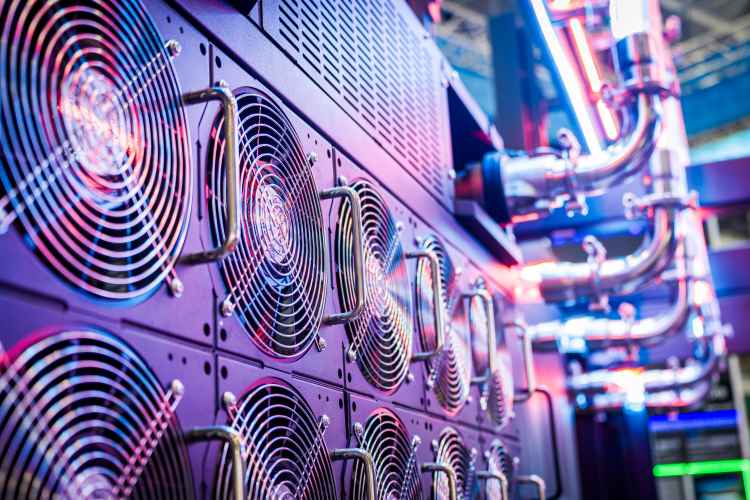
AI is driving a parallel race to build data centres and computing capacity. India has good reason to compete. Domestic AI infrastructure can attract capital, support local computing demand and reduce dependence on capacity located overseas. Yet a data centre is also a large industrial installation that consumes electricity continuously and, depending on its cooling system, can draw heavily on local water supplies. India’s AI policy will therefore have to account for the physical demands created by the digital economy.
Microsoft, Google, Amazon Web Services and other technology companies have announced large investments in cloud and AI infrastructure in India. Demand is being supported by greater use of cloud services, rising AI adoption and the continuing expansion of India’s digital economy. Several state governments are competing for these investments, with Hyderabad, Chennai, Mumbai, Bengaluru and Visakhapatnam among the prominent locations. The attraction is understandable. Countries that host substantial computing capacity will be better placed to support domestic AI companies and large users that would otherwise buy such capacity abroad.
READ | US Big Tech’s AI race is becoming a race for monopoly
The difficulty begins when data centres are treated as though their environmental footprint ends at the site boundary. Thousands of servers run around the clock. Cooling may require considerable quantities of water. Several large facilities built in the same urban region can add to peak electricity demand and draw from the same groundwater sources. These pressures are especially relevant in Indian cities where utilities are already dealing with rising consumption and periodic water shortages.
Project-by-project approvals can miss these cumulative effects. One data centre may appear manageable when assessed against the capacity of a local grid or water source. Five large facilities drawing from the same system may produce a different result. State governments that are courting data-centre investment therefore need to know how much additional electricity and water a proposed cluster will require before offering land or incentives.
Experience elsewhere provides some warning. The United States has the world’s largest concentration of hyperscale data centres, while disputes in several states have arisen over electricity demand, water use, noise and pressure on local infrastructure. Ireland tightened planning and grid rules around Dublin after data centres came to account for a substantial share of electricity consumption. The Netherlands and parts of Germany have also considered tighter conditions for large facilities. India can incorporate these lessons while its own data-centre market is still expanding.
Environmental guardrails for AI infrastructure
Stricter rules can themselves become a problem if approvals are unpredictable or governments change conditions after companies have committed capital. Technology firms deciding where to locate a large data centre compare power availability, operating costs and approval risk across countries and states. A government that cannot state its requirements before construction begins adds uncertainty to an investment that may run for decades.
READ | India’s outsourcing industry threatened by AI boom
India should therefore have environmental guardrails that are published in advance and applied consistently. Regulatory paralysis often begins when governments postpone difficult decisions during the investment phase and impose restrictions only after electricity or water shortages provoke public opposition. A developer can calculate the cost of a known water-use standard. It cannot readily price an approval regime in which restrictions depend on what happens after the facility has been built.
Environmental appraisal for large data-centre clusters should examine cumulative demand on the local grid and water supply. Where groundwater is already under stress, approval conditions can require developers to reduce dependence on freshwater. Recycled wastewater and closed-loop cooling are among the options available, though the appropriate system will depend on location and plant design. The regulation should specify the resource constraint to be met rather than prescribe one technology for every project.
Power planning needs similar discipline. Data centres operate continuously, while solar and wind generation varies through the day and across seasons. Renewable-energy procurement can lower emissions, but an annual claim that electricity consumption has been matched by renewable purchases says little about the strain placed on the grid at particular hours. Regulators and state utilities need to examine the actual demand profile of large facilities and the additional transmission or generation capacity required to serve them.
Standardised disclosure would give governments better information for future approvals. Large operators could report electricity consumption and water use under common definitions, with separate disclosure where recycled water substitutes for freshwater. Such data would allow state agencies to see whether an existing cluster is approaching local resource limits. It would also reduce disputes over sustainability claims that cannot otherwise be compared across companies.
READ | AI and sustainability: The cost behind the green promise
State governments should incorporate data-centre clusters into industrial and urban planning before approving a succession of individual projects. A location with adequate transmission capacity but severe water stress may be unsuitable for facilities that rely heavily on water-based cooling. Another location may have sufficient land and water but require major grid investment. Such constraints should influence where incentives are offered.
India will lose little by asking these questions early. It could lose considerably more if state governments encourage dense data-centre clusters and discover later that local grids or water supplies cannot support them. Restrictions imposed after shortages emerge are likely to be harsher, politically contentious and harder for investors to anticipate.
The global AI race will increasingly depend on access to reliable computing capacity. India is well placed to attract part of that investment and has a strong strategic reason to do so. Clear rules on power and water use would make that expansion easier to sustain. The alternative is to allow resource constraints to accumulate until governments are forced into the regulatory paralysis that both investors and host communities would prefer to avoid.
Anusreeta Dutta is a columnist and researcher with experience in political research analysis, ESG research and energy policy.