


India’s electronics exports rose 47% to $38.61 billion in the seven months to October 2026, according to the Commerce Ministry’s provisional trade figures. October alone brought in $6.64 billion, up 63% from a year earlier. On November 25, Sushil Pal, a joint secretary in the Ministry of Electronics and Information Technology, said exports could exceed $60 billion this financial year. The more consequential change is in the mix.
In the six months to September, electronics exports other than smartphones grew 56.5%, against 35.8% for smartphones. India now has a case for an electronics exports strategy built around suppliers that can compete for orders across products and markets.
The assembly push gave India factories and large buyers. Those buyers can help component makers reach viable production volumes by placing orders and sharing specifications. The government now has to decide what to buy with the next rupee of public support. A supplier that can sell a circuit board to several manufacturers gives the industry more room to grow than another assembly line tied to a single product cycle.
READ I India’s exports surge puts domestic value addition in focus
What the circuit board numbers show
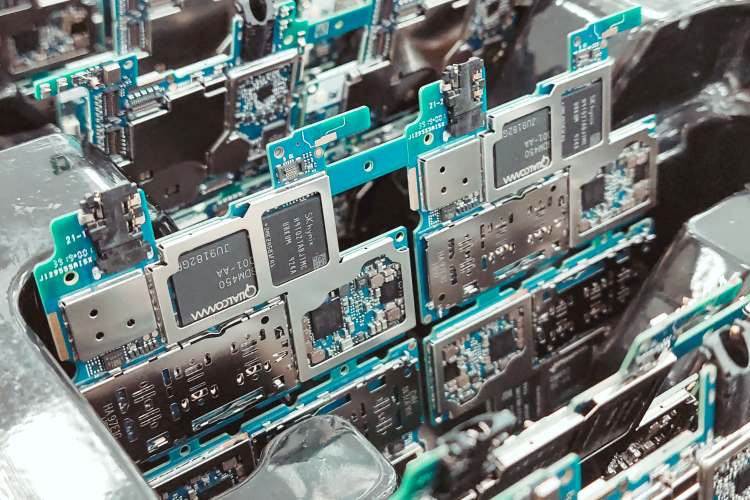
Exports of one category of mounted printed circuit boards rose from $63 million to $2.10 billion in the first half of the financial year. Singapore took $1.87 billion. In a separate category of electronics exports covering populated boards, exports reached $864 million, with China taking $789 million. These are substantial orders, and shipments to Asian


manufacturing hubs are consistent with Indian plants taking on more work within regional supply chains. The concentration also means that a change in sourcing by buyers in one market could move the national export figures sharply.
A customs entry records the full value of a board, including any imported chips mounted on it. The manufacturer’s contribution may lie in designing the board, fitting and soldering the components, or testing the finished assembly. Each activity requires a different set of skills and equipment. The electronics ministry should estimate domestic value added by product family and publish it alongside gross exports. A phone, a router and a populated board can all generate the same export revenue while leaving very different amounts in Indian wages, profits and supplier income.
READ I Software exports boom is reshaping the IT industry
Incentives to electronics exports
On November 6, the government announced 12 more approvals under the Electronics Components Manufacturing Scheme. The Union Budget raised the scheme’s outlay from ₹22,919 crore to ₹40,000 crore. At that scale, the government should publish what approved projects have actually delivered. Investment commitments and machinery commissioned are useful milestones. So are the share of units that meet buyers’ specifications on the first pass and the number of plants that secure repeat orders after their initial contracts.
There is a case for helping a supplier buy equipment before it has enough orders to cover the cost. A buyer may insist on seeing a functioning line and several consistent batches before approving a vendor. A smaller firm may struggle to finance that line without an order. Time-limited capital support can bridge the gap. Subsequent support should depend on progress towards commercial production and credible evidence that customers will keep buying.
A plant serving a single customer can be viable, especially when the buyer commits to volumes. A programme with dozens of such plants should still be judged on whether it produces suppliers capable of winning business from other customers.
Shared testing facilities would help smaller firms make that transition. A manufacturer of appliance controls, for example, may need to show that a board tolerates heat and humidity and meets a buyer’s electrical safety requirements. An accredited lab in the manufacturing cluster cuts the cost of testing each design revision. Public support for that facility can reach firms too small to qualify for a factory incentive.
READ I India’s supply chains need depth beyond final assembly
Keeping electronics exports competitive
NITI Aayog’s study of electronics supply chains identified tariffs and material costs as contributors to India’s cost disadvantage against China in both assembly and component manufacturing. The trade figures give a sense of how closely export growth and imports can coexist. Between April and October, electronic goods imports rose nearly 46% to $95.64 billion. That broad category includes finished goods as well as parts and cannot establish the import content of exports. It does show why gross shipment figures are a poor guide to the industry’s dependence on overseas suppliers.
A tariff can give a new component maker time to build volume. It can also raise costs for every Indian exporter that uses the part, including firms whose foreign rivals buy it at world prices. The finance ministry should review input duties with buyers as well as component makers and make duty-free access for export production simple to use. Where temporary protection is justified, it should have a published expiry date. A supplier that can meet international prices and delivery schedules has a market beyond the Indian factories the tariff was meant to serve.
Give engineering a place in export policy
India can earn more from the same production line if the factory’s engineers take responsibility for redesigning a board to use an alternative part, diagnosing failures or improving power consumption. Buyers have a commercial reason to pay for that work because it reduces delays and warranty costs.
Policy can help by making prototype facilities and specialist testing available to smaller manufacturers and supporting engineering projects in which firms put up their own money. PCB design and power electronics are among the opportunities identified by NITI Aayog. Both offer work across consumer and industrial products.
The next Union Budget should require the electronics ministry to track what happens as each group of subsidised plants approaches the end of its incentive period. A useful test is whether buyers renew their orders at prices that allow the plants to operate once payments stop. Those renewals would give Parliament a better basis for deciding which parts of the industrial policy deserve more money.