


India’s aviation market has become highly concentrated in the air. IndiGo and the Air India group together accounted for about 91% of domestic passengers in July. A similar, though less extreme, concentration is taking shape on the ground. That makes the government’s next round of airport privatisation a test of competition policy as much as infrastructure policy.
On August 4, the Public Private Partnership Appraisal Committee gave in-principle approval to lease 11 Airports Authority of India airports in five bundles. Each package combines a larger airport with one or two smaller ones. The Finance Ministry has flagged the “oligopolistic nature” of the aviation sector, while the Civil Aviation Ministry has proposed limiting the number of bundles that any one bidder can win. The concern is justified. However, a simple numerical ceiling may prove too crude.
READ | Duopoly in aviation sector cannot be fixed by CCI action alone
Two groups already handle half the traffic
Airport concentration is already substantial. Adani Enterprises reported that its eight-airport network accounted for 23% of India’s passenger traffic and 29% of cargo volume in FY26. GMR Airports says the Indian airports it operates account for 27.5% of passenger traffic. Between them, the two groups therefore handle more than half the country’s passengers.
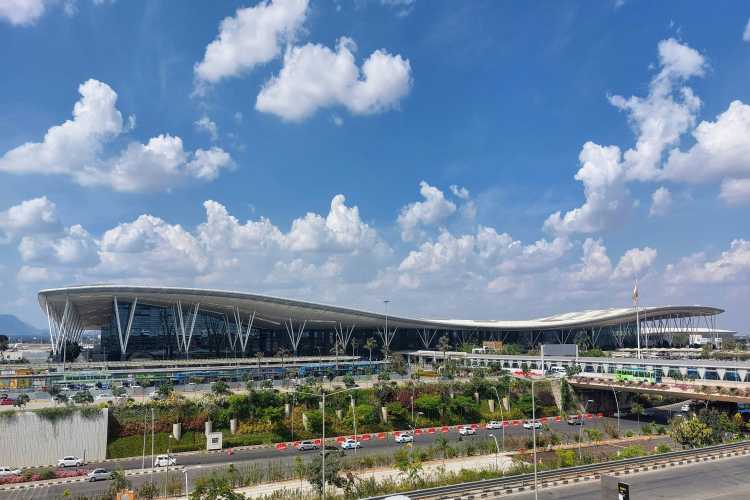
That does not make airports a duopoly in the same sense as airlines. Bengaluru is controlled by Fairfax India, which raised its holding in Bangalore International Airport Ltd to 74% in 2025; AAI and Karnataka State Industrial and Infrastructure Development Corporation retain 13% each. Other airports remain with AAI, state governments or different PPP structures.
The relevant question is therefore not how many airport operators India has. It is how much economically important traffic sits within a few portfolios.
A concession for a small regional airport cannot be treated as equivalent to control of Delhi, Mumbai, Bengaluru or Hyderabad. Passenger volumes, international connectivity and cargo flows differ enormously. So does the bargaining power that comes with them. An operator controlling several major gateways has influence over airlines, retailers, cargo companies and other businesses dependent on airport infrastructure.
READ | What the descent of Indigo means for the aviation sector
Bundling smaller airports makes economic sense
The government’s bundling model has a sound rationale. Amritsar will be paired with Kangra; Varanasi with Gaya and Kushinagar; Bhubaneswar with Hubballi; Raipur with Aurangabad; and Tiruchirappalli with Tirupati. The policy was conceived to make investment in smaller, less profitable airports viable by pairing them with stronger assets. NITI Aayog’s National Monetisation Pipeline specifically envisaged clubbing smaller airports with larger ones to secure private investment for both.
This is sensible infrastructure economics. Regional aviation cannot expand if every small airport must generate an attractive standalone return. A profitable airport can support investment at a weaker one, while a private operator can spread management expertise and procurement costs across a network.
There is also a strong case for continuing private participation. India needs terminals, runways and airport capacity faster than public financing alone can comfortably provide. The PPP experience has brought large amounts of private investment into airport infrastructure while leaving the underlying public asset with the state.
That distinction is sometimes lost in the argument over privatisation. These airports are generally being leased rather than sold. Under the AAI model, private companies obtain long-term rights to operate, manage and develop airports, while ownership remains with AAI and the assets revert to it when the concession ends. The new round is expected to offer concessions lasting 50 years.
Delhi illustrates the structure. Its airport company is a joint venture in which AAI retains 26%. Mumbai has a comparable public stake. Private operational control can therefore coexist with continued public ownership.
READ | India’s aviation industry boom faces a grim safety test
Airport competition happens before the concession
Airports have an economic characteristic that makes concentration unusually important. Most large airports possess substantial local market power. Passengers and airlines cannot switch between them with anything resembling the ease with which consumers change telecom providers or banks. Slots, route networks, surface connectivity and geography restrict the alternatives.
That is one reason India has a specialised regulator, the Airports Economic Regulatory Authority, to determine aeronautical tariffs and monitor performance standards at major airports.
For such assets, much of the competition occurs when the concession is awarded. Once an operator obtains control for 50 years, changing the competitive structure becomes difficult. The auction design therefore matters far beyond the proceeds from the winning bid.
India has encountered this issue before. During the 2018 privatisation of six AAI airports, the Department of Economic Affairs recommended that no bidder be awarded more than two airports, citing financial risk and the benefits of “yardstick competition”. The restriction was not adopted. Adani subsequently emerged as the highest bidder for all six airports.
There was an economic argument for allowing unrestricted bidding. More freedom for bidders could improve auction competition and maximise AAI’s receipts. Large operators may also have better access to capital and greater ability to spread technology, management and procurement costs across airports.
Those gains matter. Auction revenue is only one component of value for money when the concession lasts half a century.
Airport privatisation: Count traffic share, not merely airports
The government should therefore improve on a simple cap on the number of concessions. Three small airports should not carry the same regulatory weight as three national gateways.
Bid rules could set portfolio thresholds based on measurable indicators such as passenger traffic, cargo volumes, international traffic and air-traffic movements. An operator whose existing portfolio already crosses a specified share of the national market could face closer competition scrutiny before receiving another major airport.
Financial exposure deserves similar attention. When the same company controls several long-duration infrastructure concessions, excessive leverage or financial distress can create risks across the network. Diversifying concessionaires can reduce that vulnerability as well as encourage comparisons in costs, service standards and investment performance.
The Competition Commission of India should have a defined role in designing these concentration safeguards, while AERA continues to regulate airport tariffs and service standards. Competition policy works best before market power has hardened into the structure of an industry.
The case for private airport investment remains strong. Delhi, Mumbai, Bengaluru and Hyderabad show how private capital can transform infrastructure and add capacity. The next phase should preserve those gains while preventing control of the most valuable gateways from becoming excessively concentrated.
India is preparing to award assets whose concessions will run well into the 2070s. The government should judge each bid partly by the market power it adds to the bidder’s existing portfolio. Counting airports is easy. Measuring control is the real test.