


Impact of the US-India tariff deal: The tariff arrangement announced by the United States and India is being presented in New Delhi as a pragmatic reset in bilateral trade relations. It is neither a bilateral trade agreement nor an interim accord. It is a framework for one. Yet the economic consequences for India will be real, front-loaded, and asymmetric.
The claim of tariff relief rests on a comparison with an artificially inflated baseline. Washington has agreed to cut tariffs on Indian goods to 18% from a peak of 50%. That sounds generous only because the reference point is the Trump-era penalty regime, not the near-zero tariffs that prevailed before 2017. For labour-intensive Indian exports—textiles, leather, footwear, home décor, organic chemicals—the new tariff locks in a structural disadvantage relative to competitors that already enjoy preferential access to the US market.
READ I India’s trade deals test limits of strategic autonomy
An asymmetric tariff bargain
Under the US-India tariff deal, India commits to eliminating or reducing tariffs on all US industrial goods and a wide range of agricultural products. The US, in contrast, retains an 18% tariff on most Indian goods and reserves the right to remove it only after a “successful conclusion” of a future interim agreement. The asymmetry is not incidental. It is written into the sequencing.
Top Indian exports to the US
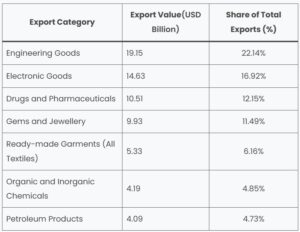

For India’s export sectors, this matters. Textiles and apparel account for over a quarter of India’s merchandise exports to the US. An 18% tariff compresses margins in an industry already under pressure from Vietnam, Bangladesh, and Mexico. The same logic applies to leather goods, footwear, and artisanal products, where price competitiveness is decisive. The framework offers no immediate relief for these sectors; it merely prevents a return to punitive levels.
READ I Trade agreements have become India’s strategic tools
Steel, aluminium, and the Section 232 overhang
The US-India tariff deal does little to resolve India’s long-running disputes with US national security tariffs. Duties imposed under Section 232 on steel, aluminium, and now copper remain in force, with limited carve-outs for aircraft and aircraft parts. The ongoing US investigation into pharmaceuticals under the same statute introduces a fresh layer of uncertainty.
India is promised “negotiated outcomes” for generic drugs contingent on the findings of that probe. This is not a concession; it is a conditional assurance. Indian pharmaceutical exports entered the US largely duty-free before these investigations began. What is now being offered is a return to the status quo ante, subject to US discretion.
READ I CPI overhaul could deepen gap between inflation data and reality
$500 billion purchase commitment
The most consequential element of the framework is not tariffs but the purchase commitment. India has agreed to buy $500 billion worth of US goods over five years—energy, aircraft, coking coal, precious metals, and technology products, including GPUs.

This single clause alters the macroeconomic arithmetic. India is one of the few large economies with which the US runs a persistent trade deficit. A guaranteed annual import bill of roughly $100 billion risks eroding that surplus. Over time, this could affect the balance of payments, foreign-exchange accumulation, and the rupee’s external resilience.
Unlike export earnings, which are relatively stable, large import commitments expose India to commodity price volatility and dollar liquidity cycles. The framework is silent on whether these purchases will be additional or merely a redirection of existing import flows. That ambiguity matters for fiscal planning and external accounts.
Energy security under supervision
The tariff rollback is explicitly linked to India’s energy choices. By executive order, President Donald Trump has removed the additional 25% tariff imposed for India’s purchases of Russian oil, while reserving the right to reimpose it if India resumes such imports. US agencies are tasked with monitoring compliance.
This is not a technical trade condition; it is a constraint on economic sovereignty. Since 2022, discounted Russian crude has played a stabilising role in India’s energy bill and inflation management. Substituting it with US and Venezuelan supplies may carry higher fiscal and logistical costs. The framework normalises external oversight of India’s energy policy in exchange for tariff relief that remains partial.
Agriculture: deferred, not settled
The Indian side insists that sensitive agricultural and dairy sectors are protected. The text of the framework suggests otherwise. India has agreed to eliminate or reduce tariffs on a broad set of US agricultural products and to address “long-standing non-tariff barriers”, with standards recognition to be negotiated within six months.
Tariff-rate quotas for products such as apples may appear modest today. But once regulatory alignment and standards acceptance are conceded, future market openings become easier to justify. The political sensitivity of agriculture explains the deliberate vagueness. Economically, the direction of travel is clear.
Standards, regulation, and market access
Beyond tariffs, the US-India tariff deal pushes India toward accepting US or international standards in medical devices, ICT equipment, and other regulated sectors. This has implications for domestic manufacturers that have benefited from India-specific regulatory regimes.
Standards harmonisation can reduce trade friction. It can also privilege incumbents with scale and legal capacity. For India’s smaller manufacturers and MSMEs, compliance costs may rise before export opportunities materialise.
Economic cost of US-India tariff deal
The framework is anchored as much in geopolitics as in trade. Supply-chain resilience, export controls, and alignment against the “non-market policies of third parties”—a clear reference to China—run through the document. India gains strategic proximity to the US. The economic price of that alignment is being paid upfront.
There is no clarity on services trade, digital mobility, or visas—areas where India’s interests are strongest. The silence is telling. What has been secured is certainty for US exporters and leverage for US regulators. What remains contingent are India’s gains.
This is not a capitulation, but it is not a balanced bargain either. India has traded tariff certainty for conditional relief, import commitments for diplomatic goodwill, and energy flexibility for market access that remains deferred.
Whether the eventual bilateral trade agreement corrects these asymmetries will depend on negotiations yet to begin in earnest. For now, the US-India tariff deal reshapes India’s trade posture toward the US in ways that will be felt across manufacturing, energy, and the external account—long before any promised benefits arrive.