


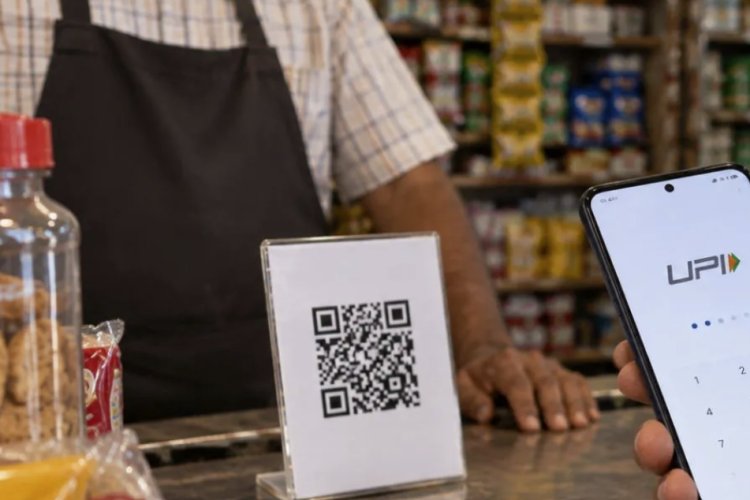
UPI MDR explained: For six years, UPI has fitted itself almost invisibly into everyday transactions. There was no swipe fee, transaction charge or monthly subscription standing between a customer and a QR code. From vegetable vendors and kirana shops to large e-commerce platforms, scan-and-pay became routine.
That arrangement changes on October 15, when the National Payments Corporation of India introduces a Merchant Discount Rate (MDR) on specified person-to-merchant UPI transactions above ₹2,000. The standard MDR will be 0.4%, capped at ₹300 for transactions of ₹75,000 or more. The charge is to be borne within the merchant payment ecosystem, not by consumers. Person-to-person payments will remain free, as will merchant payments up to ₹2,000 and payments received by eligible small merchants.
READ | UPI at 10: Financial inclusion needs a second act
The change has prompted speculation that India is returning to cash. That is too broad a reading of the new framework. The immediate effect will depend less on the headline 0.4% rate than on which transactions are actually subject to it and how merchants respond.
Most UPI payments will remain untouched
UPI handles an enormous number of small payments. Government data shows that 86% of P2M transactions in FY2025-26 were below ₹500. The government estimates that about 96% of merchant transactions will remain unaffected by the new MDR framework.
The ₹2,000 threshold therefore does not describe the typical UPI payment. A customer paying ₹180 for groceries, ₹450 for a meal or ₹1,900 for a service will not trigger the standard MDR. Eligible small merchants receiving up to ₹1 lakh a month through UPI QR codes will also remain under the zero-MDR regime.
The distinction between transaction volume and transaction value matters here. P2P transactions accounted for about 71% of UPI transaction value in FY2025-26, reflecting the role of UPI in larger transfers between individuals. These transactions are outside the new MDR framework. On the merchant side, only about 4% of P2M transactions are expected to attract MDR, according to the government.
That makes the new policy less a charge on everyday digital payments than a change in the economics of higher-value merchant transactions.
A ₹3,000 merchant payment would attract ₹12 in MDR. At ₹10,000, the charge would be ₹40. At ₹50,000, it would be ₹200. Once the payment reaches ₹75,000, the charge is capped at ₹300. For a large retailer or e-commerce platform, such costs can be incorporated into the economics of payment acceptance. For a small business operating on thin margins, even a modest charge can matter.
READ | UPI MDR debate shifts from users to large merchants
The real question is how merchants respond
Consumers will not see an MDR deduction when they make a qualifying payment. The government has advised banks to ensure that merchants do not pass the charge on to customers, while UPI application providers have been told not to impose hidden charges.
That does not eliminate the possibility of behavioural change. A merchant can absorb the cost, adjust prices, encourage another payment method or attempt to recover the amount informally. The economic response will vary according to margins, transaction size and the importance of UPI to the business.
Cash is not costless, either. It has to be handled, counted, transported and deposited. Digital payments also integrate more easily with billing, settlement and accounting systems. For many organised businesses, those advantages can outweigh a 0.4% processing cost.
The more interesting question is whether the threshold creates an incentive to split payments. A ₹4,000 purchase could theoretically be divided into two ₹2,000 UPI payments. Such behaviour may occur in some informal transactions where payment amounts are flexible, but it is unlikely to provide a universal escape from the MDR.
The small-merchant exemption is more consequential. Merchants receiving up to ₹1 lakh a month through UPI QR codes under the P2PM framework will continue to receive payments without MDR. Merchants that exceed the threshold for three consecutive months can move into the standard P2M category.
UPI was free, but the infrastructure was not
The deeper issue is the cost of maintaining a payment network that has grown far beyond its original scale.
UPI processed 24,161.69 crore transactions worth ₹314.23 lakh crore in FY2025-26. Monthly volumes crossed 2,300 crore transactions in 2026, with July alone recording 2,366 crore transactions.
Servers, cybersecurity, fraud prevention, settlement systems, dispute resolution and network reliability all require continuing investment. The Parliamentary Standing Committee on Finance cited an estimated annual operating cost of about ₹20,700 crore for the payments industry against a ₹2,000 crore allocation for FY2026-27 to support the zero-MDR framework.
That gap helps explain why the economics of zero MDR have come under scrutiny. The original policy objective was clear: encourage consumers and merchants to move from cash to digital payments. Six years after the zero-MDR regime began, UPI has reached a scale at which the question is increasingly about how the network should be financed.
The new MDR provides one answer. It does not make UPI a government tax. The proceeds are distributed among participants in the payment ecosystem, including banks and payment application providers, while a dedicated fund is also planned to support digital-payment infrastructure and adoption among small merchants.
The framework also differentiates between sectors. Railways, telecom, insurance and fuel will face a flat ₹5 MDR on qualifying transactions above ₹2,000. Capital-market transactions will attract a 0.02% MDR, capped at ₹300. Recurring UPI mandates and AutoPay transactions are outside the prescribed MDR framework.
This differentiation matters because the economics of a payment vary sharply by sector and merchant type. A uniform fee would treat a street vendor and a large online retailer as though they faced the same costs and derived the same benefits from digital payments.
READ | UPI MDR needs a shield for small merchants
The free UPI model is entering a new phase
The immediate concern is unlikely to be a mass return to cash. Most merchant transactions will remain free, all P2P transactions will remain free, and eligible small merchants will remain protected. The more important test will be whether the new MDR changes merchant behaviour at the higher end of the transaction spectrum.
If merchants absorb the cost and continue to offer UPI without friction, most consumers will barely notice the change. If merchants begin refusing UPI for larger purchases, steering customers towards cash or attempting to recover the fee through prices, the ₹2,000 threshold will acquire greater significance than its share of transactions suggests.
The policy therefore marks a change in the financing of UPI rather than the end of free digital payments. The experiment will be judged by what happens at the QR code, not by the headline rate. India has spent a decade making digital payments habitual. The next task is to ensure that the infrastructure behind that habit can pay for itself without making small merchants or consumers bear the cost.