



The Reserve Bank of India has cut the repo rate four times in 2025, reducing the policy rate by a cumulative 125 basis points. The effective repo rate now stands at 5.25%, lowering funding costs for banks and raising expectations of cheaper home loans. Several lenders have responded by trimming rates, prompting homebuyers to anticipate lighter monthly instalments. Housing demand, already supported by urban recovery, could benefit from this monetary easing.
Yet the central question is not whether the repo rate has been cut, but whether the reduction will reach borrowers quickly enough. Monetary transmission in India has long faced delays, owing to structural and institutional frictions. Unless banks deliver faster pass-through, the gains from lower policy rates will remain muted for households and for the economy at large.
READ | Why India-Russia relations will withstand western pressure
Monetary transmission and home loan benchmarks
Transmission is strongest when loans are linked to external benchmarks such as the repo rate, as required under RBI rules since 2019. These loans adjust almost automatically—usually within a quarter. But a large share of outstanding home loans remains tied to older benchmarks such as the Marginal Cost of Funds-based Lending Rate (MCLR). MCLR pricing depends on a bank’s cost of deposits, liquidity profile and operating costs, which do not adjust quickly after a policy rate cut. As a result, many borrowers experience only a partial or delayed reduction in EMIs.
How lending rates respond to RBI’s repo rate cuts
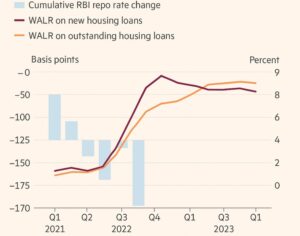

Recent moves show the uneven nature of pass-through. PNB reduced its RLLR from 8.35% to 8.10%. Bank of Baroda cut its BRLLR from 8.15% to 7.90%. Indian Bank lowered its RLLR from 8.20% to 7.95%. HDFC Bank reduced its MCLR by up to 5 basis points. These changes are small relative to the RBI’s cumulative 125-basis-point reduction, reflecting the persistence of legacy structures.
For a new borrower with a ₹50-lakh, 20-year housing loan, even a modest downward shift in the benchmark can translate into savings of roughly ₹4,000 a month. But those savings materialise only when loan pricing aligns with the benchmark that moves with monetary policy.
Why deposit rates limit transmission
A key structural obstacle is the stickiness of deposit rates. Banks cannot reduce deposit rates quickly because they compete with a range of financial instruments that now offer attractive returns. Small-savings schemes carry higher administered rates, making it difficult for banks to cut term-deposit rates without risking outflows. Mutual funds, sovereign gold bonds and other market-linked products also draw household savings, raising the pressure on banks to maintain competitive deposit rates.
The result is a persistent gap between credit growth and deposit mobilisation. While bank credit expanded by around 16% in FY24, deposit growth lagged at nearly 12%, according to the RBI’s Monthly Bulletin. When banks struggle to attract low-cost deposits, their ability to cut lending rates is constrained. This explains why lending-rate adjustments often lag policy-rate cuts by several quarters.
Reset periodicity: A hidden friction in EMI reduction
Transmission also depends on the reset frequency of home loans. Many lenders reset rates only annually. Even if the benchmark falls sharply, the effective EMI for a borrower will not change until the next reset date. RBI permits banks to choose their reset periodicity, and longer cycles work to the banks’ advantage by postponing the transmission of rate cuts.
Most borrowers do not fully understand how reset cycles affect their EMIs. Quarterly resets allow faster transmission; annual resets delay it. Thus, the structure of loan contracts plays as important a role as the policy rate itself. The consequence is that monetary easing often reaches borrowers in slow motion.
Why market rates stay high
Another, often overlooked, constraint is the government’s borrowing programme. The Union government’s gross market borrowing is over ₹15 lakh crore this year, as per the 2024–25 Budget estimates. Large sovereign borrowing drives up bond yields, which in turn influence banks’ investment portfolios and their cost of raising long-term funds in the market.
Even as the RBI cuts the repo rate, high government borrowing keeps market interest rates elevated. This weakens the broader environment in which banks must manage their balance sheets. A bank reluctant to see its bond portfolio lose value, or compelled to pay higher rates for fresh market borrowings, has little room to accelerate lending-rate reductions. This macro-financial interaction is central to understanding why transmission remains incomplete.
Fixed-rate loans and the limits of monetary easing
A growing segment of homebuyers has opted for fixed-rate home loans in recent years. These loans provide stability in monthly payments, especially after the sharp rate increases of 2022–23. But fixed-rate loans do not transmit policy easing unless borrowers refinance their loans—a process that often involves charges and procedural hurdles. Many households choose to avoid the complexity, and therefore see no benefit from repo-rate cuts.
This behavioural dimension, combined with structural frictions, adds to uneven monetary transmission.
Why faster transmission matters for growth
A timely pass-through of policy cuts is central to economic momentum. Housing accounts for nearly 7% of GDP and drives demand in construction, cement, steel and consumer durables. When EMIs fall, households gain purchasing power. When lending becomes cheaper, developers gain confidence to unlock stalled or delayed projects. Monetary easing, therefore, works best when borrowers feel the impact quickly.
RBI has pushed for greater transparency in loan pricing, mandatory repo-linkage for new loans and uniform reset frequencies. These reforms have helped, but gaps remain. According to RBI’s 2024 Monetary Policy Transmission Report, banks transmitted only about 55–60% of cumulative repo rate cuts during the previous easing cycle. Without decisive improvements, lower policy rates cannot produce the intended stimulus for consumption or investment.
India’s growth cycle will depend not just on how much the RBI cuts rates, but on how fast and how fully these reductions reach households. Sticky deposit rates, long reset cycles, crowded fiscal borrowing and fixed-rate loan structures all slow the journey from policy decisions to borrower benefits. If these obstacles are addressed, monetary easing can support stronger housing demand, healthier household finances and a more broad-based economic recovery. If not, the repo rate may fall, but EMIs will not.