


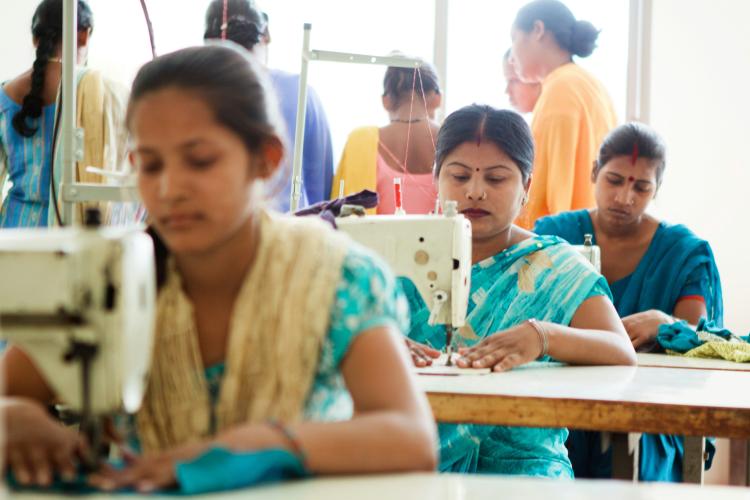
India’s female workforce has nearly doubled since 2017-18, but the increase has brought limited improvement in the quality of employment. A study by the Indian Council for Research on International Economic Relations (ICRIER) estimates that the number of working women rose from 104 million in 2017-18 to 201 million in 2025. The female worker population ratio increased from 22% to 38%. Much of this growth, however, came from agriculture and self-employment rather than regular salaried jobs. The findings raise questions about whether higher participation has improved women’s earnings and financial independence.
The ICRIER study, The Participation Paradox: Women’s Work and Time-use in India, examines employment patterns, earnings and household responsibilities. The 2025 estimates are based on a revised Periodic Labour Force Survey (PLFS), which introduced a larger sample and a calendar-year reference period. Comparisons with 2017-18 therefore require caution. Even allowing for these changes, the findings point to weaknesses in the structure of women’s employment.
READ | Women’s self-employment boom masks a manufacturing divide
Women remain concentrated in agriculture
The increase in female employment has been largely rural. The worker population ratio for rural women rose from 23.7% in 2017-18 to 44.9% in 2025. In urban areas, it increased more slowly, from 18.2% to 25.9%.
This difference is significant because India’s economic transformation has been associated with a gradual movement of workers from agriculture to manufacturing and services, where productivity and earnings tend to be higher. That transition has been uneven for women.
Among rural men, the share employed in the primary sector declined from 54.1% to 47.2% between 2017-18 and 2025. For women, it increased from 70.7% to 73.3%. Men have been able to move into other sectors, while women’s employment remains heavily dependent on agriculture.
Agriculture provides work but often fails to offer regular incomes, predictable working hours or social security. Employment on family farms may also generate little independent income for women. A rise in agricultural employment, therefore, cannot automatically be interpreted as an improvement in their economic position.
The expansion of self-employment reinforces this concern. The number of own-account workers among rural women increased from 13.9 million in 2017-18 to 56 million in 2025. Their share of rural female employment rose from 18.6% to 37.2%.
Regular salaried employment also increased, from 7.9 million to 13.9 million, but its share declined from 10.5% to 9.3%. Much of the additional employment has been absorbed by activities that do not necessarily provide steady earnings.
Self-employment can offer women greater flexibility and, in some cases, the opportunity to establish profitable businesses. But working independently does not always amount to entrepreneurship. Women may be engaged in low-return activities because regular jobs are unavailable or because household responsibilities prevent them from taking up employment elsewhere.
The distinction becomes sharper in family enterprises. Women working on farms or assisting in household businesses are counted as employed even when they receive no separate wages. Their contribution may improve household production without giving them greater control over income or business decisions.
Manufacturing offers limited opportunities for women
Manufacturing has traditionally provided an important route for workers moving out of agriculture. In India, however, the sector has created relatively few formal employment opportunities for women.
An analysis by Ashoka University’s Centre for Economic Data and Analysis (CEDA) found that women accounted for just 18.1% of India’s formal manufacturing workforce in 2024. More than three-fourths were concentrated in six states, with Tamil Nadu alone accounting for a substantial share.
Employment was also concentrated in a few industries, particularly textiles, leather and footwear, and food processing. The narrow geographical and industrial spread suggests that manufacturing growth has yet to provide women with employment opportunities across a sufficiently broad range of sectors.
The structure of enterprises compounds the problem. Larger firms are generally better placed to provide maternity benefits, childcare, healthcare and transport. These facilities can influence whether women enter employment and remain in it, particularly after marriage or childbirth.
Most Indian enterprises, however, are very small. Many operate with limited capital and cannot provide the facilities available in larger factories. For women who must also manage household responsibilities, the absence of transport or childcare can put otherwise suitable jobs beyond reach.
Industrial policy has concentrated on increasing investment, production and exports. The availability of jobs for women depends partly on how industrial centres are planned and how enterprises organise employment. Reliable transport, childcare and suitable working conditions can expand the pool of women able to take up factory jobs.
READ | BRICS must connect women’s skills with better jobs
Rural women’s earnings fall further behind
The earnings data offer further evidence that higher participation has not necessarily improved women’s economic position.
Between 2017-18 and 2025, nominal monthly earnings for rural men increased by approximately 65%, compared with 41% for rural women. As a result, women’s average monthly earnings declined from about 53% of men’s earnings to 45%.
The absolute monthly earnings gap increased from around ₹4,200 to more than ₹8,000.
These differences reflect the nature of employment, hours worked and the occupations available to men and women. They cannot be attributed entirely to unequal pay for the same work. Nevertheless, the widening gap indicates that rural women have received a smaller share of the earnings gains recorded over the period.
A larger workforce does not necessarily strengthen women’s bargaining position when much of the additional employment is concentrated in low-productivity activities. Women working on family farms, undertaking home-based work or running marginal enterprises may have limited alternatives and little power to negotiate better returns.
The problem is particularly acute when employment is irregular. A woman counted as employed may work fewer hours than she wishes or earn too little to contribute significantly to household income. Employment statistics capture her participation, but provide a less complete picture of the income and security that work brings.
India’s labour market data must therefore be read alongside earnings and employment conditions. The increase in women’s participation is substantial, but the composition of that employment helps explain why the economic gains have been modest.
READ | Women farmers carry Indian agriculture without equal access
Unpaid domestic work restricts employment choices
The burden of unpaid household work remains another constraint on women’s employment.
Time-use surveys conducted in 2019 and 2024 show that the division of domestic responsibilities has changed little. Among those undertaking unpaid domestic activities, the difference between women and men remained around 223 minutes a day in 2024. The gap in unpaid care work increased from 58 minutes to 63 minutes.
Employment also reduces the time women have available for themselves. Working women spent approximately 18 minutes less each day on self-care than women overall in rural areas. In urban areas, the difference was 31 minutes. Employed men, by comparison, recorded slightly more self-care time than men overall.
These figures illustrate the additional demands placed on women who combine paid employment with childcare, cooking, cleaning and care for elderly relatives.
Household responsibilities influence the type of employment women can accept. Jobs requiring long commutes, fixed hours or relocation may be difficult to reconcile with family obligations. Work close to home, including agriculture and household enterprises, becomes an alternative even when earnings are lower.
The ICRIER study finds that around six in ten women outside the labour force cite childcare and household commitments as their main reason for not working. The same responsibilities are far less frequently cited by men.
The unequal distribution of domestic work affects both labour force participation and the quality of jobs women can take up. Women who cannot commit to regular hours or travel to industrial centres have fewer opportunities to enter better-paid employment.
Childcare needs greater policy attention
The Maternity Benefit (Amendment) Act, 2017 extended paid maternity leave to 26 weeks for eligible women and required establishments employing 50 or more workers to provide crèche facilities. The legislation improved protection for women in covered establishments, but much of India’s female workforce remains outside its effective reach.
Women employed in small enterprises, informal businesses and household activities often cannot access these benefits. The requirement that employers finance extended maternity leave may also discourage some businesses from hiring women, although the extent of this effect is difficult to establish.
The present framework consequently provides greater protection to women who already have access to formal employment than to those working in agriculture or small informal enterprises.
Affordable childcare facilities within communities could help address this imbalance. Women employed in informal activities need access to childcare even when their employers are too small to provide it. Expanding public provision would also reduce the financial burden on individual enterprises.
Shared parental leave and alternative arrangements for financing maternity benefits deserve consideration. Placing most childcare responsibilities on women, and much of the cost of maternity leave on employers, can weaken incentives for female employment.
Better public transport, childcare facilities near workplaces and stronger enforcement of existing labour protections would also widen employment choices. Such measures are particularly relevant to manufacturing clusters, where distance from home and fixed working hours often restrict women’s participation.
India has made considerable progress in increasing female employment. The ICRIER findings show why that achievement needs to be assessed alongside the nature of work women undertake and the earnings they receive.
A workforce in which more women are employed on family farms or in low-return self-employment may improve household production without substantially changing their economic position. Unless manufacturing and services offer better opportunities, and unpaid domestic responsibilities are shared more evenly, India’s rising female employment figures will continue to overstate the gains in women’s financial independence.