


The state of Indian economy: India has entered the second half of FY26 at a time of global turbulence. The prospect of new US tariffs, volatile commodity markets, and persistent geopolitical frictions continue to unsettle the global economy. Domestic conditions look more stable, supported by steady demand, easing inflation, and policy continuity. Yet global spillovers demand caution.
The policy environment is firmer than it was a year ago. Macroeconomic management has been predictable. Corporate earnings have held steady. Markets have remained resilient. But the external environment remains uneven. Weak global growth, fragile trade flows, and rising financial volatility shape the outlook for the remainder of the year.

The finance ministry’s Monthly Economic Review for October notes that consumption is gaining strength as household balance sheets improve. The report highlights the positive effect of recent tax changes and GST rate rationalisation on disposable incomes. These steps have lowered compliance frictions and supported activity across sectors.
READ I Rupee depreciation: The real drivers of India’s currency fall
Inflation and Indian economy growth trends
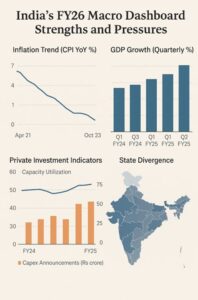
Retail inflation has moderated sharply. The drop reflects easing commodity prices, policy action, and a favourable base effect. The unusually low October print may not mark a new trend for the Indian economy, but the broader decline is clear. Lower prices have lifted purchasing power in both rural and urban regions. Urban consumption remains robust, while rising rural wages suggest an emerging recovery.
Growth momentum of Indian economy remains firm. Analysts expect Q2 GDP growth of 7–7.5%, supported by broad-based activity. Manufacturing has benefited from lower input costs. Services continue to expand in travel, hospitality, communications, and financial services. Construction remains a standout, driven by public capital expenditure and strong urban housing demand. Exports, which softened over the past year, have begun to stabilise as global trade shows tentative improvement.
Private investment and financial markets
The investment cycle shows a mixed picture. Public capital expenditure continues to carry much of the weight, while private investment remains uneven. Capacity utilisation at 73–75%, as per the RBI’s OBICUS, is below the threshold that typically triggers broad-based capex expansion. Corporate leverage has reduced, and profitability has improved, but fresh project announcements remain concentrated in a few sectors. A sustained increase in private capital formation is essential for medium-term growth.


Domestic financial markets have absorbed volatility in global markets. Equities have held steady due to strong institutional flows, a growing retail base, and robust earnings for banks and services firms. Bond markets have remained orderly under a predictable monetary policy stance. India’s inclusion in global bond indices next year is expected to draw long-term foreign capital into rupee debt. Bank credit growth remains healthy across retail, MSME, and services.
Monetary policy remains cautious. The RBI has kept the policy rate unchanged to anchor inflation expectations. Real interest rates remain positive, which supports price stability but raises borrowing costs for small businesses and households. Liquidity has tightened due to higher currency demand and forex interventions. Global monetary conditions are a major source of uncertainty. Higher long-term US yields could limit the RBI’s room to manoeuvre.
External risks and the mid-year glide path
Indian economy is facing global headwinds. Weak demand in major markets, renewed tariff tensions, and the rise of industrial policy in advanced economies are reshaping global trade. India’s exporters remain vulnerable to these shifts. The external sector is more resilient today—supported by over $650 billion in forex reserves per the RBI’s weekly data — but external risks remain high. India is pursuing new trade agreements, including the India–UK FTA, and ongoing negotiations with the EU, US, New Zealand, Chile, and Peru.
Fiscal consolidation remains central to macroeconomic stability of the Indian economy. The Centre’s target of reducing the fiscal deficit to 4.5% of GDP in FY27 will require sustained revenue buoyancy. Mid-year data from the Comptroller General of Accounts shows the deficit tracking marginally above the annual glide path. Several states have reduced capital expenditure to stay within deficit limits. Off-budget liabilities in power, irrigation, and municipal sectors remain a growing concern. A credible medium-term consolidation plan must address revenue mobilisation, subsidy efficiency, and public-sector reform.
Employment quality and rural stability
Employment creation remains a critical challenge. Labour reforms seek to modernise outdated frameworks, but implementation varies across states. A young and rapidly urbanising workforce requires more formal jobs, higher productivity, and better working conditions. The PLFS 2023–24 shows rising labour force participation, but improvements in job quality remain uneven.
Agriculture presents a mixed picture. Lower food inflation is welcome but partly reflects temporary factors. The sector remains vulnerable to climate-linked shocks, productivity stagnation, and supply chain gaps. Rural wages have begun to rise, but slowly. The IMF’s Article IV highlights the need for deeper investments in irrigation, storage, and market reforms to strengthen resilience.
Long-term prospects and reform priorities
State-level performance has begun to diverge sharply. High-growth states such as Maharashtra, Karnataka, Gujarat, and Tamil Nadu continue to attract investments, while others face weak industrialisation and limited fiscal space. Variations in the implementation of land, labour, and power-sector reforms create uneven business conditions. Since states account for nearly 60% of general government spending, this divergence carries significant macroeconomic implications. Stronger fiscal transparency, reform-linked incentives, and coordinated infrastructure planning will be essential.
Indian economy remains one of the world’s strongest structural growth stories. Demographics and digitalisation provide a window of opportunity. But sustaining growth will require deeper reforms in land markets, logistics, public health, education, and judicial efficiency. Fiscal consolidation, careful monetary management, and a renewed focus on employment and productivity will shape India’s economic trajectory in the second half of FY26 and beyond.
India’s economic outlook is stable but conditional. Domestic resilience is strong, but global uncertainty is high. A stable macroeconomic framework, stronger private investment, and deeper structural reforms will be necessary to convert current momentum into durable long-term growth. The window for decisive policy action remains open.