


The Budget 2026 treats MSMEs less as recipients of schemes and more as participants in an operating system that determines costs, risk, and scale. The focus is not headline generosity but friction reduction—capital access, compliance time, payment certainty, logistics, and local infrastructure.
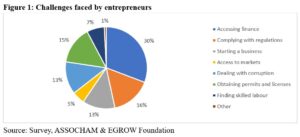
This approach mirrors the findings of the EGROW–ASSOCHAM study MSMEs Facing Challenges in Doing Business (August 2024), which identified four recurring constraints: access to finance, regulatory compliance, approvals, and payment delays. For proprietorships and micro firms, compliance costs were not marginal overheads but material business expenses. The Budget’s interventions track these pain points closely.

READ I Budget 2026: Welfare up, income durability still elusive
Addressing the MSME capital gap
Risk capital, not credit, remains the binding constraint for MSMEs attempting scale or export entry. Budget 2026-27 responds with a ₹10,000 crore SME Growth Fund, targeted at “future champion” firms identified by productivity, formalisation, and export readiness.
The ₹4,000 crore infusion into the Self-Reliant India Fund extends equity support to micro and small enterprises, where leverage alone has proved inadequate.
The emphasis on equity signals an acknowledgment that debt-heavy balance sheets limit experimentation and resilience.
READ I Budget 2026: From smart cities to City Economic Regions
Cutting compliance time through Corporate Mitras
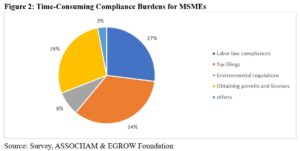
Compliance consumes managerial time that MSMEs cannot spare. Survey evidence shows tax filings and permits absorbing disproportionate effort relative to firm size.
The introduction of Corporate Mitras seeks to industrialise compliance support. Professional bodies—ICAI, ICSI, and ICMAI—will train intermediaries in Tier II and Tier III cities to handle registrations, filings, and routine compliances at predictable cost. The intervention does not simplify laws; it lowers the transaction cost of obeying them.
READ I Healthcare allocation rises, but structural gaps remain

Clusters and the textile ecosystem
Competitiveness now depends on technology absorption at the cluster level. Budget proposals to modernise traditional industrial clusters focus on shared infrastructure and technology upgrading rather than firm-level subsidies.
Textiles receive particular attention, spanning technical textiles, khadi, and handloom. The intent is to stabilise employment-intensive MSME segments while nudging them towards higher value chains.
Payment delays and TReDS framework
Delayed payments remain the most destabilising shock to MSME cash flows, especially where large buyers and public entities are involved.
The Budget strengthens the Trade Receivables Discounting System (TReDS) by expanding its use in public procurement, integrating government platforms, and deepening invoice discounting. The objective is straightforward: convert receivables into working capital faster and at lower cost.
Skills that do not leak immediately
MSMEs routinely train workers only to lose them to larger firms. Budget 2026 responds through sector-specific skilling rather than generic programmes. Three new NIPERs, upgrades to pharmaceutical institutes, industry-led training centres, and Regional Centres of Excellence along National Waterways align skills with location and sector demand.
The design accepts labour mobility as a given and focuses instead on reducing mismatch and retraining costs.
Logistics costs and export viability
For export-oriented MSMEs, container availability, small-lot pricing, and shipping concentration inflate costs. The Budget’s logistics push—Dedicated Freight Corridors, inland waterways, coastal shipping, and multimodal hubs—targets scale economies that individual MSMEs cannot create on their own.
The gains accrue indirectly, through lower transit time and reduced volatility, rather than explicit MSME subsidies.
Infrastructure where MSMEs actually operate
Many MSMEs are embedded in districts with weak last-mile roads, storage gaps, and unreliable local services. These frictions raise costs before firms even reach national logistics networks.
Public capital expenditure rises to ₹12.2 lakh crore, with emphasis on industrial corridors, logistics nodes, and Tier II–III cities. The relevance for MSMEs lies in predictability—fewer delays, tighter delivery schedules, and better cluster integration.
Women-led enterprises and SHE Marts
The introduction of Self-Help Entrepreneur (SHE) Marts aims to move women-led enterprises beyond subsistence activities. Community-owned outlets provide market access rather than credit alone, addressing the missing link between production and sales.
The intervention is modest in scale but clear in intent: ownership, not participation.
City Economic Regions as MSME anchors
The proposed City Economic Regions (CERs)—₹5,000 crore per region over five years—focus on Tier II and Tier III cities where MSME clusters already exist. The objective is agglomeration: shared infrastructure, better services, and stronger links to larger markets.
For MSMEs, the value lies less in grants and more in functioning urban systems.
A less intimidating legal and tax environment
The Budget avoids creating MSME-specific courts but moves to rationalise prosecutions, reduce multiplicity in tax proceedings, and propose a High-Level Committee on Banking for Viksit Bharat. These measures lower legal uncertainty rather than promising faster justice.
For small firms, predictability often matters more than speed.
MSMEs as part of the growth architecture
Budget 2026 does not treat MSMEs as an isolated sector. They are embedded in a wider strategy covering capital markets, logistics, skills, urban infrastructure, and regulatory process.
The shift is subtle but material: from helping MSMEs survive to making it cheaper for them to operate, fail, scale, and compete.
Shalini Singh Sharma is Research & Training Head, EGROW Foundation.