


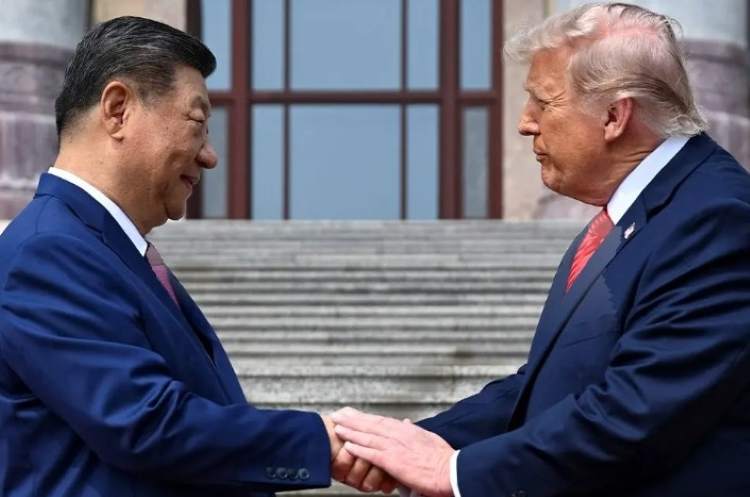
The Trump-Xi summit in Washington ended with a fragile truce, a promise to keep talking and little else of substance. The two leaders extended their trade arrangement by two months and agreed to meet again later this year, but the summit did not produce a settlement on the disputes that have made the US-China relationship increasingly adversarial. Trade tensions remain unresolved, strategic competition continues, and neither side offered a new framework for managing the security issues that could most easily turn rivalry into confrontation. The ceremony was elaborate; the diplomacy was limited.
That distinction matters. A summit need not produce a grand bargain to be useful. In relations as consequential and conflict-prone as those between the United States and China, preventing a deterioration can itself be a diplomatic achievement. But the Trump-Xi summit did little to establish rules for managing the strategic competition over technology, Taiwan and critical supply chains. On artificial intelligence, where both countries have an interest in preventing an uncontrolled race, there was no operational agreement. On Taiwan, there was no new understanding. On Iran, the leaders discussed the war but announced no joint initiative. The trade truce was extended rather than converted into a durable settlement.
READ I Trump-Xi Summit may extend the US-China trade pause
Trump-Xi summit buys time
The most tangible result was economic. Washington and Beijing agreed to extend the existing trade truce by two months. That prevents the return of the much higher tariffs that had threatened to disrupt bilateral commerce and gives negotiators more time to address tariffs, Chinese purchases, rare-earth supplies and technology restrictions.
But an extension is not a resolution. It postpones the hardest decisions.
The problem is that the truce does little to remove the leverage that each side holds over the other. Washington continues to press Beijing on rare-earth exports and agricultural purchases, while Chinese shipments of rare-earth magnets to the United States fell to 512 tonnes in August, according to Chinese customs data cited by the Financial Times. That was 13% lower than a year earlier and 20% below July. The figures point to the limits of the current détente. Trade can be kept on a more stable footing, but neither side has given up the economic dependencies that give it bargaining power.
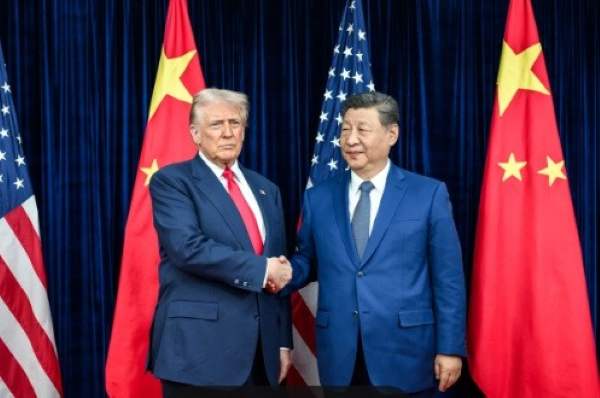

China, meanwhile, has considerable reason to prefer time over confrontation. Its exports have remained strong even as domestic demand has been weaker, giving Beijing an economic cushion against US pressure. Reuters reported before the summit that more than half of the categories of Chinese goods imported by the United States had increased from 2025 levels despite efforts to restrict Chinese exports.
For Washington, the two-month extension avoids another tariff confrontation. For Beijing, it preserves access to markets while leaving the deeper disputes open. That is a truce, not a trade settlement.
READ I Trump’s UN speech tests America’s claim to global leadership
AI exposes limits of personal diplomacy
The most conspicuous missed opportunity was artificial intelligence.
The Trump-Xi summit brought together the political leaders of the world’s two largest economies at a moment when AI is becoming a central element of economic and national-security competition. Chinese and American companies are racing to develop increasingly capable models. The technology has implications for military systems, cyber operations, industrial productivity and the control of information. Yet the summit produced no agreement on safeguards, crisis communication, verification or limits on the development of advanced systems.
Xi spoke of the need to develop and manage AI responsibly and to ensure that its development remains under human control. Trump, by contrast, has promoted the term “super intelligence” and has stressed maintaining American technological leadership. The difference is revealing. Both governments recognise that AI matters enormously; neither appears prepared to accept constraints that could weaken its competitive position.
This is where the limits of leader-centric diplomacy become apparent. Personal rapport can lower the temperature. It cannot by itself settle technical questions involving export controls, computing capacity, model training, military applications and verification.
A modest institutional mechanism might have mattered more than another display of cordiality. A standing US-China channel involving scientists, technology companies, security officials and diplomats could at least establish procedures for reporting serious AI incidents or discussing systems that create risks beyond national borders. No such framework emerged from Washington. Critics of the summit have specifically pointed to the absence of technical working groups or a mechanism for cooperation between American and Chinese AI developers.
READ I World gold prices have a higher floor despite Fed rate hikes
Taiwan remains the dangerous question
The absence of a new Taiwan understanding is less surprising but more consequential.
Xi used the summit to press Washington to oppose Taiwan independence and handle the Taiwan issue with what Beijing described as prudence. China’s position on national unity and territorial integrity, he said, remained clear.
There was no announced change in the US position.
That may sound like a non-event, but in the Taiwan Strait the preservation of ambiguity can be preferable to an ill-defined bargain. The danger is that economic negotiations could gradually become entangled with security commitments. The United States has billions of dollars in approved arms sales to Taiwan under review, while Beijing continues to regard the island as a core sovereignty issue.
The summit therefore avoided a confrontation without resolving the underlying strategic problem. That may be sufficient for the moment. It is not a framework for long-term stability.
Iran and Ukraine show limits of the relationship
The same pattern appeared on international conflicts. Trump and Xi discussed Iran and Ukraine, but the meeting produced no substantive joint initiative.
Xi called for Washington and Tehran to return to negotiations over the Iran conflict. But discussion is not mediation, and no agreement emerged assigning Beijing a defined diplomatic role.
That is significant because Washington has reasons to want Chinese influence over Iran, while Beijing has its own strategic and economic interests in the Middle East. The United States cannot assume that China will use its leverage simply because Washington asks for it.
The Trump-Xi summit therefore exposed a broader reality. Cooperation between Washington and Beijing is likely to be selective and transactional. China may cooperate where its interests coincide with those of the United States, but it has little reason to become an auxiliary instrument of American foreign policy.
What the summit actually accomplished
The temptation after a summit of this kind is to judge it by the number of agreements signed. That misses the more important question: did the two governments create mechanisms that can prevent their disputes from becoming crises?
The answer from Washington is, at best, limited.
The leaders agreed to maintain engagement and appear set to meet again at the APEC summit in Shenzhen in November and the G20 summit in Florida in December. Xi and Trump have also endorsed a broader description of the relationship as one of “strategic stability”.
Those commitments matter because sustained contact reduces the risk of miscalculation. But stability based primarily on presidential rapport is fragile. A durable relationship requires working-level arrangements that survive changes in mood, domestic politics and economic pressure.
The Washington summit bought both sides time. That is useful. But time has value only if it is used to negotiate rules for the disputes that cannot be wished away.
The central lesson from the Trump-Xi summit is therefore less about what Trump and Xi agreed than about what they could not agree. The two powers have found a way to postpone escalation. They have not yet found a way to manage competition in the areas where their interests collide most sharply. That is the unfinished business left behind in Washington.